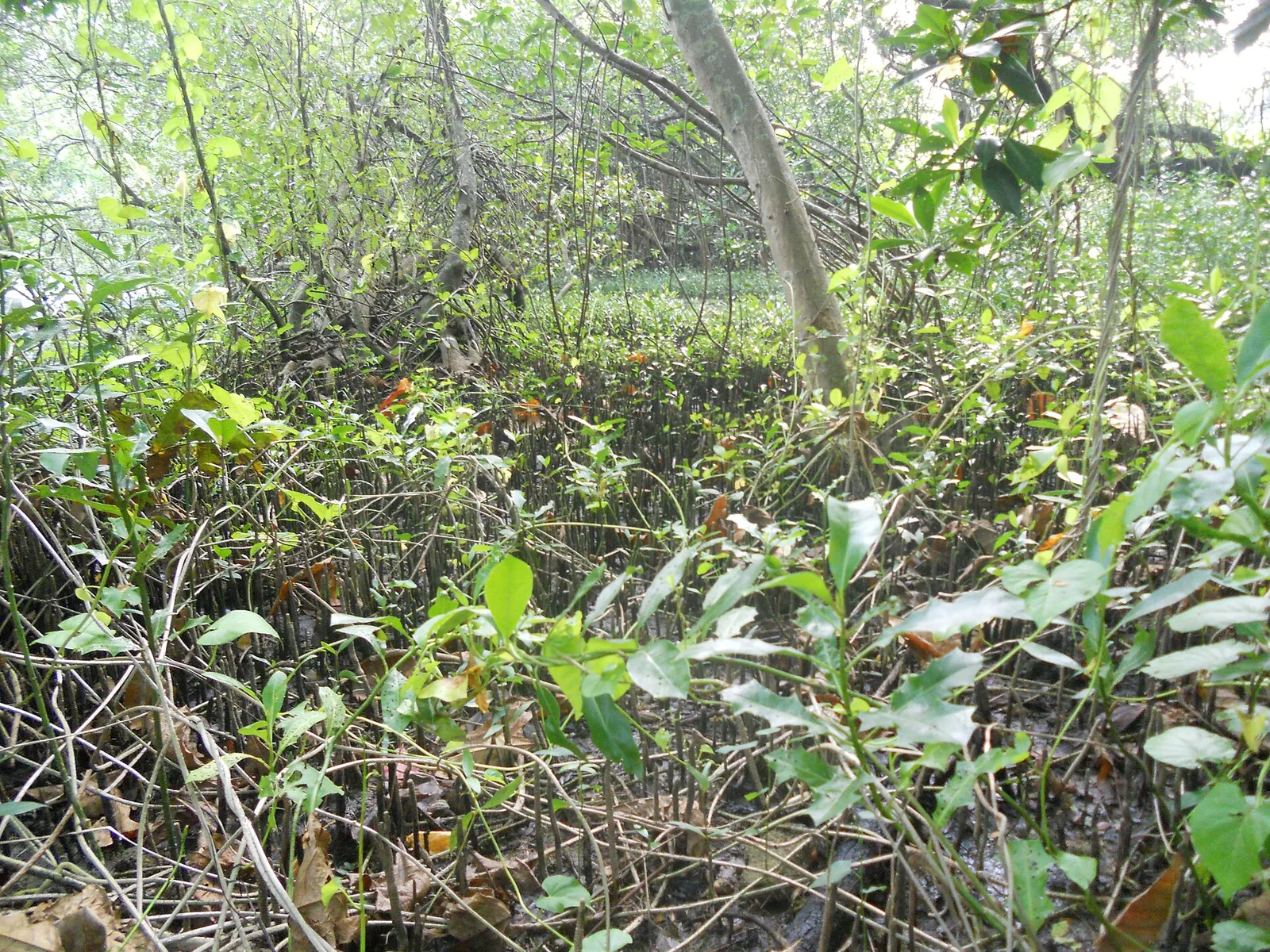
Step off the traffic behind the Kerala High Court and within twenty metres the horns fade, the light goes green, and the air drops a couple of degrees. That is Mangalavanam: a shallow tidal lake ringed by mangrove, connected to the backwaters by a slim canal, so that the water in the middle of Kochi rises and falls with the Arabian Sea.
It is 2.74 hectares. That is smaller than a lot of city parks, and it is one of the smallest protected areas in Kerala. The interesting question is not why it is so small. It is what something this small is actually doing.
The work a mangrove does
Mangroves live where fresh water meets salt and where the ground is waterlogged and unstable, and everything about them is an answer to that. The prop roots and the breathing roots hold the sediment in place and trap silt out of moving water, so the shoreline builds instead of eroding. The root tangle is a nursery: fish and crabs and prawns spend their early life inside it, protected from the things that would eat them in open water.
Those fish and crabs are why the birds are here. And the whole waterlogged system locks carbon into its soil at rates that dry forest cannot match, because the mud is anaerobic and organic matter does not rot away. Add the shade and the evaporative cooling and you have, in ecologists’ shorthand, a natural air-conditioner and carbon sink sitting inside a rapidly heating city.
All of that from a patch you could walk across in three minutes, if you were allowed to, which you are not.
- Area 2.74 hectares — among the smallest protected areas in Kerala, and the only bird sanctuary in the state set in mangrove of this kind.
- Notified as a bird sanctuary in 2004, under the state Forest Department.
- A tidal lake connected to the backwaters by a canal, so the water level moves with the sea.
- A 2006 count logged 194 birds across 32 species; later work has raised the species list well beyond that.
- Access is regulated: usually a watchtower or a short guided edge path, not a wander.
What flies here
Resident herons, egrets and cormorants, the white-breasted waterhen picking along the edges, brahminy kites overhead. In winter the list lengthens with migratory waders and warblers — redshanks, greenshanks, marsh sandpipers — stopping on long coastal journeys and finding, improbably, a wetland in the middle of a metro.
That is the thing to hold on to. These birds are not visiting a park. They are using a piece of the original backwater fringe that happens to have survived, and their route was drawn long before the city was.
Why you cannot just walk in
Because it is small enough that people walking through it would be the dominant disturbance. Access is regulated by the Kerala Forest Department, and the usual way to see it is from a watchtower or a short guided path along the edge, with visitor numbers and hours kept deliberately modest. Nesting, roosting and take-off are all happening within a few dozen metres of you.
Go early, go quietly, bring binoculars rather than a long lens, and expect a serious little nature reserve rather than a photo stop. Mist over the tidal pool at first light with the mangroves full of wingbeats is what this place gives you, and it will not give it to a crowd.
Frequently asked questions
How big is Mangalavanam?
About 2.74 hectares — among the smallest protected areas in Kerala, and the only bird sanctuary in the state set within mangrove forest of this kind. It sits behind the Kerala High Court in central Kochi.
Why is a mangrove patch this small important?
Mangrove roots trap silt and hold the shoreline, the root tangle acts as a nursery for fish, crabs and prawns, and the waterlogged soil locks away carbon at rates dry forest cannot match. Together with the shade and evaporative cooling, it functions as a natural air-conditioner and carbon sink inside a heating city.
What birds will I see?
Resident herons, egrets, cormorants and white-breasted waterhens, with brahminy kites overhead, and in winter migratory waders and warblers such as redshanks, greenshanks and marsh sandpipers. A 2006 count logged 194 birds across 32 species, and the list has grown since.
Can I walk through the sanctuary?
Not freely. Access is regulated by the Kerala Forest Department and is usually from a watchtower or a short guided path along the edge, with modest visitor numbers and hours. The site is small enough that people walking through it would be the main disturbance.
When was it protected?
It was notified as a bird sanctuary in 2004 under the state Forest Department, after birders and conservationists drew attention to its value as a nesting and roosting ground and a stopover for migrants.
What is the best time to visit?
Early morning, when the birds are active and mist is still on the tidal pool. Winter adds the migratory species. Bring binoculars, keep quiet, and treat it as a reserve rather than a park.