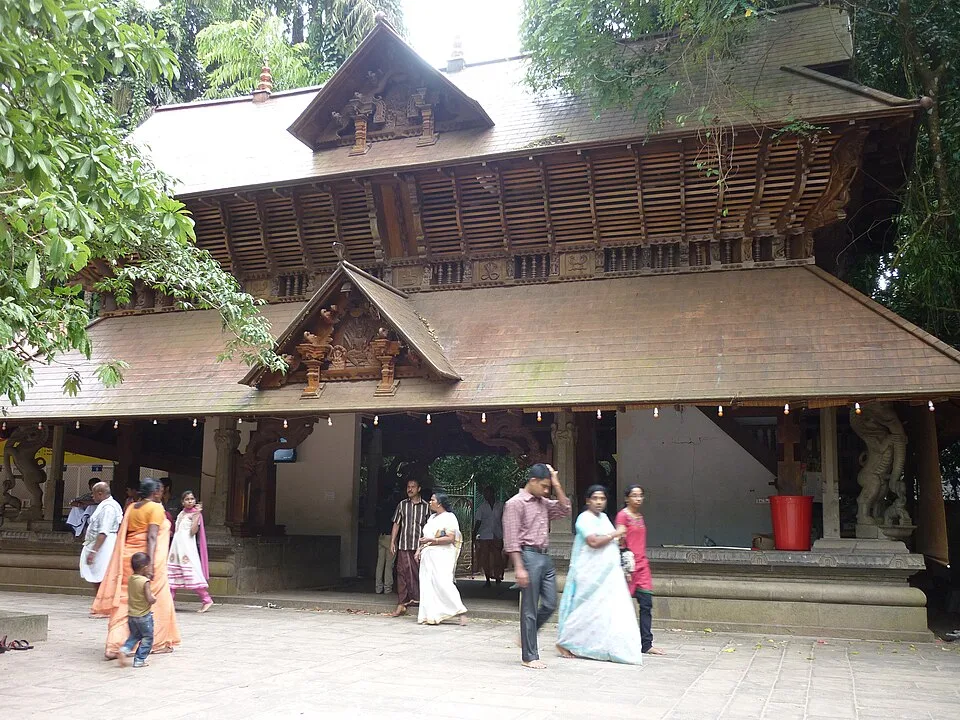
Almost every article about Mannarasala mentions, usually in a sentence and usually near the end, that the temple’s chief priest is a woman. It is treated as a charming exception — a detail to raise an eyebrow at before moving on to the snakes.
That undersells it considerably. The office of the Valia Amma is not an anomaly that happens to have persisted. It is a defined position with a documented line of succession, a fixed liturgical calendar, a rule of life, and a prescribed funeral. It is, in the most literal sense, a job.
Where the office comes from
It rests on a single line of the temple’s founding legend. A childless Brahmin couple of the Mannarasala Illam, Vasudeva and Sreedevi, are said to have tended serpents burnt in a forest fire, soothing their wounds. Nagaraja blessed them and was born as one of two sons. The serpent son eventually withdrew into the Nilavara, the chamber of the family house — and as he went he set the terms of his own worship: “Mother herself must offer me worship.”
Not a priest. The mother of the household, and after her the senior-most Brahmin lady of the family. Everything unusual about Mannarasala follows from that sentence — including the fact that this is a private family temple rather than a Travancore Devaswom Board one, which is itself rare among Kerala’s major shrines.
A line you can date
What lifts this out of the realm of pleasant tradition is that the succession is recorded. Divyashri Savithiri Antherjanam was Amma from 1916 until 1993 — seventy-seven years in office. Divyashri Umadevi Antherjanam followed, from 1993 to 2023. The present Amma is Divyashri Savithri Antherjanam.
Three women across more than a century. It is worth pausing on the first of those numbers: a tenure of seventy-seven years is longer than most institutions manage, and it means that a single person held this office through the end of princely Travancore, the formation of Kerala, and most of the twentieth century.
What the office requires
The Amma must live as a Brahmacharini — a life of disciplined penance and celibacy. And the days on which she alone enters the inner sanctum are not left to discretion; they are enumerated. The first day of every Malayalam month. Every monthly Pooyam star. From the beginning of Magha until the eve of Sivaratri. Thiruvonam in Chingam. The first twelve days of Karkitakam. And the twelve days preceding the Ayilyam star in Kanni and in Thulam.
She is also the one who carries the utsava vigraha of Nagaraja in procession at Ayilyam — and the direction is the reverse of what most accounts state. The idol goes from the temple to the Illam, not the other way. It is a homecoming: at the family house Amma performs the central Ayilyam Pooja on the completed Padmam, with the household present. That is usually told the wrong way round, and the error is instructive, because it turns a visit home into a public outing and gets the whole relationship backwards.
And a prescribed death
The rites for an Amma who dies in office are set out as precisely as her duties. Her body is placed in the four-chambered hall of the Illam. Cremation takes place in a designated area between the temple and the family house. During the mourning the temple’s offering is reduced to milk and kadali fruit alone — the Palum Pazhavum Nivedyam — and for three days the doors close immediately after the nivedyam is made.
A temple that alters its own liturgy for three days when a particular woman dies is not treating her as an eccentricity of custom. It is treating her as the office.
What we are not going to claim
You will read in a great many places, including on this page until August 2026, that Mannarasala is the only major temple in Kerala with a female chief priest. No survey supports that, and — tellingly — the temple does not claim it. Its own wording is “one of the rare temples of its kind”. We have adopted the temple’s phrasing, because when an institution declines to make the bigger claim about itself, that is usually worth noticing.
Frequently asked questions
Who is the current Mannarasala Amma?
Divyashri Savithri Antherjanam. She succeeded Divyashri Umadevi Antherjanam, who held the office from 1993 to 2023, who in turn succeeded Divyashri Savithiri Antherjanam, Amma from 1916 to 1993.
How is the Amma chosen?
The office passes to the senior-most Brahmin lady of the Mannarasala Illam, the Namboodiri family that owns and runs the temple. She must live as a Brahmacharini — a life of celibacy and disciplined penance.
Is Mannarasala the only Kerala temple with a woman as chief priest?
The temple does not say so, and neither will we. Its own description is “one of the rare temples of its kind”. The stronger claim circulates widely but is not supported by any survey we can find.
Can visitors meet the Amma?
The temple publishes Amma darshan timings — generally 11:00 to 12:00 and 17:30 to 18:30 daily, changing on Pooyam and Ayilyam days. Confirm on the day, as the schedule moves with the ritual calendar.