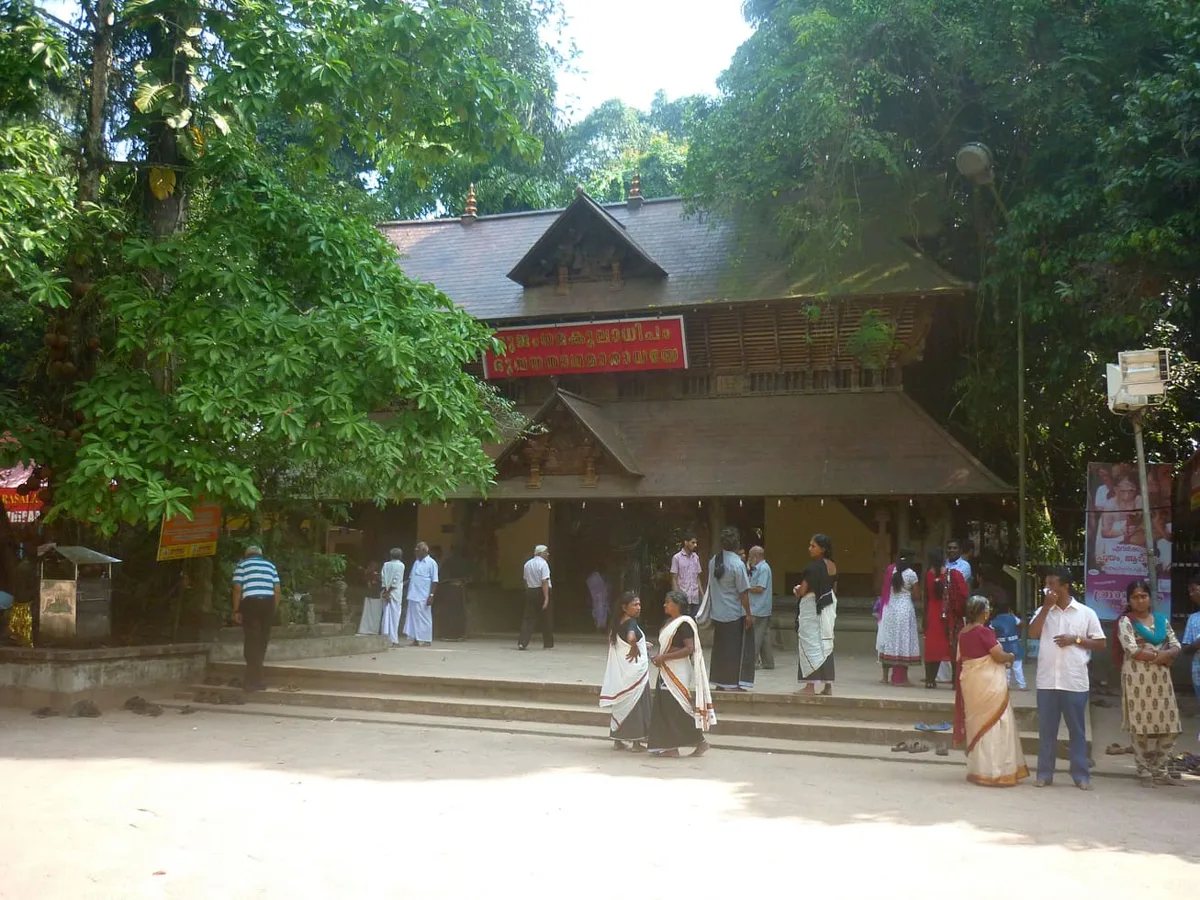
Mannarasala keeps its festivals on the star Ayilyam — Ashlesha, the lunar asterism of serpents — and it keeps three of them: in the Malayalam months of Kanni, Thulam and Kumbham. The Kumbham one honours the birthday of Lord Anantha in the Nilavara. The Kanni one is the birth anniversary of Sree Nagaraja himself.
So the obvious guess would be that Kanni Ayilyam, the deity’s own birthday, is the great day of the year. It isn’t. The famous festival, the one known across Kerala simply as Mannarasala Ayilyam, is the Thulam one — and the reason has nothing to do with theology.
A king running late
Kanni Ayilyam was originally the principal observance, and the Maharaja of Travancore made an annual pilgrimage here on that day. One year the royal journey was delayed, and the visit could not be made in time. Rather than miss it, the Maharaja deferred to the following Ayilyam, in Thulam.
What happened next is the interesting part. In atonement for the lapse the palace assumed the entire cost of that year’s celebration, and endowed the temple with extensive lands, free of tax, to secure the festival’s future grandeur.
An endowment of tax-free land is not a gesture; it is an income. From that point the Thulam observance had a permanent financial base that the Kanni one did not, and over time the funded festival became the great one. The temple’s own account is quite direct about this sequence.
Why this is worth knowing
Religious calendars are usually explained to visitors in terms of meaning — this day commemorates that event, this star belongs to that deity. Occasionally you get a glimpse of the other machinery underneath: patronage, endowments, land, and the awkward social business of a powerful man needing to make amends.
Mannarasala Ayilyam is one of the clearest examples in Kerala. The largest serpent festival in the state is held on the day it is held because a king was late once, and because the apology was expensive enough to outlive everyone involved.
It also says something about how these institutions actually survived. A private family temple with no Devaswom Board behind it needed an economic base, and a royal endowment of tax-free land was exactly that. The festival and the funding arrived in the same transaction.
Going to it
Ayilyam falls on the Ayilyam star of the relevant month, so the Gregorian date moves every year — we deliberately publish the rule rather than a date, because a date printed once is wrong ever afterwards. Expect very large crowds at Thulam Ayilyam, and expect the whole forecourt to be given over to the observance.
The centrepiece is the procession in which Amma carries the utsava vigraha from the temple to the Illam, where the Ayilyam Pooja is performed on the Padmam. Note the direction: temple to family house. It is a homecoming, not a parade.
One thing you will not see, in any year: the Sarpam Pattu, the great serpent song. The temple states that it is ordained to be conducted once every forty-one years. It should not be confused with the Pulasarpam Pattu, which is annual and takes place at Pulakkavu, a grove north-east of the Illam, on the Kumbham Ayilyam or the one following.
Frequently asked questions
Which Ayilyam is the main Mannarasala festival?
Thulam Ayilyam, in roughly October–November. It is the one known across Kerala as Mannarasala Ayilyam, even though Kanni Ayilyam is the birth anniversary of Sree Nagaraja and was originally the principal day.
Why did Thulam Ayilyam overtake Kanni Ayilyam?
Because a Maharaja of Travancore was delayed on his annual Kanni pilgrimage and deferred the visit to Thulam. In atonement the palace paid for that year’s entire celebration and endowed the temple with extensive tax-free lands, giving the Thulam festival a permanent financial base.
How often is the Sarpam Pattu held?
The temple states it is ordained to be conducted once every forty-one years. The annual observance people often mean instead is the Pulasarpam Pattu, held at Pulakkavu on the Kumbham Ayilyam or the Ayilyam following it.