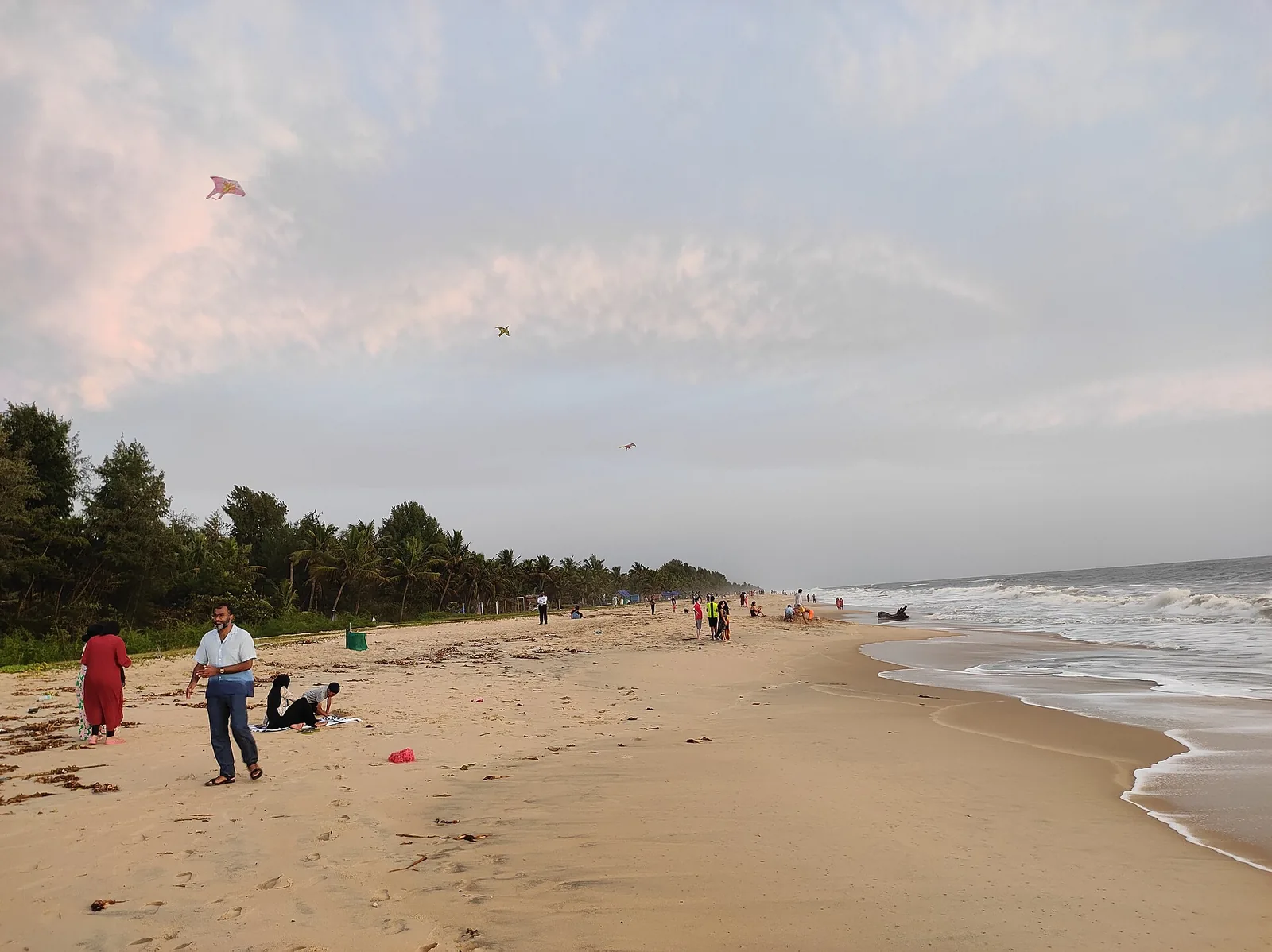
Arattu is the ceremonial bath that closes a Kerala temple festival. The deity is carried out in procession, immersed, and brought back. Almost everywhere in Kerala this happens in a temple tank or a river — the sacred water is enclosed, and it belongs to the temple.
At Mararikulam it happens in the Arabian Sea.
Ten days in Kumbham
The temple’s main annual festival is a ten-day kodiyettu utsavam falling in Kumbham, the Malayalam month that straddles February and March. The flag goes up on the shashthi of the dark fortnight. The pallivetta — the ritual hunt, in which the deity goes out to subdue what is hostile — is held on the night of Mahashivaratri, which is fitting to the point of inevitability at a Shiva temple. And the festival ends on the new moon with the arattu.
On that day the procession forms and leaves the compound by the western gate. It is not a symbolic few steps. The temple stands about two kilometres east of the sea, half a kilometre west of the highway, and the whole distance is walked. Then the god of Mararikulam is taken into the surf at Marari Beach and bathed there, in open water that belongs to nobody.
How rare is rare
The Malayalam source calls this one of the few Kerala temples whose arattu is performed in the sea, and that is worth stating precisely, because it would be easy — and wrong — to turn it into a claim of uniqueness.
It is not unique. Very nearly the same sentence appears in Malayalam about the Janardanaswamy temple at Varkala and about the Thiruvanchikulam Shiva temple at Kodungallur, both of which sit close to the coast and both of which take their deity into the sea. What is true is that this is a small club in a state with thousands of temples, and that the great majority of Kerala arattus happen in fresh water within sight of the shrine.
What is distinctive at Mararikulam is less the sea itself than the distance. Varkala’s temple is a few hundred metres from the water; Thiruvanchikulam sits in the old Kodungallur port country. Mararikulam has to cross two kilometres of village to get there — through the lanes, past the panchayat offices and the railway station and the coconut groves, out onto the sand.
And then a second bath
The sea is not the end of it. After the ocean arattu the deity is brought back and bathed again, in the second of the temple’s two tanks — the south-western one, called the Harinatheertham, which is treated as the more important of the pair.
It is hard not to read that as the ritual resolving something. Sea water is unenclosed, unowned, shared with the fishing boats and the kite flyers and everybody else on that beach. The Harinatheertham is the temple’s own water. The god goes out into the common sea and then comes home and is bathed in the household tank.
The same pond carries the balitharpanam — the offerings made to the ancestors — on the new moons of Karkidakam, Thulam and Makaram. So the tank that receives the god after the sea is also the tank where the village attends to its dead.
The face over the west gate
The gate the procession leaves by is worth a look on any of the other three hundred and sixty-four days. In 2016 a large sculpture was installed above the western entrance: the face of Shiva in raudra bhava, the terrible aspect — which, in this village’s own reckoning, is the aspect he wore after burning Kamadeva to ash, and therefore the aspect the place is named for. It has become one of the temple’s best-known features. It faces west, down the road to the sea.
If you want to see it
Kumbham moves against the Gregorian calendar every year, and so does Shivaratri, so there is no fixed date to give you and we are not going to invent one. If you are trying to time a visit, ask at the temple, or ask locally in the village — this is a well-known local festival and the dates are common knowledge on the ground long before they are anywhere online.
If you are simply on the beach the rest of the year, it is still worth knowing what you are standing on. The relationship between this village and this shoreline is not only scenic and not only economic. Once a year it is liturgical, and the sand you are walking on is the far end of a two-kilometre procession that the whole place makes together.
Frequently asked questions
What is an arattu?
The ceremonial bathing of a temple deity that closes a Kerala temple festival. The image is carried out in procession, immersed in water, and brought back. In most Kerala temples this takes place in a temple tank or a river.
When is the Mararikulam sea arattu?
On the new moon at the end of the temple’s ten-day festival in Kumbham (February–March). The flag is hoisted on the shashthi of the dark fortnight and the pallivetta falls on Mahashivaratri. Exact dates shift each year with the Malayalam calendar — confirm locally.
Is Mararikulam the only Kerala temple with a sea arattu?
No. It is one of a small number. The Janardanaswamy temple at Varkala and the Thiruvanchikulam Shiva temple at Kodungallur are described in almost identical terms in Malayalam. What is unusual at Mararikulam is the distance — the procession walks about two kilometres from the temple to the shore.
What happens after the sea bath?
The deity is bathed a second time in the Harinatheertham, the temple’s south-western tank. The same tank is used for balitharpanam, the ancestral offerings, on the new moons of Karkidakam, Thulam and Makaram.