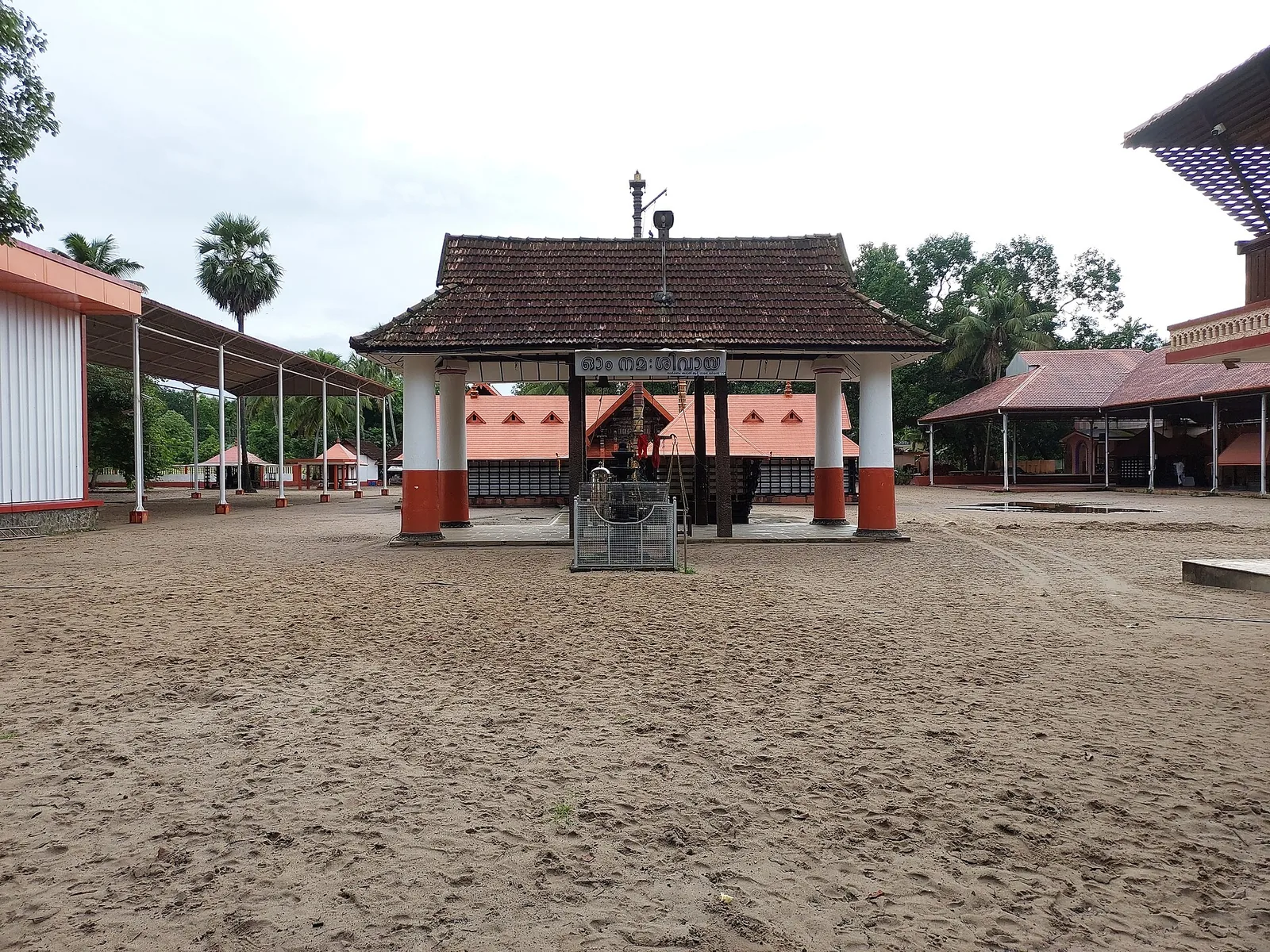
Marari Beach takes its name from the village behind the dunes, Mararikulam. The village takes its name from a stone in a field. And the stone is remembered because of a woman who wanted to sharpen a blunt sickle.
None of this is in the English-language material about Marari, which runs almost entirely to hammocks, Ayurveda and sunsets. It is in Malayalam, in two articles — one on the village, one on the temple — and they tell substantially the same story with a couple of instructive differences.
Before the Shiva temple there was a doctor
The temple account is careful about the order of things, and the order is the surprise. What stood here first was not a Shiva shrine at all. On the north side of what is now the compound there was a temple of Dhanvantari — the physician form of Vishnu, the deity of Ayurveda, the god you go to when you are ill. It was known then as the Mannuvelil temple, and by all accounts it was doing perfectly well.
Around it grew screwpine — pookaitha, the spiny pandanus of Kerala’s wet coastal ground. Its long leaves are the raw material for thazhappaya, the woven mats that were in universal use before plastic, and the people here cut the leaf, wove the mats and carried them to the neighbouring villages to sell. That is the economy this legend happens inside: not fishing, not tourism, but mat-weaving.
The stone that bled
One day a woman came to cut leaf in the plot on the south side of the temple. Her sickle had gone dull, so she did what anyone does — looked around for a stone and rubbed the blade against it to put an edge back on.
Blood ran out of the stone.
She ran, badly frightened, to the Valiya Namboothiri of the Paduthol Pazhur Mana, the Brahmin household that then lived here, and he came back with helpers and looked at it. What he understood, the account says, was that the blood was coming from a swayambhu Shiva linga: a lingam nobody had carved, which had manifested of itself.
He made a particular kind of payasam — a milk-and-rice offering — called śaiśyam, and offered it to the stone in propitiation. And that is where the legend does something most legends cannot. Śaiśyam is still the chief nivedyam of Mararikulathappan, the lord of Mararikulam. It never stopped. Whatever you make of a bleeding stone, there is a dish still being cooked at this temple, on this coast, because of what a woman with a blunt sickle found in a screwpine plot.
Searching nearby, the Namboothiri found a second self-manifested stone, and understood it as the presence of Swayamvara Parvati — Parvati in the aspect of the woman performing austerities to win Shiva as her husband. He began worship there too, and decided to build a great temple giving the two of them equal standing. Shiva faces east; Parvati, a swayambhu figure about a foot high, faces west. Each has a flagstaff of their own. The shrines of Shiva’s sons — Ganapati, Subrahmanya, Ayyappan — followed.
Who the woman was
The two Malayalam articles differ on one detail and it is not a small one. The article on the village says simply that a woman found the stone. The article on the temple says a Pulaya woman — naming her caste, one of Kerala’s Dalit communities, historically among the most severely excluded from temple entry in the whole of India.
We have followed the fuller telling rather than the one that leaves her out, because dropping the detail changes the story. A Pulaya woman at work in a field is the person through whom this deity is found. The Brahmin household arrives afterwards, to interpret and to build. That is the shape the tradition itself preserves, and it is the same shape as the Karumadikuttan stories a little to the south, where petrification legends attach to Pulaya figures. It deserves to be carried across rather than smoothed away.
Two stories about one name
The name has a second derivation running alongside, and it is a piece of compact Sanskrit wordplay. Maran is Kamadeva, the god of desire. Ari is his enemy, his slayer — which is Shiva, who burned Kamadeva to ash with a glance. Kalam is the land. Maran-ari-kalam: the land of the slayer of Kama. Worn down in the mouth, Mararikulam.
And here the two articles disagree again, productively. The temple’s account says exactly that: kalam, land, contracting to kulam. The village’s account says the woman sharpened her sickle on a stone lying at the steps of a pond, and that the linga was later installed on that pond bank — which reads the ending as kulam, a pond, quite literally, and means the name is a description of where the thing was found.
There is no way to settle it and no particular reason to. The village keeps both, and both point at the same Shiva.
What this has to do with the beach
The temple is not on the beach. It stands about two kilometres inland, roughly half a kilometre west of the highway, and any page that puts it on the sand is wrong. But once a year the connection is made physically: the festival procession leaves by the temple’s western gate and walks the two kilometres west to bathe the deity in the sea. That is the subject of a separate piece — the sea arattu at Marari — and it is the reason a beach page carries a temple legend at all.
Frequently asked questions
What does the name Mararikulam mean?
Two derivations are told. One reads it as Maran-ari-kalam — Maran being Kamadeva the god of desire, ari his slayer (Shiva, who burned him to ash), and kalam the land: the land of the slayer of Kama. The other takes the kulam literally as the pond beside which the swayambhu linga was found. The village keeps both.
What is śaiśyam?
A particular kind of payasam that the Valiya Namboothiri of the Paduthol Pazhur Mana is said to have offered to the self-manifested linga when it was discovered. It remains the chief nivedyam — the principal food offering — of Mararikulathappan to this day.
Is the Mararikulam Mahadeva temple on Marari Beach?
No. It stands roughly 2 km inland, about half a kilometre west of NH-66. What comes to the beach is the annual arattu procession, which travels from the temple’s western gate to the sea.
Which deity came first at the temple?
Dhanvantari, the Ayurvedic physician form of Vishnu. The Malayalam account says a Dhanvantari shrine known as the Mannuvelil temple stood on the north side of the site before the Shiva linga was discovered in the plot to its south.