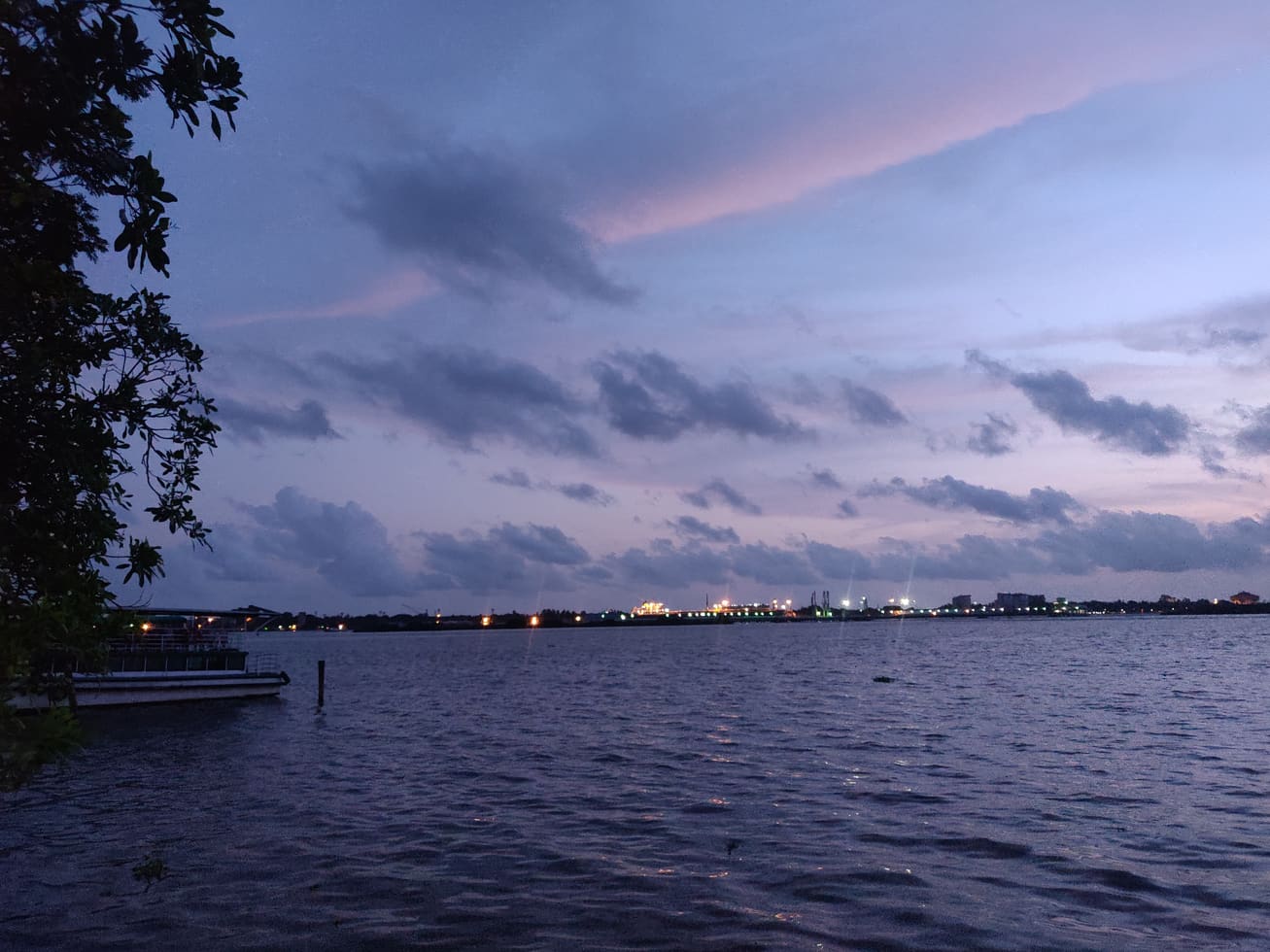
Stand at the rail on Marine Drive and it feels as though the promenade has always been here, holding back the backwaters. It has not. The ground beneath your feet did not exist a few decades ago — it was open water, part of the Vembanad Lake system that laps at the western edge of Ernakulam. Marine Drive is, quite literally, land that Kochi made.
A city that ran out of shore
Ernakulam, the mainland half of Kochi, grew fast through the twentieth century, but it grew up against water on its western side. There was no seafront to speak of for the public — just a working edge of jetties and the harbour beyond. The idea that the city needed an open waterfront, somewhere ordinary people could walk and gather, took hold as Kochi modernised.
The GCDA and the Mumbai inspiration
In the 1980s the Greater Cochin Development Authority (GCDA), the state agency charged with planning the region, launched the Marine Drive project. The name and the ambition borrowed openly from Mumbai's famous seaside Marine Drive. The plan was to reclaim a band of land from the Kochi backwaters and build along it — commercial complexes to fund the scheme, and, crucially, a marine drive proper: a road hugging the reclaimed shoreline.
How the land was made
Reclaiming the strip meant filling in a margin of the lake to create dry, buildable ground where there had been water — the same technique that has extended waterfronts in coastal cities the world over. Onto that new land came the GCDA shopping complex and, over the following years, hotels, malls and the public spaces that define the district today.
- The plan was always a driveway on the western edge — a literal marine drive. But coastal protection rules tightened in the 1990s, making a shoreline road untenable. Rather than build it, the authorities laid a pedestrian walkway instead. The constraint turned out to be a gift: no traffic ever came between the people and the water.
Why a walkway beat a road
With the road ruled out, the western strip was landscaped as a sea-facing pedestrian promenade — paved, railed and open to the water along its whole length. Where a road would have walled the waterfront off behind lanes of traffic, the walkway did the opposite. It gave the entire edge back to walkers. Anyone who has watched a sunset here, undisturbed by cars, is enjoying the accidental dividend of a coastal-protection law.
Kochi's favourite hangout
Over the decades the reclaimed strip grew into the city's default gathering place. Later touches — the pastel-lit Rainbow Bridges over the Market Canal, cruise jetties, cafés and the renaming of the road as APJ Abdul Kalam Marg after the former president — layered onto the same simple idea: a free, open, sea-facing space in the middle of a busy city. Today it draws families, courting couples, joggers, tourists off the ferries and vendors with their carts, every evening, in numbers no monument in Kochi can match.
A made place, fully at home
There is a quiet lesson in Marine Drive. It is entirely artificial — planned land, poured onto a lake, shaped by regulation as much as design — and yet it is the most natural-feeling public place in the city, the one Kochi points to first. The backwaters it was carved from still slide past the rail, indifferent, as though the ground had been there all along.
Frequently asked questions
Was Marine Drive really built on reclaimed land?
Yes. The strip was reclaimed from the Kochi backwaters — part of the Vembanad Lake system — as part of the GCDA's Marine Drive project begun in the 1980s. The ground was open water before.
Why is it a walkway and not a road?
The original plan included a shoreline road, but the enforcement of coastal protection laws in the 1990s made that impossible, so a pedestrian promenade was built along the water's edge instead.
Who built and manages Marine Drive?
The Greater Cochin Development Authority (GCDA), the regional planning body, developed the reclaimed land, the shopping complex and the promenade.
Why is it called APJ Abdul Kalam Marg?
The road along the promenade was officially named after Dr APJ Abdul Kalam, the former President of India, though most people still simply call the whole waterfront Marine Drive.