From the street the Dutch Palace gives nothing away — a long, low, whitewashed building with a tiled roof that could pass for a warehouse. Inside it holds one of the richest surviving bodies of Kerala mural painting anywhere, and the single most extraordinary room in it is a bedroom.
A hundred square metres of Ramayana
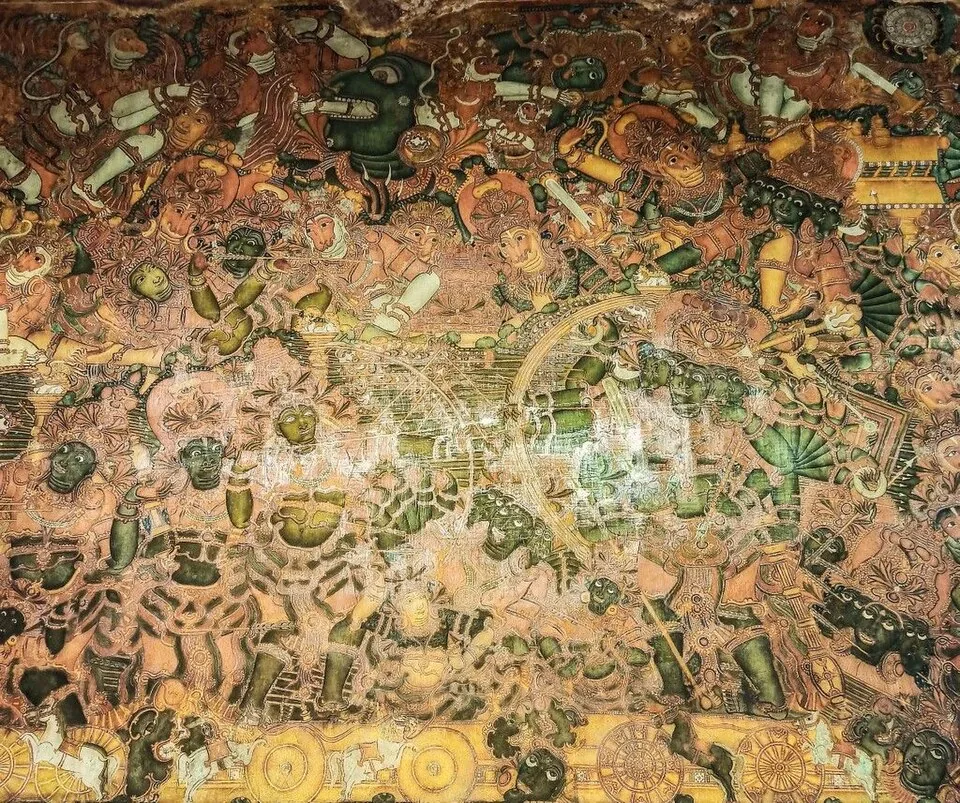
The royal bedchamber carries the entire Ramayana across roughly a hundred square metres of wall, in tightly packed panels that run continuously around the room: the exile, the abduction of Sita, the alliance with the monkeys, the war at Lanka. There is almost no empty ground anywhere in it. Figures curl into and around each other, foliage fills the gaps, and the eye has nowhere to rest, which is not a failure of composition but the whole point of the style.
Think about what that room was for. A king slept in it, wrapped on all four walls in the deeds of Rama. Whether you read that as devotional, as dynastic propaganda, or simply as the most expensive wallpaper on the Malabar coast, the intent is unmistakable: the sovereign’s private hours were to be spent inside the epic that legitimised sovereignty.
How they were made
The murals are generally dated by scholars to the seventeenth and eighteenth centuries, painted in the mature Kerala temple-mural idiom. The technique is exacting: natural mineral and vegetable pigments laid onto lime-plaster walls, in a restricted palette of warm ochres, reds, greens and black that gives the whole tradition its unmistakable glow.
That they have survived three centuries of coastal humidity is a genuine marvel of craft and of later conservation. A major restoration programme was carried out in the late 2000s. The palace itself was declared a protected monument in 1951 and is looked after under the Archaeological Survey of India.
- Krishna Leela and Shiva Leela cycles, and episodes drawn from the Kumarasambhavam.
- Krishna lifting Mount Govardhana; Vishnu reclining on the cosmic serpent; Lakshmi on her lotus.
- Shiva and Parvati fused as Ardhanareeshwara.
- A much-discussed Krishna panel, multi-armed and frankly sensuous, surrounded by gopis.
The floor, which nobody looks at
While your head is tilted back at the ceilings — carved with rosette and cupola motifs, and worth the neck ache — spare a look downwards. The floors are a lustrous, near-black surface said to be made from burnt coconut shells, charcoal, lime, plant juices and egg white, polished until they pass for dark marble. It is a traditional Kerala technique and it has held its shine for centuries.
The building around all of this is a nalukettu — the classic Kerala plan of four wings folded around a central courtyard — softened here and there with European arches and proportions. In the courtyard stands the shrine of Pazhayannur Bhagavathi, tutelary goddess of the Kochi royal house, with further shrines to Krishna and Shiva flanking the palace. A Portuguese-built mansion, arranged around a Hindu goddess, because the thing it existed to do was make kings.
Why you cannot photograph them, and why that is fine
Photography is prohibited inside, particularly in the mural rooms, to protect fragile three-hundred-year-old pigment from light and flash. The rule is enforced. Treat it as a gift: with no camera to raise, people actually look, and these are paintings that only give themselves up to sustained attention. Ten minutes in the bedchamber tracing the narrative around the walls is worth more than any photograph you could have taken.
Practically: allow forty-five minutes to an hour and a half, expect the interiors to be dim and hushed, and know that the palace is generally closed on Fridays and open around 10am to 5pm on other days. The entry fee has traditionally been nominal. Confirm both at the counter — hours and fees move and we do not publish figures we cannot stand behind.
Then walk out into the spice street. The Paradesi Synagogue is at the far end of Jew Town, the Jain temple is a few minutes away and Bazaar Road runs north — and the murals will sit better in your head for having a quarter around them.
Frequently asked questions
What are the murals in the Mattancherry Dutch Palace?
A body of Kerala-style temple murals, generally dated to the seventeenth and eighteenth centuries, painted in natural mineral and vegetable pigments on lime plaster. The most celebrated is the royal bedchamber, which carries the entire Ramayana across roughly a hundred square metres of wall. Other rooms hold Krishna Leela, Shiva Leela and Kumarasambhavam scenes.
Why is photography banned inside the Dutch Palace?
To protect the murals. Three-hundred-year-old pigment on lime plaster is vulnerable to light and flash, and the ban is enforced by staff throughout the mural galleries. You can photograph the exterior and the surrounding streets.
How big is the Ramayana mural?
It covers roughly a hundred square metres of the royal bedchamber walls, in dense continuous panels running around the room — the exile, Sita’s abduction, the war at Lanka. It is one of the most complete surviving Ramayana cycles in the Kerala mural tradition.
What are the black floors made of?
They are said to be made from burnt coconut shells, charcoal, lime, plant juices and egg white, polished to a near-black lustre that imitates dark marble. It is a traditional Kerala flooring technique and it has kept its shine for centuries.
Who looks after the palace and its murals?
The Archaeological Survey of India. The palace was declared a protected monument in 1951, and a major conservation programme on the murals was carried out in the late 2000s.
How long should I spend inside, and when is it closed?
Around forty-five minutes to an hour and a half is right for the murals and the museum galleries. It is generally closed on Fridays and on national holidays, and typically open from about 10am to 5pm otherwise. Entry has traditionally been nominal — confirm the current fee and hours at the counter.