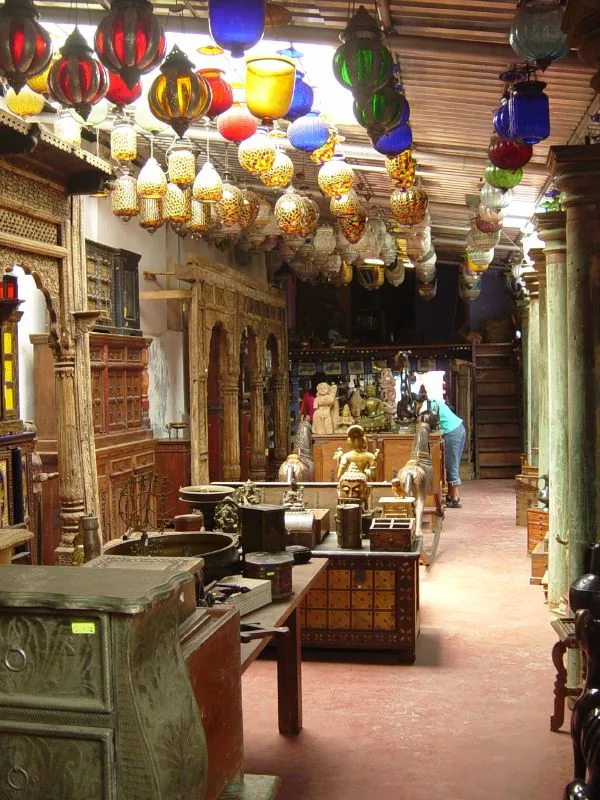
Mattancherry Jew Town is one short street between a palace and a synagogue, and it is lined with shops selling carved wooden furniture, brass and copper vessels, oil lamps, ritual silver and colonial oddments. Every guidebook calls it an antique district. Very few of them explain where the antiques originally came from, which is the only fact that makes the street make sense.
The stock came out of the houses
Through the twentieth century, and above all after the founding of Israel in 1948, the great majority of Kochi’s Jewish community emigrated. The houses along this street emptied — not suddenly, but steadily, over decades. Their contents went with the departures: furniture accumulated across generations of a trading family, vessels, lamps, curios, the ordinary heavy objects of a settled household.
Those contents were bought up and put on sale in the shops that now line it, and the old godowns and trading houses were converted into the shops, hotels and cafes that sell them. The antique trade of Jew Town did not arrive here. It grew directly out of the departure. What is in the windows is, in its origins, the liquidation of the neighbourhood’s own households.
What the stock tells you about the port
Walk into three shops and the inventory reads like a shipping manifest: Indian pieces beside European, Chinese and Arab ones. That mix is not curation. It is what a port that traded with all of them for five centuries actually accumulated in its houses, and it is a better portrait of old Kochi than most museums manage.
Look at the buildings while you are in them. The frontages are narrow and pressed together, Dutch at the top and improvised below, and the doorways carry Star of David motifs and Hebrew lettering on premises that have been selling something else for fifty years. That is the most eloquent thing on the street and it is free.
Buying: two things worth knowing
First, the ages quoted to visitors are opening positions rather than facts. Some pieces here are genuinely old and a great many are not, and bargaining is expected — prices quoted to foreigners start high and are meant to.
- Genuine antiquities over a hundred years old cannot be exported from India.
- So if a dealer tells you a piece is two hundred years old and perfectly exportable, one of those two claims is false.
- Buy what you like for its own sake. Do not pay a premium for an unverifiable date.
- Ask for a receipt with a description, and keep it.
Second, not everything here is aimed at visitors. The international pepper trade retains a presence here — a direct thread back to why anyone built here in the first place — and Bazaar Road immediately to the north is still, just, a working spice quarter.
Two calendars run the street
Saturday is the Jewish sabbath: the Paradesi Synagogue is closed and much of the street shuts with it, which makes a Saturday visit the classic wasted trip. Many dealers also close on Sunday. Go on a weekday, ideally in the morning, when Bazaar Road is working too and you can walk the whole quarter in one movement — palace at one end, synagogue at the other, spice godowns to the north.
And go knowing what you are looking at. A shopping street is a shopping street. A shopping street stocked with the contents of the houses on it, sold by the people who stayed, is something else entirely, and it is the most articulate few hundred metres in Kochi about what a port city loses.
Frequently asked questions
Why is Mattancherry Jew Town full of antique shops?
Because the houses emptied. As Kochi’s Jewish community emigrated through the twentieth century — especially after 1948 — the contents of their homes were bought up and sold from shops on the same street, and the old trading houses and godowns were converted into those shops. The trade grew directly out of the departure.
Are the antiques in Jew Town genuine?
Some are and many are not, and quoted ages should be treated as sales talk. There is also a legal catch: genuine antiquities over a hundred years old cannot be exported from India, so a piece that is both two centuries old and freely exportable cannot be both. Bargain hard and buy for the object, not the date.
Are there still Jews living in Mattancherry Jew Town?
Very few. A community that once numbered in the thousands is down to a handful, the great majority having emigrated to Israel in the decades after 1948. The synagogue survives and the street keeps the name, but this is a heritage quarter rather than a living Jewish neighbourhood.
What day should I avoid visiting Jew Town?
Saturday. It is the Jewish sabbath, the Paradesi Synagogue is closed and a good part of the street shuts with it. Many dealers also close on Sunday. A weekday morning is best, because Bazaar Road’s spice godowns are working at the same time.
How long does Mattancherry Jew Town take?
An hour and a half to two hours for the street and its shops. Half a day if you do the quarter properly — the Dutch Palace at one end, the Paradesi Synagogue at the other, this street between them, and Bazaar Road immediately north.
Can I get to Jew Town by ferry?
Yes, and it is the nicest approach. The Mattancherry ferry from Ernakulam boat jetty lands near the northern end of Bazaar Road, roughly ten minutes’ walk away, so you arrive through the working spice quarter instead of by autorickshaw through traffic.