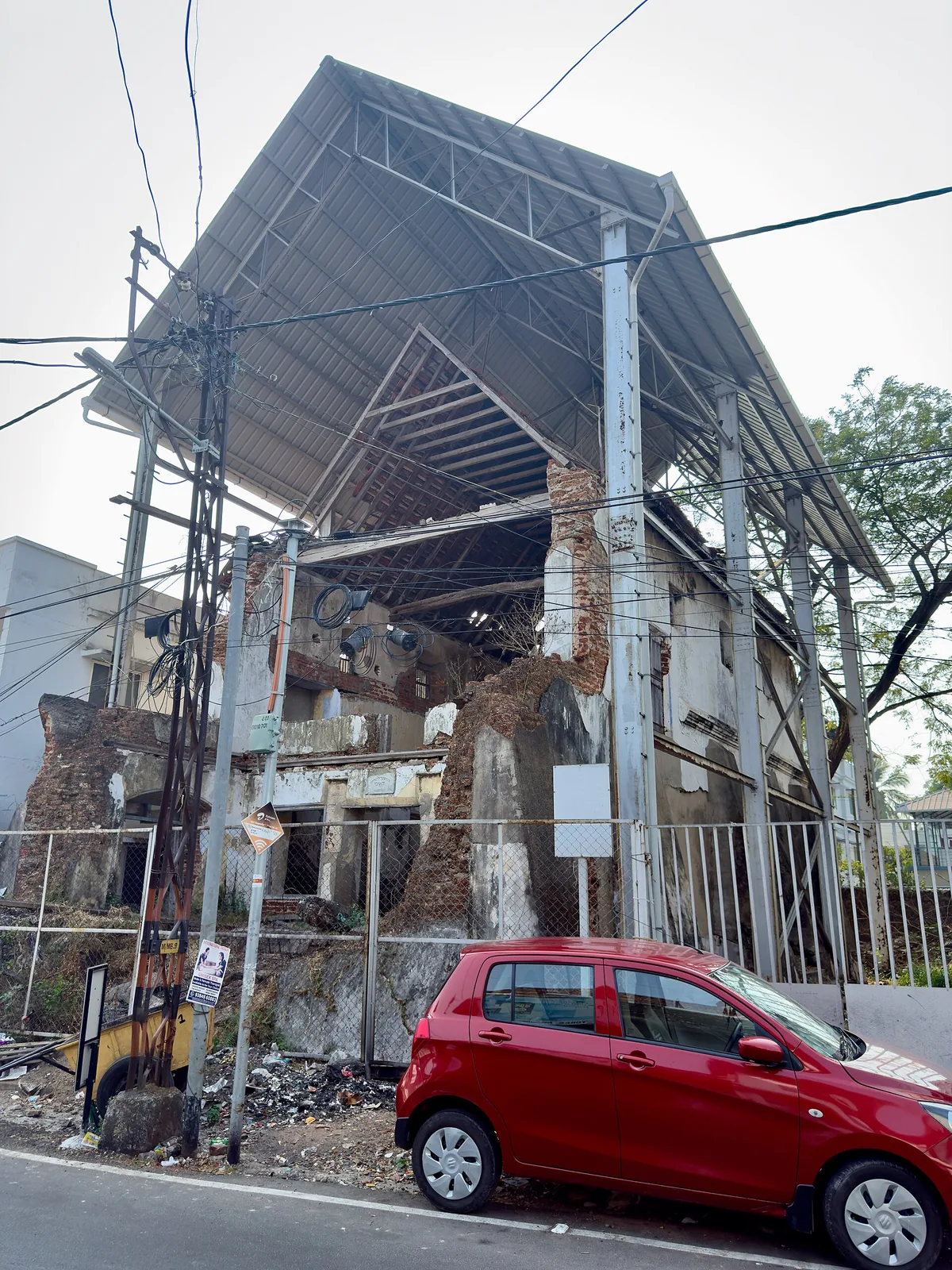
Almost everyone who comes to Mattancherry and Jew Town visits one synagogue, photographs the tiled floor, and leaves believing they have seen the Jewish Kochi. There was never only one. Kochi had several congregations, and the one you queue for was the Paradesi — the synagogue of the later-arriving European Jews. The older community, the Malabari Jews, had their own buildings, and one of them is a short walk away.
It is called Kadavumbhagam. It was completed in 1544 — older than the building most visitors think of as the old one — and it is behind a fence.
The name is a description
Kadavu is the Malayalam word for a landing place on the water, the ghat or riverside where boats come in. The synagogue was built by the waterside and named for it, which tells you something about how this community lived: on the water, in a working port, with the boats at the end of the street.
There is a second Kadavumbhagam synagogue across the water in Ernakulam. They are different buildings, of different congregations, and confusing them is easy — most photographs labelled “Kadavumbhagam” online are of the Ernakulam one, which still stands and is well known for being kept up by a single family. This story is about the Mattancherry building.
The interior left first
The Malabari congregation emptied through the aliyah of the 1950s, when most of Kerala’s Jews left for Israel. What was left was a building nobody had a community for.
In 1991 the answer arrived from Jerusalem. The Torah and the objects of worship, and then the carved wooden interior itself — the panelling, the beams, the ark, the women’s gallery with its bimah — were dismantled, shipped, and reinstalled in the Israel Museum, where they are on display today. It was done with the support of the Jerusalem authorities and it is generally described as a rescue, and on the evidence of what happened afterwards it is hard to argue with that.
What it produced, though, is a building that exists in two places. The room is in Jerusalem, complete and lit and cared for. The walls that used to be around it are in Mattancherry.
The outside came down in 2019
On the morning of 10 September 2019, after heavy rain, a section of the Kadavumbhagam synagogue at Mattancherry collapsed. It was reported as the loss of a roughly 600-year-old structure — a figure that stretches the congregation’s history rather than the fabric’s, but which conveys how the loss was felt.
What stands now is a shell under a temporary steel roof, fenced from the lane, with brick showing through broken render. Restoration has been announced. As with a great many announced restorations, the interesting question is what will be restored, given that the thing which made the interior worth seeing has been in another country since 1991.
- It is on the Jew Town side of Mattancherry, a short walk from the Paradesi Synagogue.
- There is nothing to enter and no ticket. It is a ruin behind a fence and it should be looked at from the lane.
- It is a religious site to the community it belonged to. Photograph the building, not through gaps, and do not climb the fence.
- The interior is in the Israel Museum, Jerusalem — worth knowing before you go, so you are not looking for something that is not there.
Why it belongs on the itinerary anyway
Because Jew Town is sold as a heritage street and mostly experienced as a shopping one, and five minutes at this fence corrects the picture faster than anything in the ticketed building. The Paradesi survives because it became a monument that people pay to enter. Kadavumbhagam did not, and the difference between the two is not age, or beauty, or importance — the older, Malabari congregation has the better claim on all three. The difference is who was left to look after it.
Stand there for a moment and the street reads differently on the way back.
Frequently asked questions
How old is the Kadavumbhagam Synagogue at Mattancherry?
It was completed in 1544, which makes it one of the oldest surviving synagogue structures in India — older than the Paradesi Synagogue that most visitors see.
What does Kadavumbhagam mean?
Kadavu is Malayalam for a landing place or ghat on the water. The synagogue was built by the waterside and named for it.
Where is the interior of the Kadavumbhagam Synagogue?
In the Israel Museum in Jerusalem. In 1991 the Torah, the objects of worship and the carved wooden interior and beams were moved there with the support of the Jerusalem authorities, and they are on display.
What happened to the building in 2019?
A section of it collapsed on the morning of 10 September 2019 after heavy rain. What remains is a shell, now under a temporary roof and behind a fence. Restoration by the Indian government has since been announced.
Can I go inside?
No. It is a fenced ruin with nothing to enter. Look at it from the lane, treat it as the religious site it is, and do not climb in.
Is this the same as the Kadavumbhagam synagogue in Ernakulam?
No — they are two different buildings of two different congregations, on opposite sides of the water. The Ernakulam one still stands and is the one most online photographs actually show. This story is about the Mattancherry building.