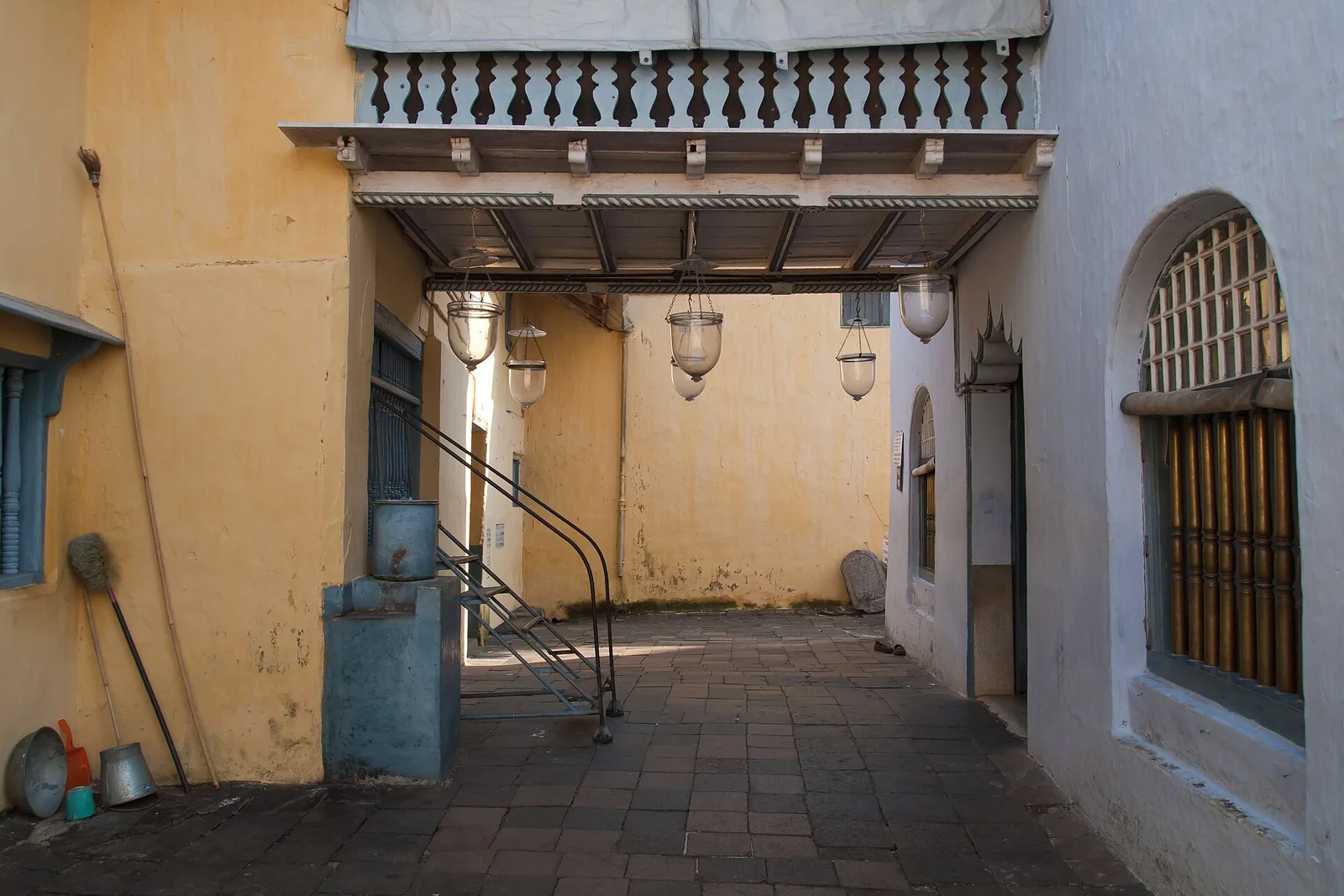
The Mattancherry Paradesi Synagogue is told, almost everywhere, as a story about shelter: a people expelled from Europe, taken in by a Hindu king, still praying in the room he gave them land for. All of that is true. It is also only half the building’s history, and the other half happened inside these walls rather than outside them.
Three classes in one room
For most of its history the congregation was formally stratified. At the top were the Paradesi — the word means "foreigners" — the later arrivals of Sephardic and European descent, often called the White Jews. They alone held full membership. Below them were the Malabari or Black Jews, the far older community that had been on this coast for centuries before the Paradesi arrived: permitted to worship here, but not admitted to full membership.
At the bottom were the Meshuchrarim, descendants of freed slaves and of mixed African-European parentage. They had no communal rights at all. They had no synagogue of their own. And they were not allowed inside this one. They sat on the steps.
- Paradesi ("White") Jews — full members.
- Malabari ("Black") Jews — the older community; could pray here, could not be members.
- Meshuchrarim — descendants of freed slaves; no rights, no synagogue, not admitted inside.
- They sat outside on the entrance steps. You walk over them going in.
It is worth saying plainly, because the usual telling smooths it away: a community that had been given land and protection by a Hindu king, at a moment when Europe was expelling and burning it, maintained inside its own walls a hierarchy organised largely by ancestry and skin colour. Both facts are true at once. Neither cancels the other.
The lawyer from the bottom tier
Abraham Barak Salem was born in Kochi in 1882, the first Cochin Jew to train as a lawyer, and himself a descendant of the Meshuchrarim — a man from the class that sat on the steps. He spent decades campaigning against his own community’s colour bar, and he did it with the method being used, at that same moment and a few miles away, against the British: satyagraha, Gandhi’s non-violent civil resistance. It earned him the name he is still known by in Kochi, the Jewish Gandhi.
His demands were not abstract. They were three concrete things: the right to full membership of the congregation; the right to read from the Torah; and the right to be buried in the synagogue’s cemetery. Put like that, the scale of the exclusion becomes obvious. These were not privileges. They were the ordinary furniture of belonging to a congregation, withheld from people who had been part of it for generations.
He won, and the win was partial first
By the 1940s the Paradesi Synagogue had been opened to the whole community. Malabari and Meshuchrarim members could hold full membership, read from the Torah and be buried in the Paradesi cemetery — though at first in a separate section, which is worth recording rather than rounding off, because it is how most such victories actually arrive.
Salem died in 1967, aged 85, and was buried in the cemetery attached to this synagogue. An honour that had been denied to his own ancestors within living memory was granted to the man who had removed the denial. If you want one fact to hold this whole story in, that is it.
Why it belongs on the visit
Because the room is small and beautiful and almost every visitor leaves with a single uncomplicated feeling about it, and the building deserves better than that. Kerala did shelter a people the rest of the world was expelling, and this prayer hall is the proof. The sheltered community drew its own internal lines, and one of its own members spent a lifetime rubbing them out. You are a better visitor if you carry both facts up the steps.
And the physical detail does the work that no plaque manages. There is no interpretive panel about the Meshuchrarim. There is a set of steps, and the knowledge of who used to sit on them, and the fact that you are about to walk across them and go in.
Frequently asked questions
Who was Abraham Barak Salem?
Born in Kochi in 1882, the first Cochin Jew to train as a lawyer, and himself a descendant of the Meshuchrarim — the lowest tier of the Paradesi congregation. He campaigned for decades against his own community’s internal colour bar using satyagraha, Gandhi’s method of non-violent resistance, which is why he is remembered as the Jewish Gandhi of Cochin. He died in 1967, aged 85.
Who were the Meshuchrarim?
Descendants of freed slaves, of mixed African-European parentage, and the bottom tier of the Paradesi Synagogue’s three-class hierarchy. They held no communal rights, had no synagogue of their own and were not allowed inside this one — they sat on the steps outside the entrance.
What is the difference between Paradesi and Malabari Jews?
The Malabari Jews are the far older community, settled on the Kerala coast for many centuries. The Paradesi — the word means "foreigners" — arrived later, largely Sephardic Jews from Spain, Portugal and the Middle East, and built this synagogue in 1568. For most of its history only Paradesi Jews were full members; Malabari Jews could worship here but were not admitted to membership.
When did the Paradesi Synagogue’s colour bar end?
By the 1940s, after decades of campaigning by A. B. Salem. The synagogue was opened to the whole community, with rights to full membership, to read from the Torah and to be buried in the Paradesi cemetery — though burial was initially in a separate section of that cemetery.
Is A. B. Salem buried at the synagogue?
Yes. He died in 1967 and was buried in the cemetery attached to the Paradesi Synagogue — an honour that had been denied to his own Meshuchrarim ancestors within living memory.
Does the synagogue explain any of this to visitors?
Not really. There is no interpretive panel on the community’s internal hierarchy, and most visits pass over it entirely. The clearest physical trace is the entrance steps, where the Meshuchrarim sat because they were not admitted inside, and which every visitor now walks across on the way in.