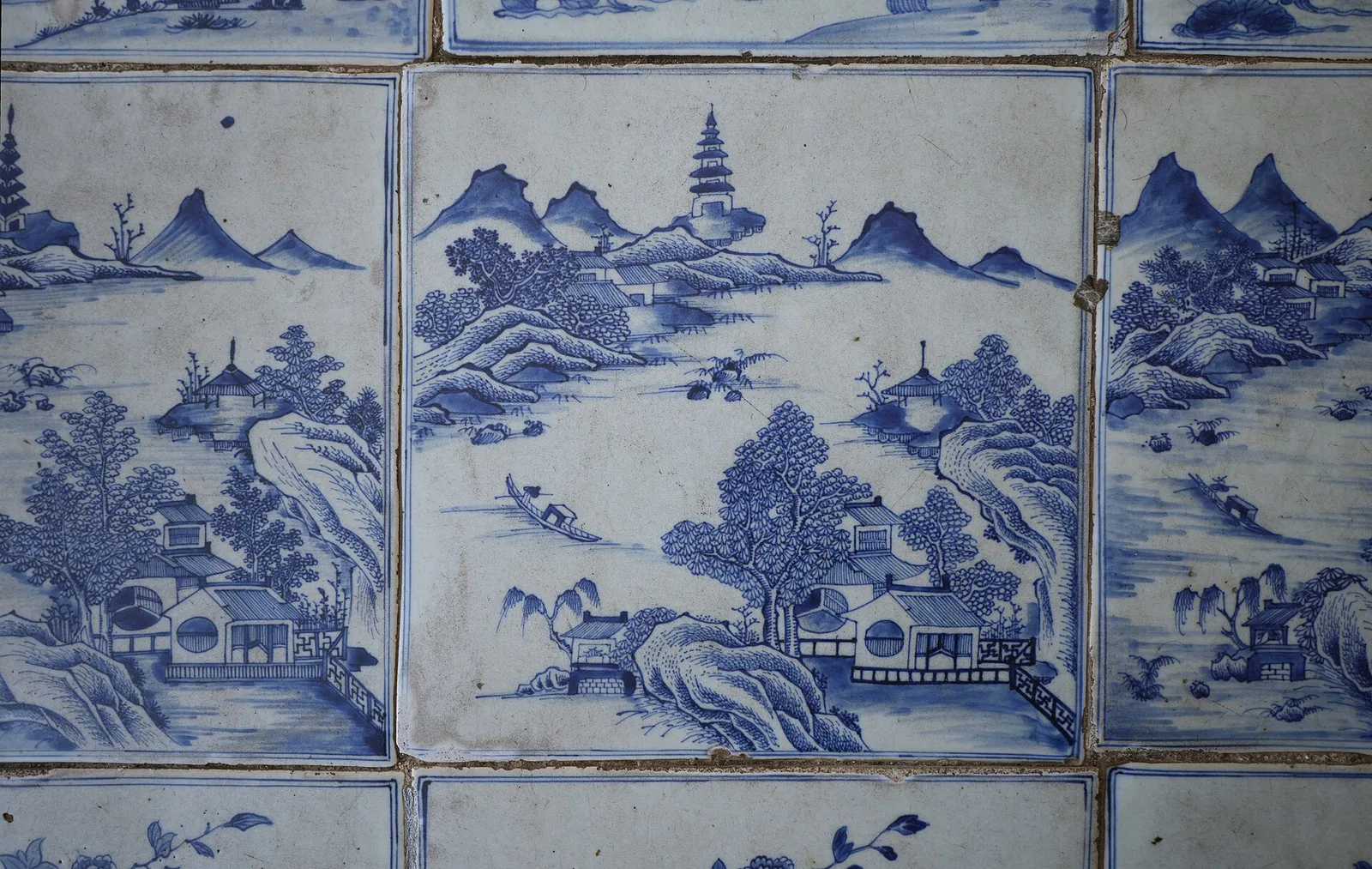
You enter the Mattancherry Paradesi Synagogue barefoot, and the first thing that stops people is not the chandeliers overhead but the ground underfoot. The prayer hall is paved with more than a thousand hand-painted blue-and-white porcelain tiles brought from Canton in the eighteenth century, and the detail that visitors always test for themselves is true: no two of them are quite the same.
What you are standing on
The tiles are willow-pattern porcelain — the blue-on-white Chinese export ware that also filled European dining rooms in the same century. Lotus and plum blossom, chrysanthemum and willow, peony and rock: each little scene shifts slightly from the next, so the floor reads as a thousand variations rather than a repeating pattern. Crouch down for thirty seconds and the room changes character entirely.
They arrived as part of a much larger act of furnishing. The wealthy merchant and community leader Ezekiel Rahabi, principal Indian agent of the Dutch East India Company, is credited both with importing the tiles and with raising the clock tower outside in 1760–61. The Belgian cut-glass chandeliers came later, in the nineteenth century, each one a different colour and design. What you are in is a small room assembled from four continents by people who could order from all of them.
The cow’s-blood legend
The story attached to the tiles is the most retold thing in Jew Town, and it goes like this. The consignment from Canton was originally destined not for the synagogue but for the palace of the Raja of Cochin. A member of the Jewish community, wanting the tiles, quietly let the Hindu ruler know that the glaze had been mixed with cow’s blood. Horrified, the Raja rejected the whole shipment — and the community acquired the tiles for their prayer hall.
Enjoy it as folklore and hold it lightly. Historians treat the anecdote with caution and there is no documentary support for it; it has the shape of a story invented afterwards to explain an unusual object. It is also, on any reading, a strange thing for a sheltered minority to boast about doing to its protector, which is part of why the tale has survived — it is told as wit rather than as deceit, a parable of cleverness outmanoeuvring wealth.
- Guides read the willow-and-pavilion scenes as an old Chinese romance: lovers separated in life, reunited as a pair of doves.
- Others tell it as the spirits of monks from a burned monastery, journeying towards paradise.
- Both are traditions about the pattern, not about this floor specifically.
- The tiles travelled thousands of miles already carrying stories before they got here.
What else is in the room
Above the floor: the low canopy of Belgian glass, the brass-railed bimah in the centre, and against the eastern wall the carved teak ark holding Torah scrolls, several sheathed in silver and gold and crowned with jewelled ornaments given over generations. An Oriental rug in the room is said to have been a gift from Emperor Haile Selassie of Ethiopia.
And in a case, the copper plates — the community’s founding charter, granting seventy-two privileges to the merchant Joseph Rabban. You will be told they are sixteen centuries old. Modern epigraphy dates them to about 1000 CE instead, on the evidence of their Vatteluttu script and the reign of the granting king. That is a thousand-year-old royal charter in a small room in Kerala, which needs no exaggeration.
Seeing it properly
The synagogue is a single room and you can walk it in twenty minutes, but the floor rewards more. Photography inside is prohibited, which is a gift disguised as a restriction: with no camera to raise you end up actually looking, and the tiles are the thing that repays looking. Shoes off, shoulders and knees covered, voices low.
It is generally open Sunday to Thursday and closed Fridays, Saturdays and Jewish holidays — so a Saturday plan is a wasted one. Confirm on the day; hours and holiday closures move, and this is a small consecrated building rather than a managed attraction.
Frequently asked questions
Are the Paradesi Synagogue floor tiles really all different?
Yes. The floor is paved with over a thousand hand-painted blue-and-white willow-pattern porcelain tiles brought from Canton in the eighteenth century, and no two carry quite the same scene. It is the detail every visitor checks and it holds up.
Is the story about cow’s blood on the synagogue tiles true?
Almost certainly not. The legend says a community member told the Raja of Cochin that the tiles destined for his palace had cow’s blood in the glaze, so that he would reject them and the synagogue could have them. Historians treat it with considerable caution and there is no documentary support. It is repeated on nearly every visit as folklore rather than as history.
Who brought the tiles to the Paradesi Synagogue?
They are credited to Ezekiel Rahabi, the wealthy merchant and community leader who served as the Dutch East India Company’s principal agent in India. He is also credited with the clock tower outside, built in 1760–61.
Can I photograph the tiles?
No. Photography is prohibited inside the prayer hall and the policy is enforced. You can photograph Synagogue Lane and the clock tower outside. In practice the ban improves the visit — people look at the floor properly instead of through a screen.
How old are the copper plates kept in the synagogue?
They are traditionally dated to 379 CE and still widely described as sixteen centuries old, but scholarly consensus since M. G. S. Narayanan’s work in 1972 places them at about 1000 CE, based on the Vatteluttu script and the reign of the granting king Bhaskara Ravi Varman. They grant seventy-two privileges to the Jewish merchant Joseph Rabban.
Which days is the Paradesi Synagogue open?
Generally Sunday to Thursday, and typically closed on Fridays, Saturdays — the Jewish sabbath — and Jewish holidays, with some public holidays also affected. Confirm locally before travelling; it is a small consecrated building, not a managed visitor attraction.