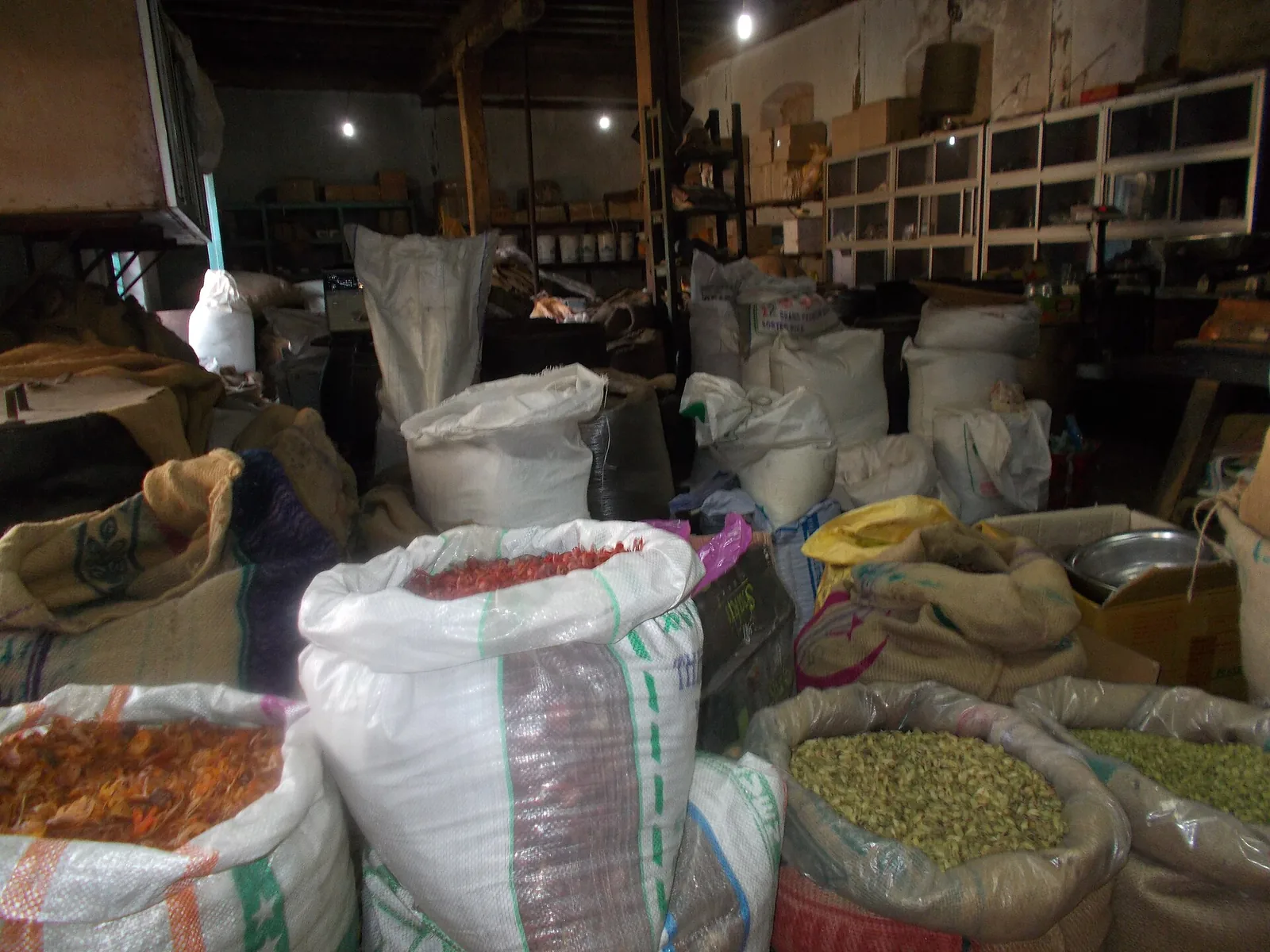
Almost everything written about the Mattancherry spice markets is in the present tense and describes a bazaar unchanged for five hundred years. Walk it and the tense is wrong. Most of the godowns are shut, much of the community that ran them has gone, and a good share of the buildings now sell coffee, art or furniture. That is not a sad footnote to the story. It is the story, and it is more interesting than the romance.
What a godown was for
A godown is not a shop and was never meant to be looked at. It is a processing floor with a door onto a road: pepper, cardamom, ginger, turmeric and cinnamon came down from the Western Ghats and were dried here, cleaned here, graded here by hand and by eye, sacked, weighed and sold on. The wide loading doors, the deep plain interiors and the total absence of frontage are all functions of that job.
Which is worth saying because guides routinely date these buildings to the Portuguese. Some fabric in the quarter genuinely is old, but the surviving warehouse frontages are overwhelmingly Dutch- and British-period commercial construction, put up when the volume justified them. The trade is five hundred years old. Most of the buildings are not.
What actually closed them
The causes were not local, which is the part that gets left out when the decline is described as neglect. International demand for Indian spices became volatile; Southeast Asian markets took share; and large spice industries grew up in Latin America and Africa, closer to some buyers and cheaper at scale. Reporting on the quarter now describes almost all the godowns as closed, and much of the Gujarati and Kutchi merchant community that ran the business as having left.
Nothing about that is a failure of Kochi. The quarter did not get worse at grading pepper. The world reorganised around it, and a port whose entire reason for existing was a monopoly on something rare discovered that the something was no longer rare. You can see the same shape in Beypore’s shipyards and in every commodity town anywhere.
- Some godowns still work. Weekday mornings are when you will see them do it.
- An international pepper trade retains a presence in the quarter.
- Retail spice sold to visitors is a veneer on a wholesale street — two different prices.
- The Gujarati and Kutchi commercial presence has thinned sharply since the trade contracted.
The biennale did the rescuing
The buildings survived by becoming something else. From 2012 the Kochi-Muziris Biennale needed large, raw, atmospheric interiors near the water, and the sea-facing warehouses of Mattancherry and Fort Kochi were exactly that. Several were sold or leased as venues. Others became cafes and design studios; a good many at the southern end turned into antique shops feeding the Jew Town trade.
It is an ironic rescue and worth naming as one. The architecture of a trade was preserved by the thing that replaced the trade. A godown that is now a gallery is both a conserved building and a business that no longer does what the building was for, and reasonable people in Mattancherry disagree about whether that counts as heritage or as a very slow eviction.
How to read the street now
Come on a weekday morning and you get the working remnant: handcarts, reversing lorries, open doors, the smell changing every twenty metres depending on whose shutter is up. Come at four in the afternoon and you get the successor economy — closed shutters, antique dealers, coffee. Both are true. Only one of them is what the guidebook promised you.
The honest way to spend an hour here is to walk it slowly and count: working godown, gallery, cafe, antique shop, shut. That tally is the most accurate description of the Mattancherry spice quarter anyone can give you, and it changes every year.
Frequently asked questions
Is the Mattancherry spice trade still alive?
Partly, and it would be dishonest to claim more. Some godowns still work and an international pepper trade keeps a presence in the quarter, but reporting describes most warehouses as closed and much of the Gujarati merchant community as having moved on. Come for a remnant of a great trade rather than a bazaar in full cry.
Why did the Mattancherry spice markets decline?
Because of changes outside Kerala: volatile international demand, competition from Southeast Asian markets, and the growth of large spice industries in Latin America and Africa. The quarter did not get worse at what it did — the global trade reorganised around it.
Were the Bazaar Road warehouses built by the Portuguese?
Mostly not, despite the common claim. The trade here is around five hundred years old, but the surviving godown frontages are largely Dutch- and British-period commercial buildings put up when volumes justified them. Look at the brickwork and the loading-door detailing.
What is the Kochi-Muziris Biennale’s connection to the spice warehouses?
From 2012 the biennale took over several large sea-facing godowns in Mattancherry and Fort Kochi as exhibition venues, because they offered big raw interiors near the water. That conversion preserved a lot of warehouse architecture — while accelerating the quarter’s shift away from the trade the buildings were made for.
Is it worth buying spices on Bazaar Road?
Often, but go in knowing it is a wholesale street with a retail veneer, and that the two prices are not the same. Bargain, inspect what you are being sold, and be sceptical of confident claims about grade or origin — the quality range on cardamom and pepper in particular is very wide.
What is the difference between the spice markets and Jew Town?
They adjoin and are usually walked together but they are different things. Bazaar Road is the working spice quarter — godowns, grading, lorries. Jew Town at its southern end is the antique and visitor street that grew into the space a departed community left behind.