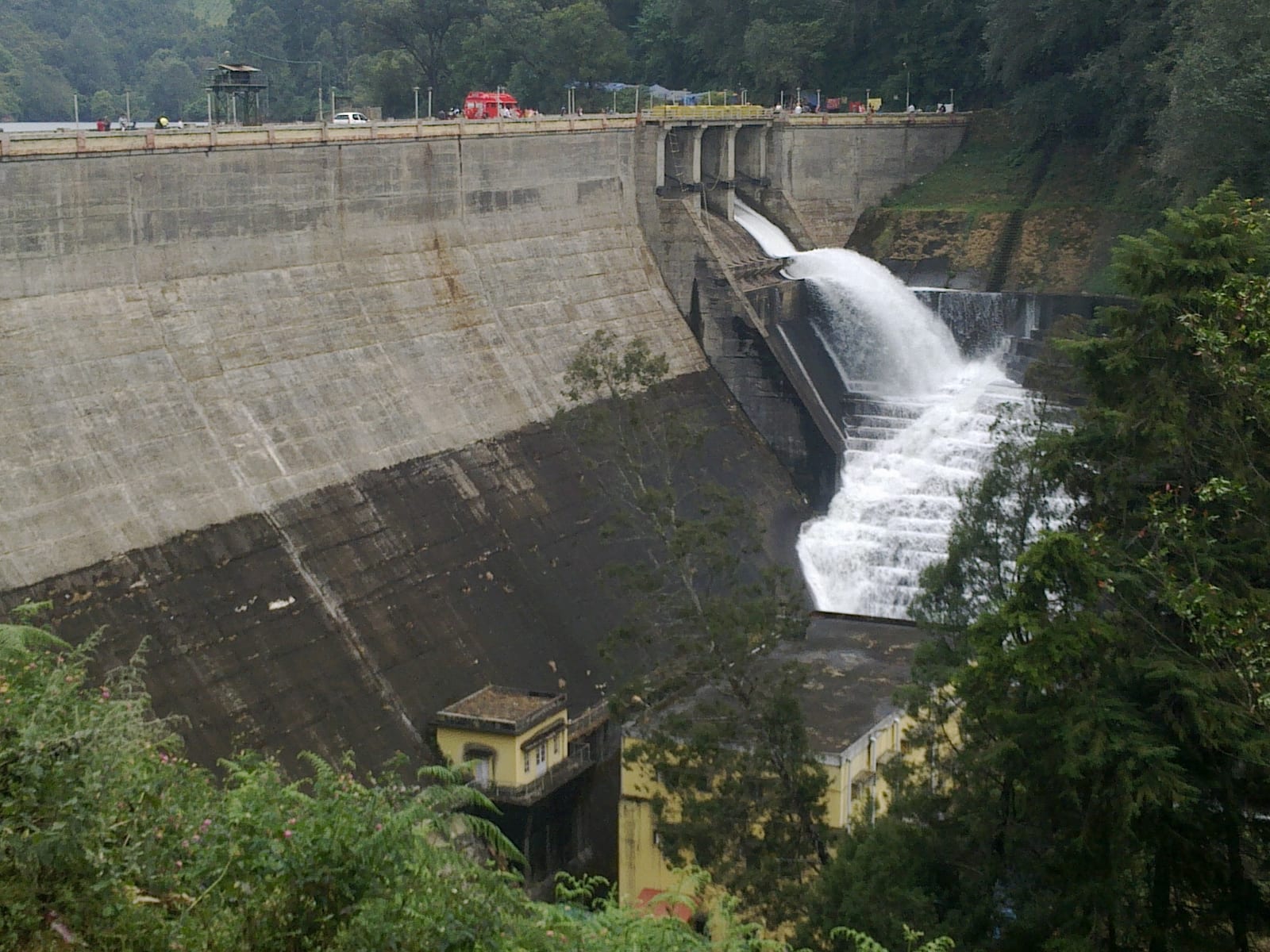
Boats cut across the still green water at Mattupetty Dam, and the lake reflects the hills so cleanly that it looks as if it has always been there. It has not. Kerala Tourism records that Mattupetty Dam is a concrete gravity dam built in the late 1940s under the Pallivasal Hydro-electric project, for water conservation and power generation. So the lake that draws crowds out of Munnar was made to store water for electricity, and the dam is still a vital source of power for the hill town today.
The water brought something else that nobody planned for, because the lake soon became a haven for birds and animals and then for visitors. The District Tourism Promotion Council of Idukki runs boating and speed boating on it, and Kerala Tourism lists pedal boats and speed boats for hire. Yet the place takes its nickname from neither the dam nor the boats. Mattupetty is known as the Cattle Village, and that name comes from a farm about three kilometres from the dam.
That farm began with a foreign government looking for a way to help. Onmanorama writer Ajay Kamalakaran explains that Switzerland, in those years, wanted to build goodwill in the newly independent countries of Asia and Africa. Its proposals were studied by both governments, and in 1963 the Indo-Swiss Project was born under a bilateral agreement between India and Switzerland. It was the first project in India of the Swiss Agency for Development and Cooperation, and the teams it sent to the high ranges of Idukki chose vacant land at Mattupetty near Munnar.
The choice made sense to anyone who saw the ground, because the farm's grasslands and rolling hills remind travellers of Switzerland without the snow. Kerala Tourism says the project set out to develop a new cattle breed that could adapt to the local environment. An experimental station at Mattupetty ran crossbreeding experiments and pasture trials, and the new animals were bred from the Brown Swiss breed and local cows. That mix gave Kerala a cow suited to its own hills, and the best known result is the sought-after Sunandini breed.
The bigger breakthrough, though, was a technique rather than an animal. To spread the new breed faster, the project used artificial insemination with frozen semen, a first for India. In 1965 the Mattupetty project produced the first deep-frozen bull semen in the country, which meant a good bull's line could now be stored and carried to cows far beyond these hills. A small farm on the Munnar road had done it before anyone else in India.
The farm outlived the Swiss partnership and passed to Kerala. Today the Kerala Livestock Development Board runs it as a model livestock village spread over 191 hectares. Kerala Tourism says travellers can visit the dairy farm, which holds hundreds of high-quality cattle. Many people pair it with the lake on the same morning, since the two lie so close on the road out of Munnar. The cows grazing on the slopes are the living end of an experiment that began more than sixty years ago.
The road that links them is older still. Before the dam, Mattupetty was a station on the light railway that carried tea from Munnar towards Top Station. Today the same road runs on past Echo Point and Kundala Lake.
Frequently asked questions
When was Mattupetty Dam built?
It was built in the late 1940s as a concrete gravity dam under the Pallivasal Hydro-electric project, for water storage and power.
What is the Indo-Swiss dairy farm at Mattupetty?
It is the livestock project started in 1963 under an agreement between India and Switzerland. It is now run by the Kerala Livestock Development Board over 191 hectares.
Why is Mattupetty famous for cattle?
The farm bred new cattle from Brown Swiss and local cows, including the Sunandini breed. In 1965 it produced India's first deep-frozen bull semen.
Is there boating at Mattupetty Dam?
Yes. The District Tourism Promotion Council of Idukki runs boating and speed boating on the lake.