The building is easy to miss. It stands at a lane junction in Kuttichira, in the old Muslim quarter of Kozhikode, and from the street it reads as a modest two-tier house of worship: red Mangalore tiles rising to a steep gable, a bright blue plinth and verandah wall behind scrolled metal railings, ochre columns, a Malayalam plaque fixed low beside the gate. Two loudspeaker horns sit at the apex of the gable, which is the plainest evidence you will get from the pavement that the mosque is still working. Set flush into one of its walls is a slab of granite that historians of Kerala treat as one of the most remarkable documents in the state.
What is actually on the stone
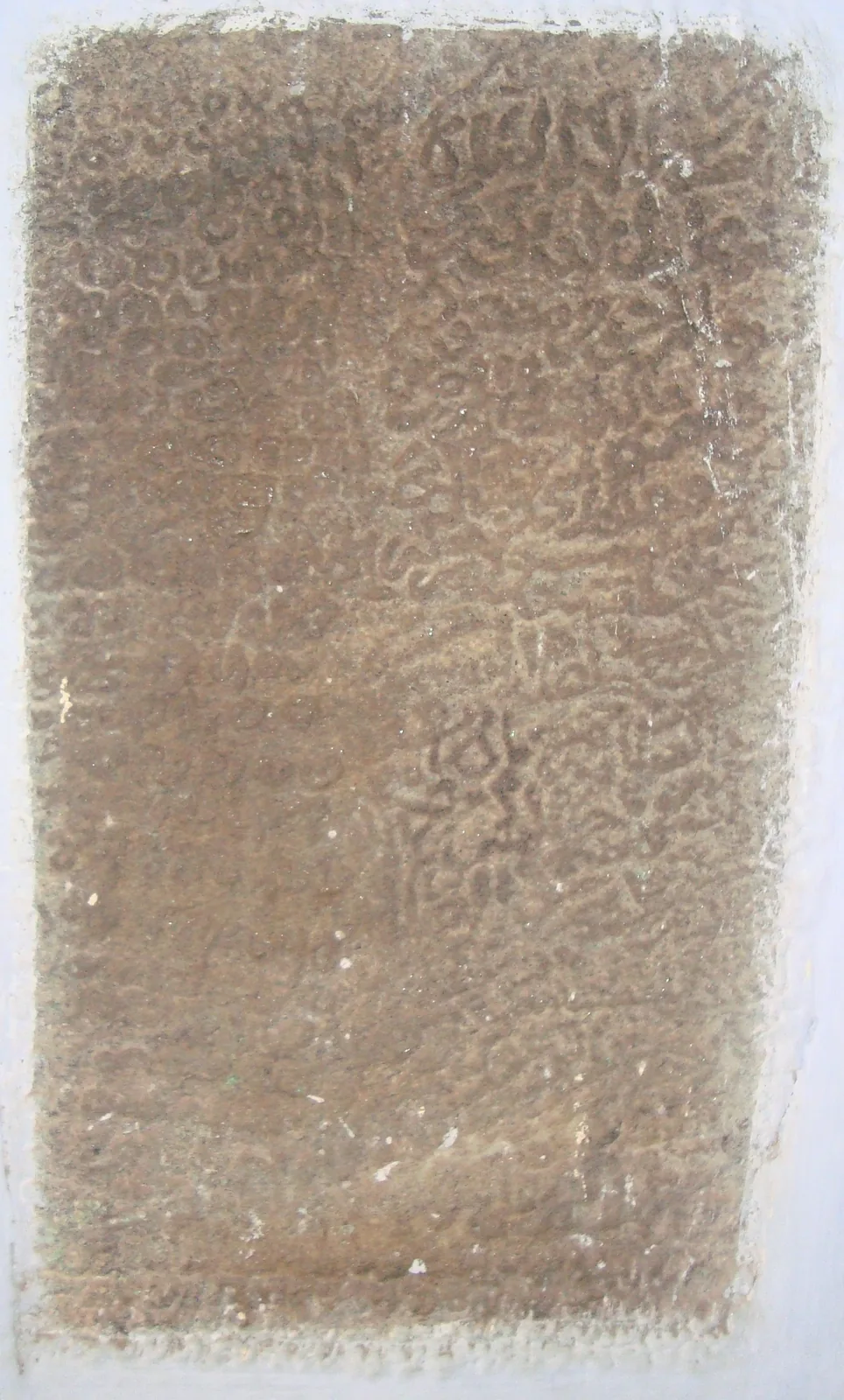
The inscription is undated. Its usual placement in the thirteenth century is palaeographic — an estimate read off the letter forms — and that distinction matters, because a great deal of writing about this mosque quietly promotes the estimate into a record. What the stone does have is an unusual physical character. The letters are not incised into the surface in the manner of the Kodungallur–Chera inscriptions. They stand raised in relief, in imitation of standard Islamic epigraphic practice. A Malayalam script has been cut the way an Arabic one would be, which is the first small sign that this is a document produced where two traditions were sharing a workshop.
It is bilingual, and it is functionally split. The operative Malayalam terms are in Vattezhuthu; the closing portion is in Arabic, in what one description calls a Kufic manner. It was William Logan, Collector and Magistrate of Malabar, who first flagged the stone for scholarship in his 1887 manual Malabar, where he called the building the Machchinde Mosque. The reading historians now work from was produced by M. G. S. Narayanan with M. R. Raghava Warrier and Kunhu Muhammed, published as "The Zamorin’s Gift to the Muccunti Mosque" in Cultural Symbiosis in Kerala in 1972, and treated again in the Proceedings of the Indian History Congress at its 59th session at Patiala in 1999.
The Malayalam half: a revenue order
The Malayalam portion runs to thirty-two very short Vattezhuthu lines and reads as administration rather than as ceremony. It opens as the order of Punturakkon — "Lord of Punthura", a known title of the Zamorin of Calicut — issued through an officer-in-attendance. It grants a daily allowance of one nazhi of rice to the mosque, and a further endowment of twelve para from lands named as Kunnamangalam and Pulikkizhu, with the intention that it continue in future.
No ruler is named. The title is what ties the grant to Calicut’s ruling house, and it is worth pausing on what the document therefore is: a Hindu king writing a Muslim place of worship into his standing revenue arrangements, in perpetuity, in the flat language of a clerk. Not a gesture at a ceremony. A line item.
The Arabic half: the part that is usually dropped
The Arabic portion says something else entirely, and it is the hinge of the whole document. In Z. A. Desai’s translation, published in A Topographical List of Arabic, Persian and Urdu Inscriptions of South India in 1989, it records that Shahab al-din Raihan — described as the atiq, the freed slave, of the late Mas’ud — purchased land from its owner out of his own money and constructed on it this mosque and a well, and made provision for its imam and its muezzin by constructing a large building.
Read the two halves together and there are two acts and two parties. A manumitted slave bought a plot with his own savings and built a mosque, a well, and an endowment for the men who would run it. A king later attached maintenance to what the freed man had made. Nearly every published summary collapses these into one act, and the merged version almost always credits the Zamorin with the building. He did not build it. He kept it going, which is a different and in some ways more interesting thing to have done.
What the stone is and is not unique for
Narayanan’s claim for it, as reproduced from his Kozhikkodinte Katha, is narrow and precise: it is the only surviving document recording an endowment by a Hindu king to the Muslims of Kerala. In that exact form it holds up. The looser versions in circulation do not. It is not "the only bilingual inscription in Kerala". It is not "the only Vattezhuthu–Arabic inscription in India". It is not "the only record of Hindu–Muslim harmony" in the state.
The reason those looser claims fail is that Kerala’s epigraphic record is full of rulers endowing communities not their own. The Ramanthali inscriptions of 929 and 1075 CE, also in Vattezhuthu, record Mushika and Alupa rulers endowing a Hindu temple. The Chera copper plates record royal grants to Christian and Jewish communities — the Tarisappalli plates of 849 at Kollam are the famous instance, and they are signed by witnesses writing in Arabic, Pahlavi and Judeo-Persian Hebrew. What is unusual about the Muccunti stone is the recipient, not the act of endowment, and it does not need the inflation.
The condition, told honestly
The slab is in poor shape and the poor shape is partly ours. English Wikipedia describes it as highly damaged, worn and fragmentary. The photograph on Wikimedia Commons — which is the only photograph of it anyone has published — bears that out: the Arabic is legible in patches at the upper right and mid right, and the Vattezhuthu on the left, the half that carries the Zamorin’s order, is largely worn away.
And the wall around it has been whitewashed, repeatedly, with the whitewash carried right up to and over the slab’s edges. There is a chalky rim on the stone and white flecks scattered across its face. Nobody is vandalising anything; someone is painting a wall, the way walls get painted. But a document that the scholarship calls unique is being painted around, and that is worth saying out loud on a page that sends people to look at it.
It is still in situ, which is the other thing to correct. A claim circulates that the tablet was moved and is now kept in a nearby church. It is not. It is where it has been, set flush into a whitewashed wall inside the mosque, and the photograph shows the wall margin on all four sides of it.
- The mosque is free and active. There are no published hours and no ticket counter.
- Men of all faiths are generally welcome; women’s access is not stated in published visitor guidance, so ask at the door.
- Ask before photographing, as the mosque does not publish a visitor photography policy.
Frequently asked questions
Who built Muchundi Mosque?
Shahab al-din Raihan, named in the Arabic half of the inscription as a freed slave — atiq — of the late Mas’ud. He bought the land with his own money and built the mosque and a well. The Zamorin endowed its upkeep afterwards.
Is the inscription dated to the 13th century?
No. It is undated. The thirteenth-century placement is palaeographic, from the letter forms, and should be described as an estimate.
What languages is it in?
Old Malayalam in Vattezhuthu script for the operative terms, and Arabic for the closing portion. The letters are raised in relief rather than incised, which is Islamic epigraphic practice applied to a Malayalam text.
Can I read it on site?
Barely. The surface is heavily eroded; the Arabic survives in patches and the Vattezhuthu is largely gone. Go for the object and its setting rather than expecting to read lines off it.