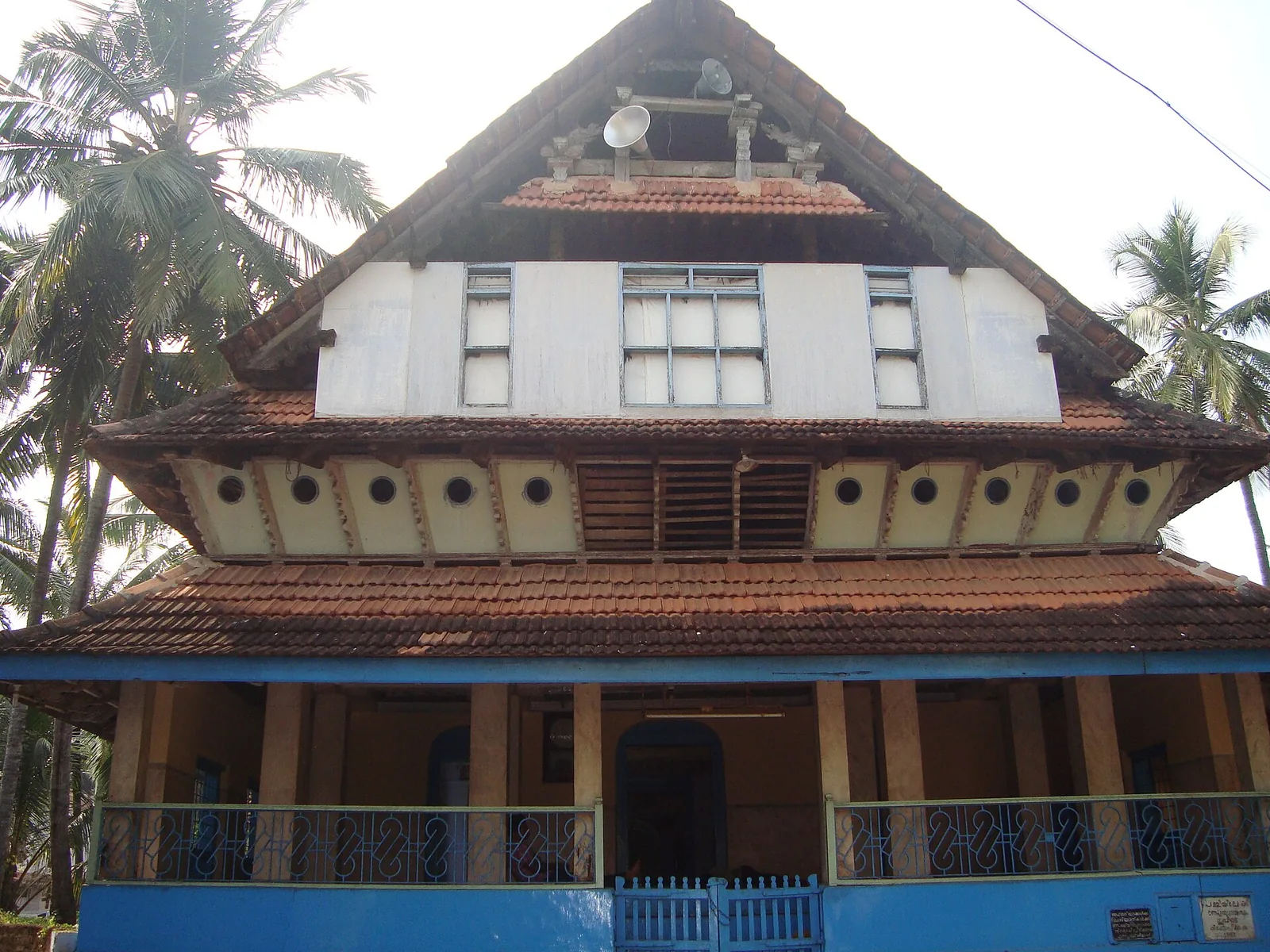
Few buildings in Kerala have been spelled so many ways. Muchundi, Muchunthi, Muccunti, Muchandi, Muchiyan, Machinde — and, in the Malayalam that the neighbourhood actually uses, മുച്ചുന്തിപളളി. William Logan wrote it Machchinde in 1887. The Madras High Court wrote it Muchanti in 1912. India’s national mapping company files it today under Muchundhi. That spread is not carelessness. It is the residue of a real argument about what the name means, and the argument has two sides that are both better supported than the popular accounts admit.
Theory A: it is a man’s name
M. G. S. Narayanan derived the name from Muchiyanre palli — "the mosque of Muchiyan" — with Muchiyan contracting to Muchin and thence to the modern forms. The strength of this reading is that it is not a reconstruction from outside. The mosque’s own inscription, in its Malayalam half, calls it the Muchiyan’s mosque. Historians tentatively identify Muchiyan with Shahab al-din Raihan, the freed slave named in the Arabic half as the man who bought the land and built the place.
Narayanan also noted two survivals of the name in the immediate neighbourhood in his own day: a house called Muchintakam, and a mausoleum — a jaram — called Muchiyante Jaram. A house name and a tomb name preserving a founder’s name beside his foundation is exactly the sort of corroboration a place-name argument wants.
Theory B: it is a junction
The rival reading is simpler and older-sounding. Calicut Heritage traced the name to muchanti, a Tamil word for a junction — a place where three lanes meet — noting that the same word survives with the same meaning in the Tamil quarter of Penang. On this account the mosque is named for where it stands rather than for who built it, which is how a very large number of South Indian places are named.
Two pieces of evidence support it more strongly than most retellings acknowledge. The first is a court record. In Muthala Kandi Katturi Koya Molla v. Palli Veetil Abu Baker, decided by the Madras High Court on 16 July 1912, the judgment refers throughout to "the Muchanti mosque in Calicut". That is not an antiquarian’s spelling; it is the building’s ordinary legal name in a working court within living memory. The shift from Muchanti to Muchundi is a twentieth-century one.
The second is that the junction is still there and is still called that. It is mapped as a named place in its own right — Muchundi Junction — twenty-seven metres due east of the mosque, and MapmyIndia files the mosque’s postal address under a second-level locality named simply Muchundhi. The junction reading is therefore not a philologist’s speculation about a dead word. The junction is a live, mapped, present-day place name, and the mosque sits on it.
The house may still be there too
A nearby place-name, Muchundiyakam, may preserve Narayanan’s Muchintakam under a slightly different spelling; the identification remains probable rather than established. Scholarship also mentions Muchiyante Jaram, but no dependable current visitor location establishes that the mausoleum survives. Do not enter residential lanes searching for either site.
The 1912 case is worth reading for itself
That court judgment is more than a spelling witness. The suit was not about land, or about the inscription, or about any of the things a heritage building usually ends up litigating. A worshipper went to court seeking a declared right to offer prayers and recite the Qur’an on particular dates in the month of Sha’ban, and to distribute sweetmeats. The Mulla denied that worshippers could recite without his permission.
So what survives from 1912 is a dated documentary glimpse of the mosque’s ritual calendar and a quarrel over who controlled it — a fight about whether a congregation could observe its own dates in its own building, argued in a colonial high court, about a mosque founded six centuries earlier by a freed slave. Whether the practice continues we do not know.
Which theory wins
Neither, cleanly, and that is the honest answer. The inscription genuinely says "the Muchiyan’s mosque", which is hard evidence for the personal-name reading and comes from the building itself. The junction genuinely exists, is genuinely still named, and genuinely has the mosque standing on it, which is hard evidence that muchanti is not a dead word here. The 1912 spelling establishes when the modern form took over without deciding which etymology came first.
What can be said is that the two readings are not really competing for the same ground. One explains a thirteenth-century name; the other explains why it stuck. And there is a pleasing possibility neither side has to concede: that a mosque built by a man called Muchiyan stood at a muchanti, and that the two words have been holding each other up ever since.
Frequently asked questions
What does Muchundi mean?
Two explanations compete. Either it comes from Muchiyanre palli, the mosque of Muchiyan, a personal name that the inscription itself uses; or from muchanti, a Tamil word for a junction, with the mosque standing where lanes meet. Both have real support.
What is the mosque called in Malayalam?
മുച്ചുന്തിപളളി — Muchundi Palli. Ask for it that way in the quarter.
Why are there so many spellings?
Because the name has been transcribed by different hands over 140 years: Logan’s Machchinde in 1887, the Madras High Court’s Muchanti in 1912, Muccunti in the epigraphic literature, Muchundhi on Indian mapping data, Muchundi in general use.
Is Muchundi the same as Muneerul Masjid?
No. Muneerul is a different mosque about 330 m south-south-west. The names are not variants of each other: Muneerul comes from munir, meaning luminous, and is one of the commonest modern mosque names in Kerala.