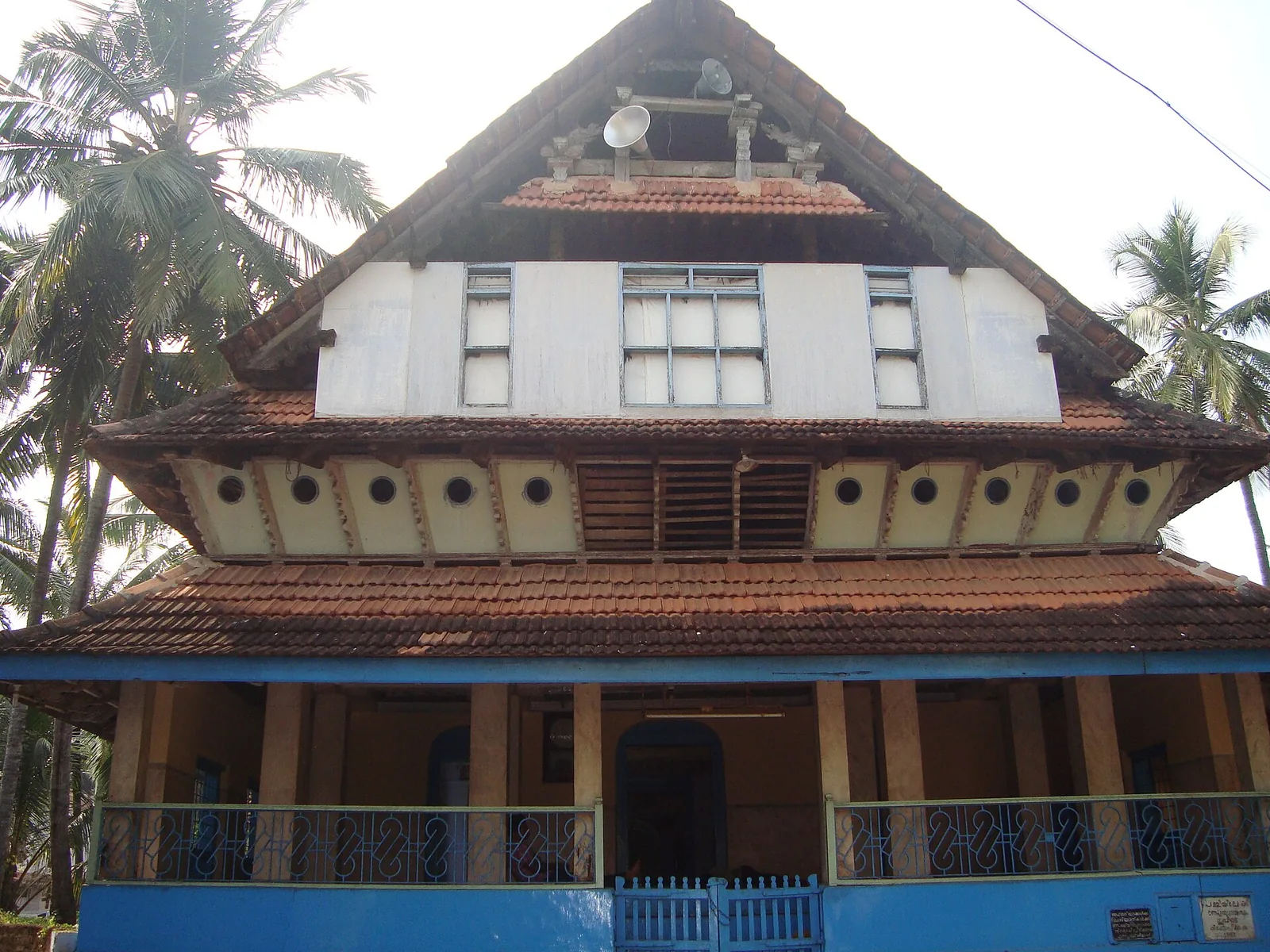
Most mosques anywhere in the world do one obvious thing on a Friday: they fill. The jum’ah, the Friday congregational prayer, is the week’s fixed point. Muchundi Palli does not hold it, has not held it as far as anyone reports, and continues to run five daily prayers without it. That is unusual enough that it is mentioned wherever the mosque is written about. What is rarely mentioned is that the building explains itself.
The missing minbar
Mehrdad Shokoohy’s Muslim Architecture of South India, published by Routledge in 2003, is the scholarly authority on this building. His description of the prayer hall notes a semi-circular mihrab under a semi-circular arch with a wide border — and records that there is no minbar.
A minbar is the stepped pulpit from which the khutbah, the Friday sermon, is delivered. The khutbah is not decoration; in the standard understanding it is a constituent part of the Friday prayer rather than an addition to it. No pulpit, no sermon. No sermon, no jum’ah. What looks like a quirk of local custom is a fact about the furniture, and the furniture is a fact about what the building was built to be: a mosque for daily prayer and, by the Malayalam accounts, for teaching — not the congregational mosque of its quarter.
Three mosques, three jobs, four hundred metres
The quarter makes more sense once you see the division of labour. Walk about a hundred and sixty metres north of Muchundi — two minutes through the lanes — and you reach the Kuttichira Juma Masjid, single-storeyed, with the largest floor area of any mosque in Kerala and room for something like a thousand worshippers. That is the mosque that holds the Friday prayer for this neighbourhood. Continue past the Kuttichira tank and about four hundred metres from where you started is Mishkal Palli, the four-tiered timber pile on some fifty teak pillars, built by the Arab shipowner Nakhuda Mishkal, burned in part by the Portuguese and rebuilt under the Zamorin. Mishkal keeps a carved wooden minbar in Friday use.
Three buildings, three founders, three functions, inside four hundred metres. Standing in front of any one of them you could not confuse it with the others — Muchundi is small and two-tiered on a low plinth, the Juma Masjid is a single vast floor, Mishkal is a tower of roofs. Reading about them, people confuse them constantly, and a good deal of published copy merges two or three of them into a single phrase. Ours did, until we wrote this page.
What it did instead: it taught
Malayalam sources carry an account of the mosque’s working life that English ones mostly do not, and it should be handled as what it is — a single-source tradition, rich and plausible and uncorroborated. On that account students came from overseas and from the islands for religious study here, down to the seventeenth century. Sadaqathullah, a Sufi from Kayalpattinam on the Tamil coast, is said to have lived at the mosque for years, teaching. The mosque is said to hold a collection of very rare coins.
And Malayalam sources record that the poet Moyinkutty Vaidyar composed the Uhud Padappattu, published in 1878, upstairs at Muchundi Palli. A second account has him camping at the mosque while compiling some of his works. Against that, his own memorial institution — the Mahakavi Moyinkutty Vaidyar Mappila Kala Academy — lists the work in his bibliography without mentioning Muchundi or Kuttichira at all. So it is a tradition, worth telling and worth attributing, not a fact to assert.
Today worship happens on the ground floor only. The upper floor, where the teaching is supposed to have taken place, is unused.
How to read the building from the lane
Shokoohy’s plan is worth carrying in your head, because most of it is visible or inferable from outside. A small rectangular original structure sits on a plinth about a metre and a half high. An open colonnaded porch with three doors leads into a small antechamber; three more doors lead from that into the prayer hall. There are numerous exterior doors, each with a semi-circular arch and a wide border. The roof comes in two parts: a single hipped roof on wooden columns over the original core, and the porch roof in two external tiers, indented at the eastern gable end so that it reads as three.
Inside, if you are admitted, look up rather than around. The ceiling is coffered. The beams are decorated and carry religious inscriptions. Malayalam sources describe the ceiling boards, beams and door leaves worked in a padmadala or lotus-petal motif — which is temple carving vocabulary, cut by craftsmen from the same workshops, carrying a mosque’s Qur’anic calligraphy. The walls are karinkallu, black stone, under a timber frame. English Wikipedia notes calligraphy on the ceiling with carved flowers along the sides; a local mapper, quite independently, describes very intricate wooden carvings especially on the doors and ceilings, in typical Kerala style but highly Islamic. Three descriptions from three directions converging on the same thing.
It is genuinely still in use
This should not need saying, but "no Friday prayer" is easily heard as "disused". English Wikipedia’s infobox lists the mosque as active. Independent accounts state that daily prayers and Islamic rituals continue, on the ground floor, and that the five daily prayers are observed even though the Friday congregation is not. And there is a piece of physical evidence anyone can check in the one photograph of the place: two loudspeaker horns are mounted on the old timber framing at the apex of the gable. A mosque that had fallen out of use does not carry a working call-to-prayer PA.
Which is the practical instruction for a visitor, too. There is no ticket, no counter and no published hours. There is also no Friday closure spike here, because there is no Friday congregation — the one day you might expect to be turned away is the one day the building is quieter than its neighbours. Come between the prayer times, dress modestly, take your shoes off, and ask before you photograph anything.
Frequently asked questions
Why does Muchundi hold no Friday prayer?
Because it has no minbar — no pulpit. The Friday sermon is delivered from a minbar and is a constituent part of the jum’ah, so without one there is no Friday congregational prayer. Shokoohy records the absence of a minbar in his study of the building.
Is the mosque still in use?
Yes. Five daily prayers continue, on the ground floor; the upper floor is unused. It is listed as an active mosque, and the 2010 photograph shows working loudspeakers at the gable.
Where do people go for Friday prayers instead?
To the Kuttichira Juma Masjid, about 160 m north — a two-minute walk — which has the largest floor area of any mosque in Kerala.
Can I go inside?
Men of all faiths are generally welcome, dressed modestly and without footwear. Published visitor guidance does not state the arrangement for women, and restrictions quoted online refer to Mishkal rather than Muchundi. Ask at the door.