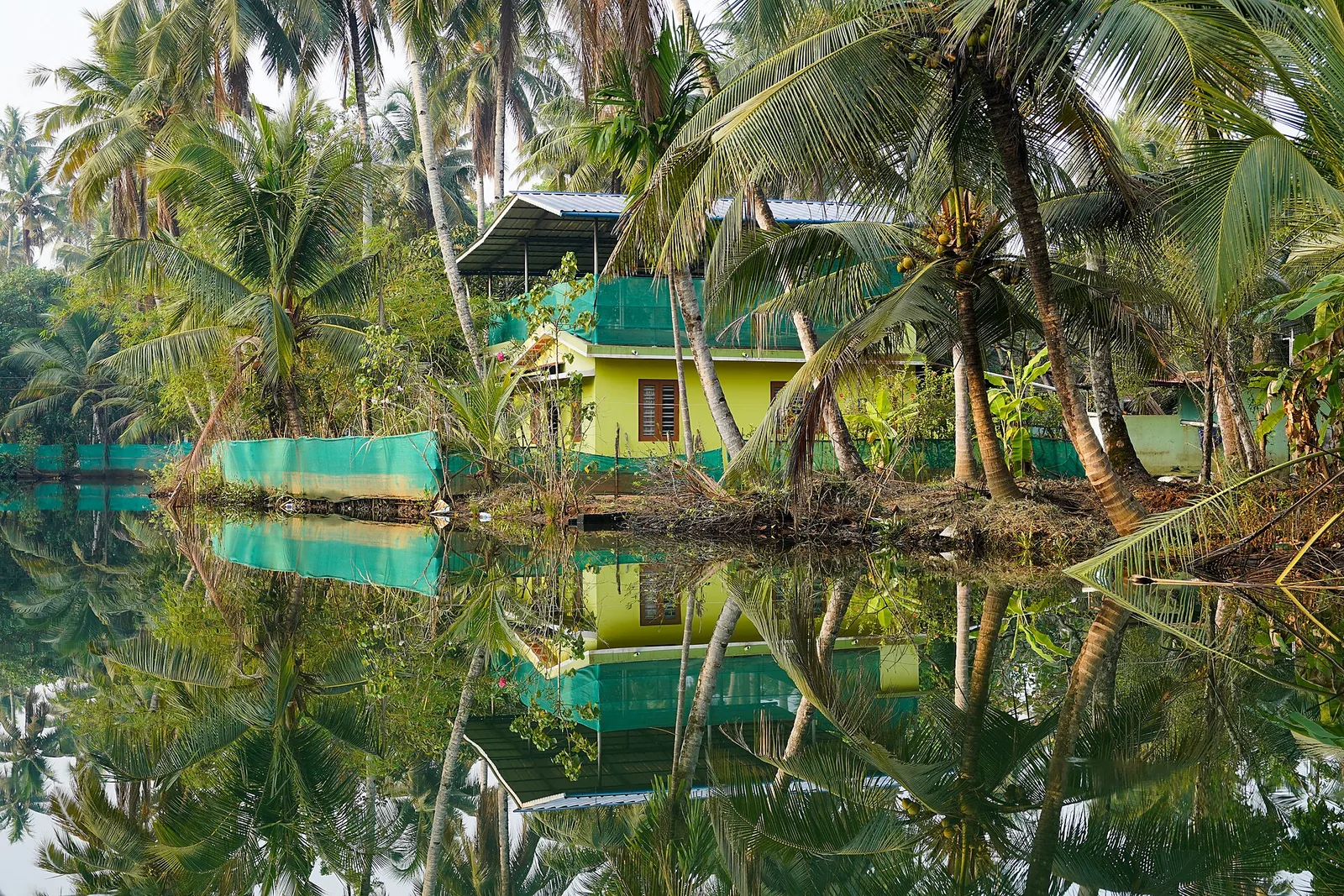
Look at the houses along the canals on Munroe Island and you will notice that many of them carry an open extra storey on top: a bare platform under a roof, unwalled, apparently unfinished.
It is not unfinished. When the water comes up, that is where the household and its things go. A visitor reads a half-built house. It is a flood plan, and it is the cheapest one available.
The mechanism, stated precisely
The engineering here is unusually clear, and it inverts the story most people arrive with.
Boreholes taken by the National Centre for Earth Science Studies, using standard penetration test logs, found more than 120 metres of unconsolidated loose sediment below ground level — medium-to-high-compressibility clay with unconfined compressive strengths of only 9 to 34.5 kilonewtons per square metre. That is very soft ground indeed, and it goes down further than most people’s idea of the island goes across.
K.K. Ramachandran, head of atmospheric processes at NCESS, put the consequence bluntly to The Indian Express: since the mud below is highly fluidised, only the very heavy buildings built without proper engineering techniques are going down, some even one to one and a half feet.
The traditional island house was light. Timber, laterite, a tiled roof. The modern one is not: a reinforced concrete house is, by a wide margin, the heaviest object that has ever been set down on this mud. In the 2019 reading, the land is not subsiding — the buildings are pressing into it.
We should be straight that this is contested. The same institute’s 2023 paper in Scientific Reports describes land subsidence and measures about 14% of the island’s area lost. The two findings sit unreconciled in the literature. But whichever is right, the practical instruction for anyone building here is identical, and that is the useful part.
The evidence you can walk past
Septic tanks overflow into courtyards and sit-outs. The station platform settled. So, Ramachandran notes, did the double-track railway line itself, which is his exhibit for load-induced settlement rather than land subsidence — a line carrying close to 150 trains a day in either direction is a great deal of repeated weight on 120 metres of mud.
And the worst-affected wards are the ones that make the point cleanest. Nenmeni and West Pattamthuruth are landlocked. They are not losing shoreline at all. They are settling in place. Erosion at the edges and compaction in the middle are two different processes, and almost all writing about this island collapses them into one.
One third the weight, or three feet up
The Indian Institute of Architects, Kollam centre, chaired by Niranjan Das Sharma, designed two prototypes. They are the two honest answers to soft ground, and between them they cover the whole problem.
Design one makes the house lighter. A light superstructure in lightweight concrete blocks with a PUF-insulated metal roof, weighing about three times less than the existing structure — high-pitched roofs, perforated GI sheets for ventilation and to keep mosquitoes out. If the load is the problem, remove the load.
Design two lifts the house clear. An elevated structure standing on locally available coconut-tree trunks, with epoxy-protected steel frames and fibre-cement boards, raised about three to four feet above the ground. If the water is the problem, get above the water — on the one structural material this island grows for itself.
Earlier prototypes were funded through KDISC, the Kerala Development Innovation and Strategic Council, which runs amphibious housing programmes for both Munroe Island and Kuttanad. The foundation stone for the first amphibious house at Munroe Thuruthu was laid in January 2024. Around 2,000 families are described as under threat.
Gopinath, a retired sand worker and one of the beneficiaries, described his replacement to The Indian Express in the flattest possible terms: a PUF-insulated metal roof, and a chemical toilet that can withstand floods. He had an old tiled-roof house that would get frequently flooded during high tides.
What the engineering does not solve
Bhadran, of Pattamthuruth West, whose foundations seep a little further into the mud each year, said the thing that stays with you longest: like the lotus in the ponds, we keep floating here. Even if we want to sell our houses, there are no takers. Who wants to live here? The people here are mostly poor and cannot afford to buy land or a house elsewhere.
And: our relatives don’t visit anymore. They ask us to give up our home and go somewhere else. But where do we go?
He also mentions, almost in passing, that he used to know when the tides would come and no longer can. That is worth pausing on, because it is a lay observation that matches the instruments exactly. NCESS found that the flooding here does not track the ocean’s spring tide — that a one-metre coastal spring tide arrives at the island, 10.5 km inland, at under half that height, and does not flood it. The mechanism remains unexplained. Ramachandran’s phrase for it is that there is something happening within the Ashtamudi lake, some kind of internal resonance which we are yet to decode. A man who has watched this water his whole life saying he can no longer predict it is the same finding, arrived at from the other end.
The wider ledger
Coconut: barren stumps across Pattamthuruth and Peringalam, roots killed by salt. Paddy: 227 acres in 1950, 8 acres in 1995, under 2 acres in 2018, with 22 historically named fields gone entirely. Work: men who farmed coconut and coir now pick clams in the inland canals. Land: sold for dirt-cheap prices, because there are no buyers. Access: Pattamthuruth ward is effectively cut off from the rest of the island for want of a road and a railway overbridge, and piped water is suspended during prolonged floods.
The policy argument is live and both sides are on the record. Kerala’s Finance Minister K.N. Balagopal has said it would be difficult to find lasting solutions for the issues of Munroe Thuruth alone, as it was part of the worldwide phenomenon of global warming and climate change. The social activist T.K. Vinodan puts the other case: interventions must equip the local community to adapt to the changing circumstances and find sustainable solutions. The position reported from the constituency’s MP is that residents should be given incentives to stay rather than be relocated — amphibious housing, travel arrangements, new cropping systems.
Between a global explanation that no panchayat can act on and a local one that says build lighter and build higher, the houses with the open top storey have already chosen. They chose before anybody drew a prototype.
Frequently asked questions
Why do the houses have an open upper floor?
It is where the household and its possessions go when the water rises. It reads as an unfinished storey and functions as a flood plan.
Is it the land sinking or the houses?
Genuinely contested, by two studies from the same institute. The 2017–2019 NCESS work using satellite radar interferometry and a GPS array concluded the land is not subsiding and that heavy, poorly engineered concrete buildings are pressing into fluidised mud by up to a foot and a half. The 2023 NCESS paper in Scientific Reports describes land subsidence and measures about 14% of the island’s area lost. Either way the building advice is the same: lighter, or raised.
What is amphibious housing here?
Two prototypes from the Indian Institute of Architects, Kollam centre. One uses a light superstructure of lightweight concrete blocks and a PUF-insulated metal roof, weighing about three times less than a conventional house. The other stands the house on locally available coconut-tree trunks with epoxy-protected steel frames, raised three to four feet above the ground. The first foundation stone at Munroe Thuruthu was laid in January 2024, with earlier prototypes funded through KDISC.
How many people are affected?
Around 2,000 families are described as under threat, and more than 500 households have already been forced to vacate their homes according to the 2023 NCESS study.
Can residents just sell up and move?
Largely not. Residents describe land selling for dirt-cheap prices because there are no buyers, and most households cannot afford land or a house elsewhere. That is why the policy argument is about incentives to stay and adapted housing rather than relocation.