Statistics about depopulation are hard to feel. A congregation is not. On Munroe Island, in Pattamthuruth West ward, there is a church that serves one family.
It is called St Mary’s, and nobody calls it that. Everybody calls it the Dutch Church.
What is actually on the building
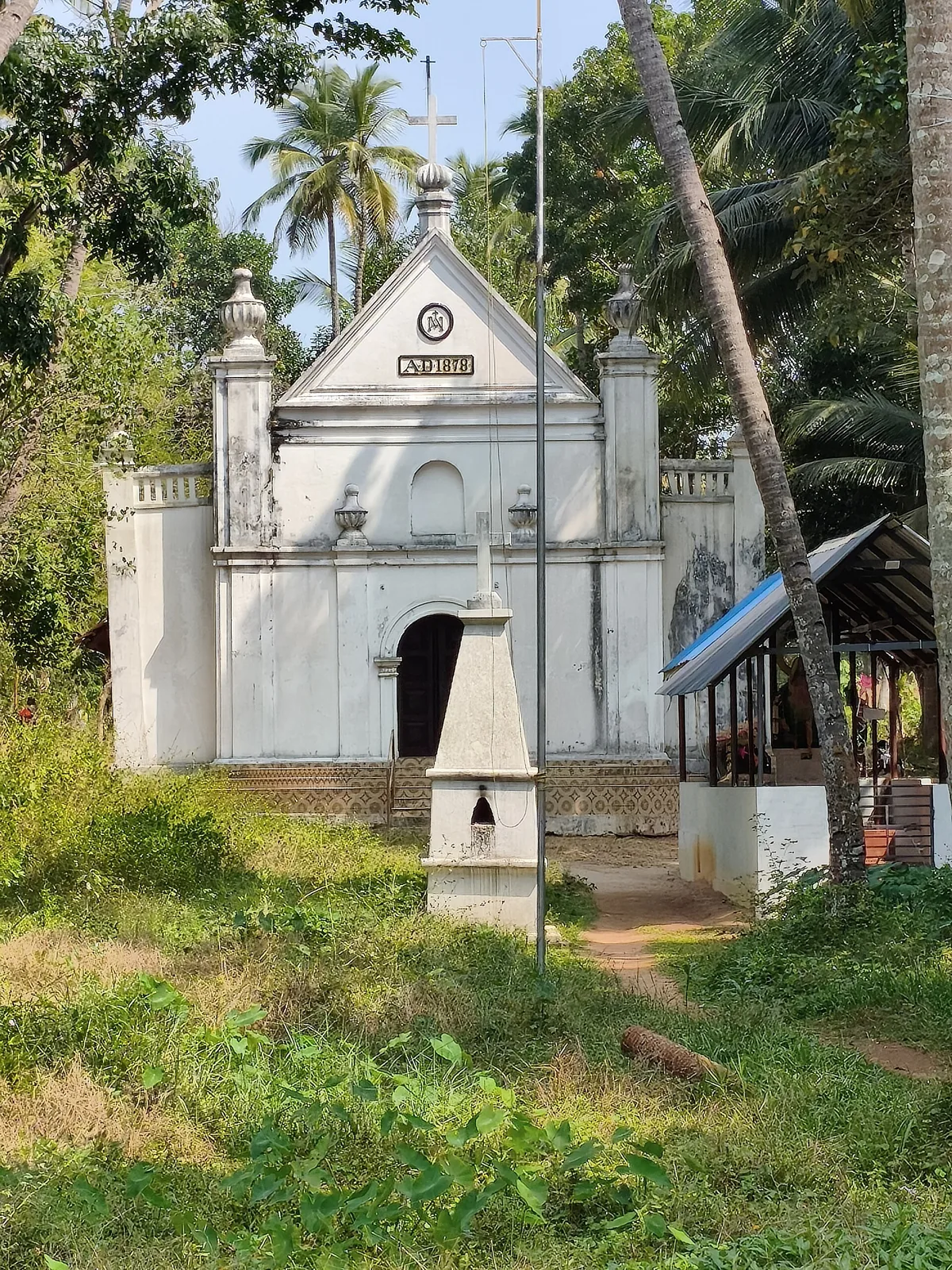
The west front is worth reading carefully, because the building is more precise about itself than the literature is. It is a gabled, white-plastered façade with urn finials at the corners and a cross at the apex. In the pediment there is a monogram set in a circular roundel, and beneath that a carved plaque. The plaque reads, in raised letters: A.D. 1878.
That is the one date on the building, and it is the only date anyone can point to. Round-arched central doorway, dark timber door, low balustraded side parapets, and — the nicest detail — a band of patterned glazed tiles running along the base like a skirting board. Walk round to the side and the arcade gives the game away entirely: square plinths, round columns with painted capitals, exposed timber rafters under a tiled roof, panelled teak shutters. It is a Kerala building wearing a colonial-classical coat.
The Dutch had left eighty years earlier
Wikipedia says it, Kerala Tourism says it, and every tour operator on the island says it: the church was built by the Dutch in 1878.
That is not possible. The Dutch East India Company’s position in Kerala ended with the fall of Cochin in 1795, and their remaining Malabar settlements were ceded to the British. By 1878 there had been no Dutch presence in Travancore for more than eighty years. Whoever laid that date-stone, it was not the VOC.
A more plausible sequence is reported by Onmanorama: a Portuguese foundation of 1518, with major renovations in 1878 that adopted Dutch architectural elements. We could not independently verify the 1518 date either, and we are not going to print it as fact.
What is verifiable is narrow and worth stating exactly: the building carries an 1878 date-stone, its style is Dutch-derived, and "Dutch Church" is a local name for a manner of building, not a record of who paid for it. A great many Kerala buildings are named for the style they wear. This is one of them.
Forty families to one
The congregation is the part that stops you.
The only Christian family left on the island is that of Robert Rorieguez, with his wife Kochuthrasia and their daughters Jancy and Jasmine. He is quoted plainly on how it happened: there were around forty Anglo-Indian families here once, but they gradually moved away for better connectivity and opportunities.
Forty families to one. The church is under the Kollam Latin Catholic Diocese and has no permanent priest, because there is no congregation to serve. Mass is said occasionally, when a visiting priest comes.
The grass around it grows long between visits. You can see that in any photograph of the place.
And the feast still happens
Here is the part that makes this a story about an island rather than a story about a building.
The church holds a three-day festival every April. It feeds more than four thousand people. It is organised and run by the island’s Hindu families.
Not attended by — organised by. The households that keep the feast of a Catholic church with one Catholic family are the Hindu households of Pattamthuruth and the wards around it. Nobody appears to find this remarkable locally, which is itself the most Kerala detail in the whole account.
It is worth saying clearly that this is not an emptied island with one relic on it. OpenStreetMap records Our Lady of Assumption Roman Catholic Church at Perungalam, a St George Orthodox Chapel, and a good scatter of Hindu shrines — the Bhuvaneshwari Temple, the Mulachanthara Devi Temple, the Pulimoottil Devi Temple, the Chirayil Sreekrishna Swamy Temple. This is a mixed island that is losing people. Those are different things, and the second one is what the church measures.
Why the exodus, and where it is going
The panchayat president, Mini Suryakumar, and the reporting around her tie the departures to the island’s physical condition in one line: tidal floods and saltwater seepage have shrunk the island and its inhabitants.
That is the connection the church makes visible. Munroe Island has lost about 14% of its land area by the measurement published in Scientific Reports in 2023, and more than 500 households have been forced to vacate their homes. Those households had religions. When a place loses half its people, it does not lose them evenly — the smallest community goes first and goes fastest, because it has the least holding it in place and, in this case, the most obvious somewhere-else to go.
A congregation of one is what a demographic curve looks like from the inside.
Seeing it
The church stands in Pattamthuruth West, on the bank of Ashtamudi. It is a working church without a working congregation, not a monument and not a ticketed site, so the ordinary courtesies apply and then some: it is somebody’s parish, even if that somebody is four people.
One practical warning about finding it. The best photograph of the church on Wikimedia Commons carries a geotag about 1.6 km north-east of where the church actually is — an Android upload with an unreliable coordinate. The photograph is unambiguously of this building; the coordinate is not to be trusted. Ask on the island rather than following a pin.
Frequently asked questions
Was the church really built by the Dutch?
No. The Dutch East India Company’s position in Kerala ended with the fall of Cochin in 1795, so there had been no Dutch presence in Travancore for over eighty years by 1878. "Dutch Church" is a local name for the architectural style. What is verifiable is that the pediment carries a carved A.D. 1878 date-stone and the styling is Dutch-derived.
How many Christians are left on the island?
One family — that of Robert Rorieguez, his wife Kochuthrasia and their daughters Jancy and Jasmine. He recalls around forty Anglo-Indian families on the island once. The church has no permanent priest as a result; Mass is said when a visiting priest comes.
Who runs the church’s festival?
The island’s Hindu families. It is a three-day feast held in April at which over 4,000 people are fed, and it is organised by Hindu households for a Catholic church with one Catholic family.
Is the island emptying out?
Yes. More than 500 households have been forced to vacate their homes, according to the 2023 NCESS study in Scientific Reports, which also measured about 14% of the island’s land area lost. Press estimates of the departures run as high as 800 families, though none is sourced to a register.