There is a question that travel writing about Munroe Island never asks, and it is a better question than most of the ones it does ask: why did anyone start paying attention?
The island had been losing ground since the 1980s. Residents had been living with it seriously since around 2000. The national coverage did not begin then.
Sonam post
Lance Naik Sudheesh B, service number 2609858F, served with 19 Madras of the Madras Regiment. His home village is recorded as Munroe Thuruthu, Kollam district.
In December 2015 he was one of ten men detailed to hold Sonam post on the Saltoro Ridge, among the highest manned military positions in the world. The altitude is given as 19,600 feet by one source and 20,500 by another; we quote the range rather than pick a number, because the sources disagree and neither is obviously better.
He had served before this. Operation Rakshak in Jammu and Kashmir, Operation Rhino in the North East, two volunteered years with the Rashtriya Rifles, a place in an intelligence collection team. He was a noted footballer. He is survived by his wife, Smt Salumul P, and a daughter.
3 February 2016
On the morning of 3 February 2016 an undetected ice wall gave way above the post. The avalanche buried it under roughly twenty-five feet of snow, in temperatures reported between minus forty-five and minus sixty degrees Celsius.
All ten men were lost.
One was pulled out alive. Lance Naik Hanumanthappa Koppad was found under about thirty-five feet of snow after six days, which is the kind of fact that stops making sense the longer you look at it. He was flown to the Army Research and Referral Hospital in Delhi and died there of multiple organ failure on 11 February 2016.
Sudheesh was among the dead. The Kerala government announced a compensation package for his family.
What it changed
The record is explicit about the effect, and it is unusual to find a causal claim like this stated so directly: his death spurred the interest of the outer world in the problems of this place.
The coverage bears it out. The Quint published "Munroe Islanders of Kerala Battle the Rising Seas" on 6 November 2016, nine months after his death. Reji Joseph’s "That sinking feeling" ran in Down To Earth on 15 August 2017. The national environmental coverage builds from roughly that point, and the scientific attention — the National Centre for Earth Science Studies began its two-year instrumented study in 2017 — follows the same curve.
It is not a comfortable mechanism. An island had been telling the state for fifteen years that its ground was failing, in the ordinary registers available to a village of nine thousand people: petitions, panchayat resolutions, local reporting. What made the country look was a soldier’s death two thousand kilometres away in a place with no connection to the island’s problem whatsoever.
The two grounds
The image the story keeps returning to is the geological one, and it is not decoration.
Munroe Island sits on more than 120 metres of unconsolidated loose sediment — soft, medium-to-high-compressibility clay with unconfined compressive strengths of nine to thirty-four and a half kilonewtons per square metre. Ground that a house presses into. The island’s own railway platform, at one metre above sea level, had visibly settled before it was rebuilt.
Sudheesh died on the other extreme of the same problem: ground that is not ground either, at the top of the world, twenty-five feet of it on top of him. A man from a place where the earth is too soft to hold a house, buried under earth made entirely of ice.
That is not why the story matters. It matters because it is the honest answer to how this island entered the national conversation, and because the answer is arbitrary and a little shaming. But the symmetry is there, and it is why the story is told on the island the way it is.
At the station
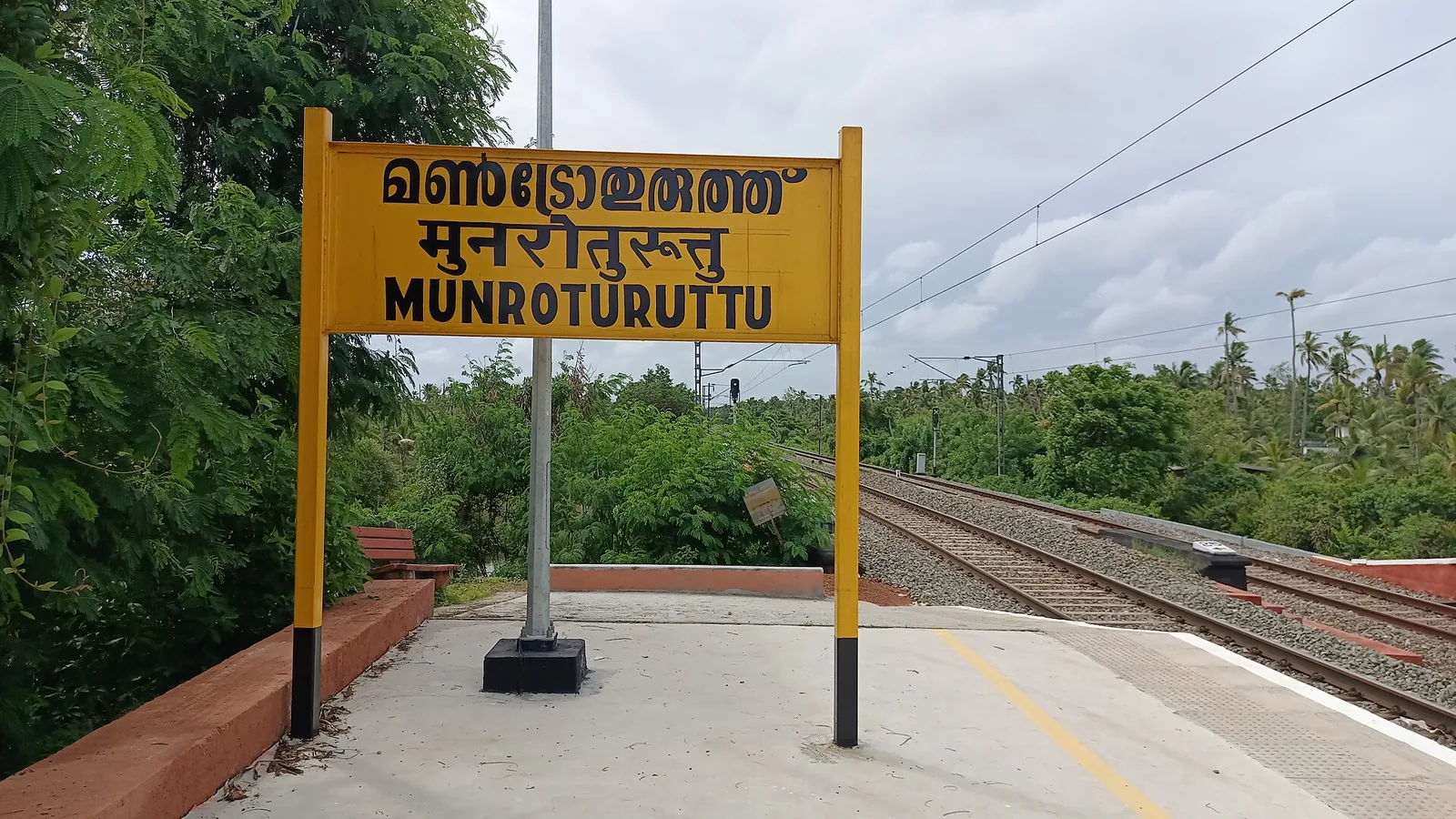
Munroturuttu station, code MQO, is a two-platform halt on a double-track line carrying close to 150 trains a day. The platform that had settled was rebuilt: the station closed on 31 January 2024 and reopened on 25 September 2024, which is why the concrete in recent photographs looks so new.
It is a small halt on a large line, and it is the piece of national infrastructure that runs through this island. Standing on it is the plainest way to hold both halves of the island’s situation at once — one metre above sea level, and connected to everywhere.
Frequently asked questions
Who was Lance Naik Sudheesh B?
A soldier of 19 Madras, the Madras Regiment, service number 2609858F, from Munroe Thuruthu in Kollam district. He had served in Operation Rakshak and Operation Rhino and volunteered two years with the Rashtriya Rifles. He died in the Siachen avalanche of 3 February 2016.
What happened at Sonam post?
On the morning of 3 February 2016 an undetected ice-wall avalanche buried the post on the Saltoro Ridge — given variously as 19,600 or 20,500 feet — under roughly twenty-five feet of snow, in temperatures reported at minus forty-five to minus sixty degrees Celsius. All ten men were eventually lost. Lance Naik Hanumanthappa Koppad was recovered alive after six days under about thirty-five feet of snow and died in Delhi on 11 February 2016.
How is that connected to the island sinking?
Directly, in terms of attention. The record states that his death spurred the interest of the outer world in the island’s problems, and the national coverage bears it out — The Quint in November 2016, Down To Earth in August 2017, with the NCESS instrumented study beginning in 2017. The island had been losing ground since the 1980s without that attention.
Is the railway station worth seeing?
It is the plainest single exhibit on the island: a two-platform halt at one metre above sea level on a double-track line carrying close to 150 trains a day. Its platform had visibly settled, and it was rebuilt — closed 31 January 2024, reopened 25 September 2024.