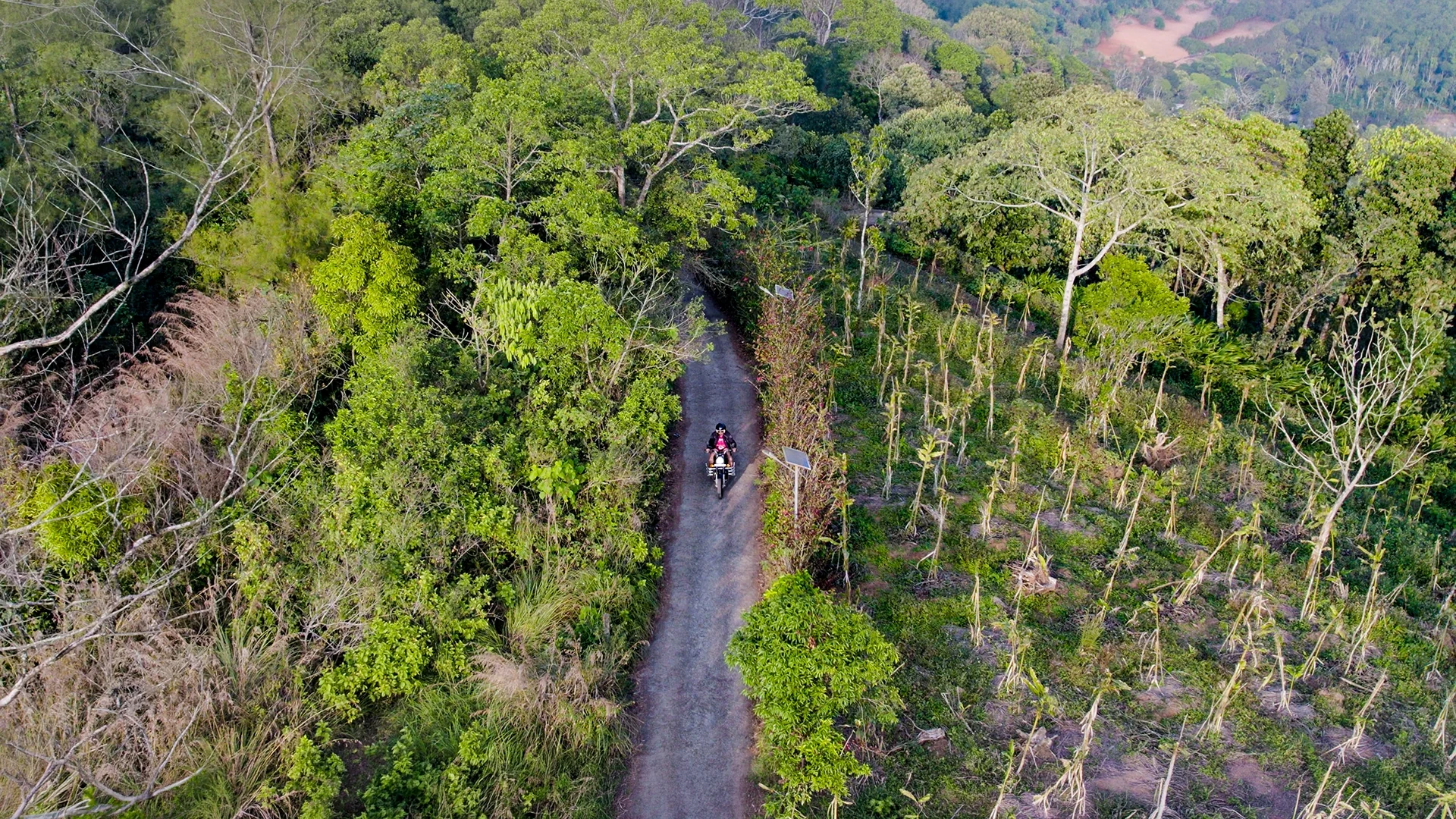
A narrow road can explain Murikkady more clearly than a list of spices. In the overhead photograph, a paved lane runs between tall trees and organised planting, with a person and motorcycle giving the scene scale. The road connects a working landscape rather than cutting through scenery without a purpose.
Read the edges of the lane
The two sides of the photographed road have different textures. Taller vegetation forms a dense edge on one side, while more orderly planting occupies the other. That contrast shows how a small route can pass between different uses of the same hillside.
The photograph does not identify every crop, and the road’s appearance cannot establish ownership. What it does reveal is the close relationship between movement and cultivation. People need to reach plots, buildings and neighbouring holdings, so the lane belongs to ordinary work as well as a visitor’s approach.
Kerala Tourism places Murikkady on the wider Anavilasam route from Kumily. This helps situate the locality within a road journey, but the final entrance for a plantation visit remains the particular host’s gate. A village name is useful orientation; it is not a universal visitor counter.
A plantation walk begins with a host
A guided visit can turn the road-side pattern into a closer explanation. The host can identify which crop occupies a plot, how it is reached for work and which parts of the holding are suitable for visitors. Those details vary between properties.
A demonstration garden may gather several species along a compact route. A working plantation may concentrate on fewer crops over a larger area. Both can be interesting, but their walking demands and purpose differ. Establish which kind of visit is offered before imagining a long trail through every visible patch of green.
The access lane should also remain clear for its normal use. Parking across a narrow entrance or standing in a vehicle’s turning space can interfere with the work the visitor has come to understand.
Look beyond a retail stop
Spice shopping and learning about cultivation can be connected without becoming the same activity. A useful walk explains what is actually grown and processed on the holding. A shop may sell produce from several places, so the connection between a packet and the visible plot is worth asking about rather than assuming.
The most memorable details may be practical: how a path bends around planting, where shade falls or how different parts of the property connect. Those observations give Murikkady a local scale that a general Thekkady shopping itinerary can miss.
Approach the locality through that working relationship. The road brings you to a named host; the permitted walk explains the holding; the wider landscape shows how those small cultivated spaces fit the hills near Kumily.
Plan the visit: Murikkady.