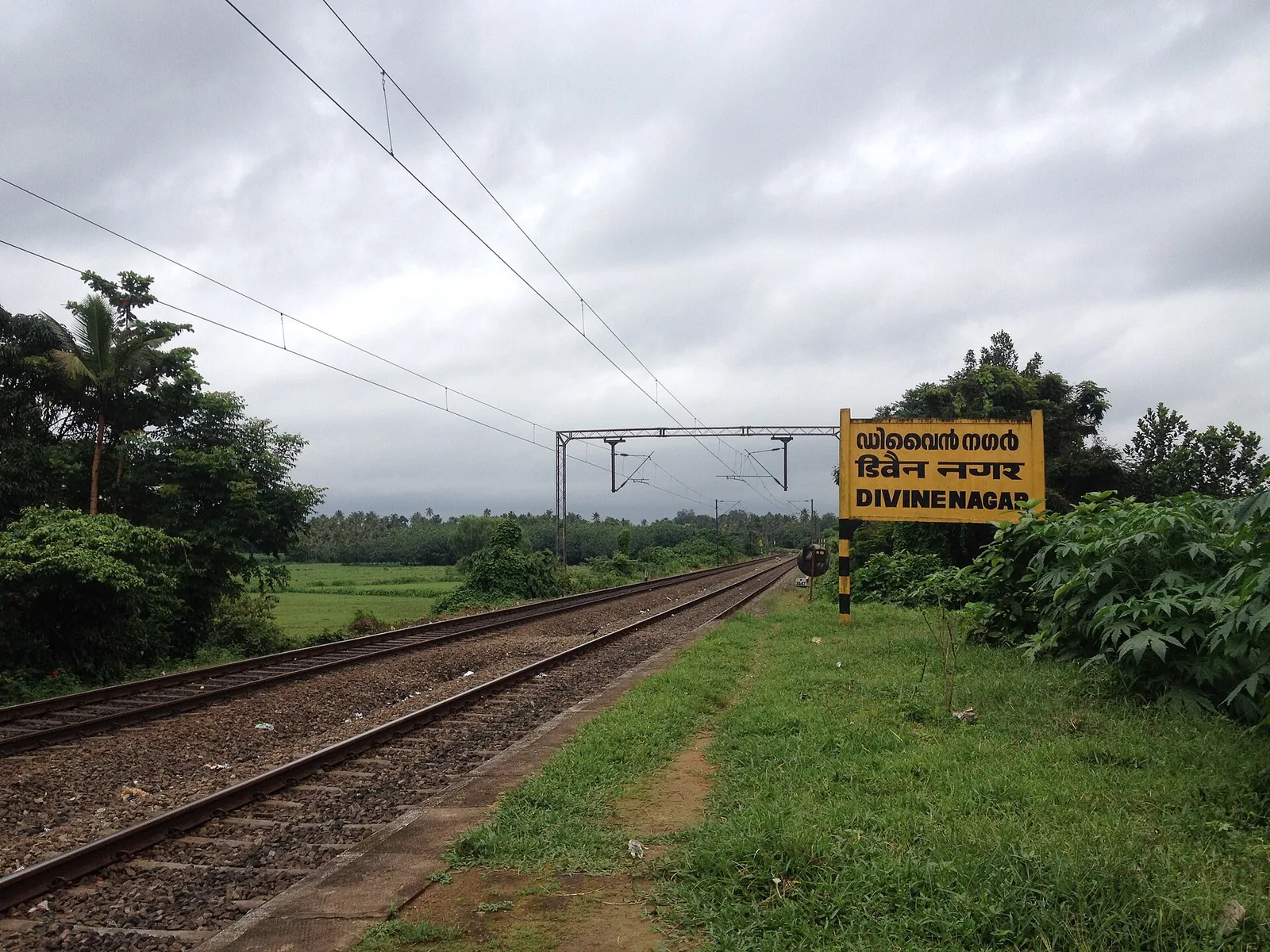
There is a yellow board on the Shoranur–Cochin Harbour line, between Chalakudi and Koratty, that reads ഡിവൈൻ നഗർ / डिवैन नगर / DIVINE NAGAR. It is not an old name. There was no Divine Nagar before there was a Divine Retreat Centre; the settlement, the halt and the name are all consequences of an institution that arrived in 1989.
A station that follows a congregation’s timetable
The halt carries the station code DINR and is a HG-1 class station in the Thiruvananthapuram division of Southern Railway. English Wikipedia records the detail that makes it unusual: “This railway station is cared for by a divine retreat center.” Two pairs of passenger trains and two pairs of MEMU services stop here daily — and one pair of express trains, the Netravati Express, halts on Fridays, Saturdays and Sundays “for the convenience of people travelling to the Divine Retreat Centre which is situated adjacent to the station”.
Read that stopping pattern against the retreat clock and it resolves into something almost mechanical. Retreats at the Muringoor Divine Retreat Centre end on a Friday and begin on a Sunday. An express that stops on Friday, Saturday and Sunday is stopping on the departure day, the turnaround day and the arrival day, and on no other day of the week. The Indian Railways timetable has been shaped, in this one small place, by a religious institution’s weekly cycle.
Why 1996 and not 1989
The campus opened in 1989 and the halt in 1996, and the seven-year gap is the interesting part. The English retreats began in 1991, the Divine Youth wing in 1995 with a first National Youth Retreat that drew over five hundred young people. The station arrives at the point where the intake stops being a Kerala intake. When people are travelling from Goa, from Bangalore, from Hyderabad and from the north, a road drop-off at a highway junction stops being adequate and a railway platform starts being necessary.
It also explains the shape of the place on a map. Malayalam Wikipedia’s article on Melur grama panchayat lists Muringoor’s notable features in a single breath: “the famous Divine Dhyanakendram is situated here. There are also the Divine Nagar railway station, a school, and a Chaldean church of a kind rarely found in Kerala.” A retreat house, its station, its school. That is a settlement built by an institution rather than one that acquired an institution.
The three ways in
The halt is the smallest of the three arrivals and by far the most legible. The main station is Chalakudi, code CKI, a kilometre or two north. The road is National Highway 544, which runs directly between the centre’s two campuses — a rare arrangement in which the retreat’s own internal geography is bisected by a national highway, and one reason the two campuses keep offset timetables. The airport is Cochin International at Nedumbassery, which Malayalam Wikipedia puts at 18 km from Muringoor: a retreat centre twenty minutes from an international airport is, again, not an accident of the 1980s but a fact the institution has grown into.
Malayalam Wikipedia gives Muringoor’s distance to Chalakudi station as 2.5 km by rail and 5 km by road, which is the sort of discrepancy that only makes sense in a place where the line and the highway diverge around a river bend. The centre gives its own distance from Chalakkudy town as about two kilometres.
The village that measures itself from it
The clearest evidence that Divine Nagar has stopped being a coinage and become a landmark is that the neighbouring villages now give their distances from it. Malayalam Wikipedia’s articles on Annanad, Kadukutty and Vadama all list, under how to get there, both the distance to Chalakudi station and the distance to “Divine Nagar Muringoor” — three kilometres, five kilometres and 10.6 kilometres respectively. A halt that opened in 1996 has been absorbed into the way four or five villages describe where they are.
Muringoor junction on the highway carries one other burden worth knowing about, because it explains some of the traffic. The Muringoor–Ezhattumugham public works road begins there, and Malayalam Wikipedia describes it as the easy route to the Athirappilly falls and to Ezhattumugham for anyone coming up from the southern districts. So the junction beside the retreat gate is simultaneously the arrival point for a week’s retreatants and a turning for waterfall traffic, which is a large part of why the stretch of NH 544 here behaves the way it does on a weekend.
What the picture actually shows
The photograph at the top of this article is worth looking at properly, because it is a corrective. There is no platform building in it, no crowd, no shrine and no gate. There is a board, a pair of electrified tracks, an overhead mast, wet paddy on the left and scrub on the right, under a flat grey monsoon sky. It was taken in July 2014, midweek. This is what the busiest religious arrival point in the taluk looks like on a day when nobody is arriving.
That gap — between the four days a week when the halt is a rural nothing and the three days when an express train stops at it — is the most accurate single image of the place we have found. The centre is not a permanently thronged shrine. It is a machine that fills and empties on a six-day cycle, and the infrastructure around it idles for the rest of the time.
The name
One last thing about the name, because place-names in Kerala usually run the other way. Muringoor is old: Malayalam Wikipedia records it as the western part of Melur panchayat and the northern part of Koratty panchayat, with a Cheenikkal Bhagavathi temple, a rare Chaldean church, and — a few hundred metres from the retreat gate — the hamlet of Kottamuri, named for the point at which Tipu Sultan’s army cut through the Nedumkotta. Divine Nagar sits inside all of that as a thirty-year-old coinage, and it is now the name on the railway board.
Maps acknowledge both names by labelling the station “Divine Nagar (Muringoor)” / ഡിവൈൻ നഗർ (മുരിങ്ങൂർ): the newer name first, the older one in brackets.
Frequently asked questions
What is the station code?
DINR. Divine Nagar is a HG-1 class station in the Thiruvananthapuram division of Southern Railway, on the Shoranur–Cochin Harbour section between Chalakudi and Koratty.
When did it open?
English Wikipedia dates the Divine Nagar halt to 1996, seven years after the Muringoor campus was acquired and five years after weekly English retreats began.
Which trains stop there?
Two pairs of passenger trains and two pairs of MEMU services daily. One pair of expresses — the Netravati Express — stops on Fridays, Saturdays and Sundays specifically for people travelling to the retreat centre, which matches the retreat cycle’s departure and arrival days.
Is Divine Nagar an old place-name?
No. It dates from the retreat centre, which acquired the Muringoor property in 1989. The older name is Muringoor, and maps retain both in the label “Divine Nagar (Muringoor)”.
What is the main railway station for the centre?
Chalakudi, code CKI, a short distance north. Malayalam Wikipedia gives Muringoor to Chalakudi as 2.5 km by rail and 5 km by road. Cochin International Airport at Nedumbassery is about 18 km away.