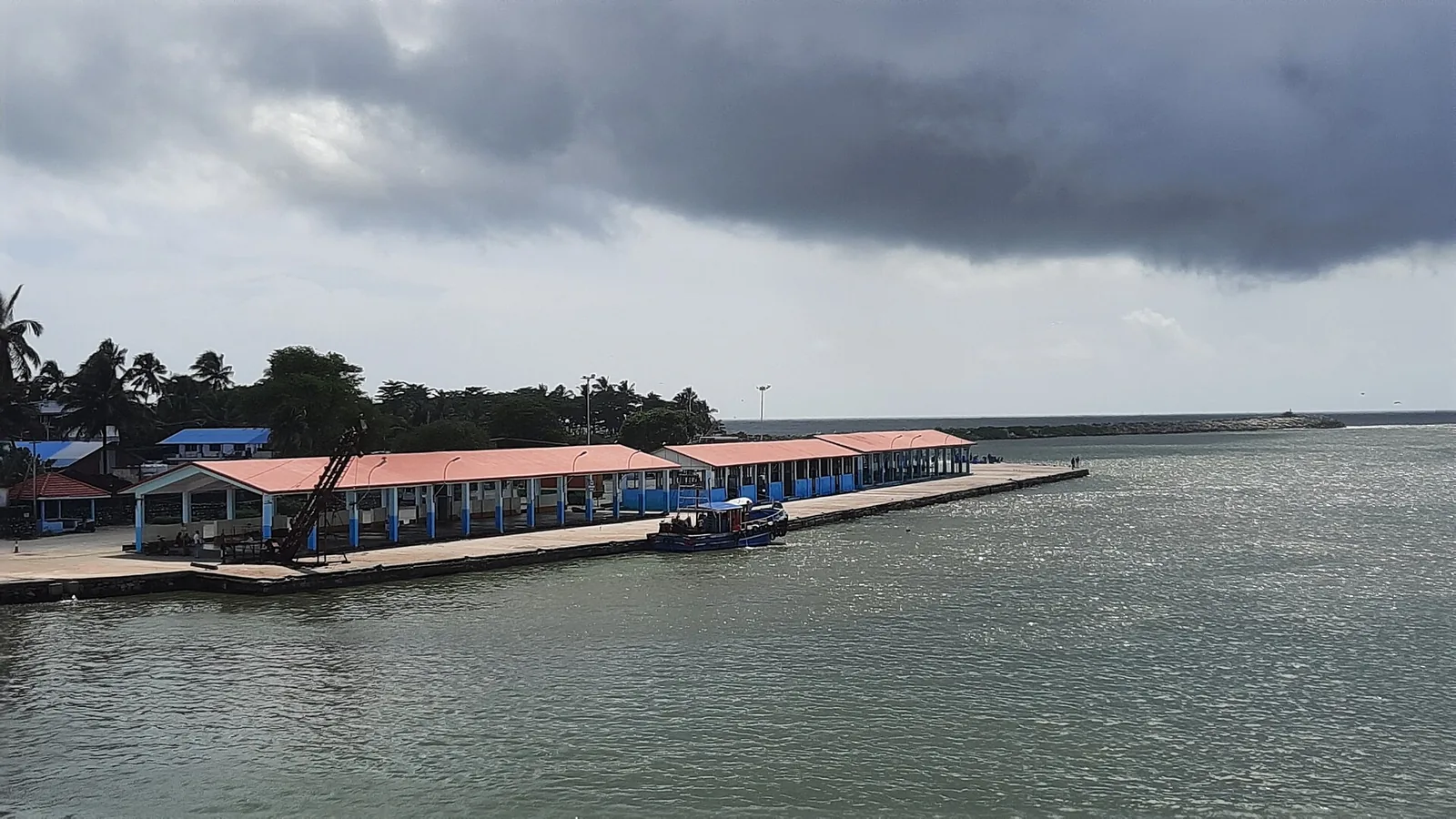
Every year the mechanised fleet at Neendakara stops fishing for fifty-two days and the quay goes quiet. The ban is now routine — dates announced, free rations issued, traditional inboard vessels exempt. In 2024 it ran from 9 June to 31 July.
It took seven years of agitation, thousands of arrests and an indefinite hunger strike to get there. And twice, at the crucial moment, this harbour was let off.
Why a ban at all
Because of what started here. The switch to harbour-based mechanised vessels chasing shrimp for export took off from 1960, and the FAO’s Kerala case study gives the consequence in one sentence: in a little over a decade, a sharp decline in fish harvests followed as a result of ecosystem damages caused by unregulated and excessive trawling for shrimp.
The monsoon is when many species spawn. A closed season in June, July and August is the simplest available intervention, and it is the one the traditional fishworkers’ organisations spent the 1980s demanding.
1981: ten days
The first monsoon trawling ban order in Kerala is dated 24 May 1981.
Within about ten days a relaxation was made for the Neendakara area — which had the largest concentration of mechanised boats in the state. AJ Vijayan, a founder of the National Fishworkers’ Forum, says the order was withdrawn after protests from trawl owners in Kollam.
On 12 June 1981 fifty fishworkers of the Kerala Swatantra Malsya Thozhilali Federation forced their way into the office of the Director of Fisheries and were arrested.
An expert committee on the conservation of marine fishery resources was set up under D. Babu Paul the same year. It reported on 21 July 1982, and its recommendations were not unanimous. A later committee chaired by N. Balakrishnan Nair recommended a total ban on trawling by all types of vessels in the territorial waters of Kerala during the months of June, July and August.
The agitation
What followed is one of the larger sustained environmental protests in Indian history and is almost unknown outside Kerala.
In 1984 there was mass agitation, with over 7,000 fishermen arrested and women picketing highways. Between 25 May and 9 June 1985 came the “fill the jail” campaign, in which around 220 fishworkers served prison terms. On 23 July 1985 more than 10,000 people marched on Neendakara itself and picketed the Fisheries Port Office. All were arrested.
In 1988 there were marches in seven districts, Father Thomas Kocherry began an indefinite fast, and over a thousand people picketed the capital’s harbour.
1988: exempted again
A ban on monsoon trawling was announced — reportedly on 23 June 1988 — with an exemption for Neendakara.
A caution on sourcing, since precision matters here: the ten-day relaxation of 1981 is attested in two independent accounts, and the fact of a Neendakara exemption in 1988 is reported, but the exact 23 June date comes from a single secondary source. Treat the exemptions as well attested and the specific date as single-sourced.
The same year Kerala became the first Indian state to impose a monsoon trawl ban. CMFRI records it flatly: the Government of Kerala imposed a trawl ban from 1988 onwards along the entire coast line of the state. In 1989 the Chief Minister declared the ban for the period from 20 July to 31 August in the entire state.
The shape of the thing
Read the sequence and a pattern emerges that is not about villains. The harbour with the most mechanised boats was also the harbour with the most to lose from a closed season, the most organised owners, and the loudest voice in the room. Twice it got the carve-out. It took a decade of people going to prison to close it.
There is also a symmetry worth noticing. Neendakara is where the boats came from in the first place — where a foreign aid project abandoned beach fishing in 1960 and put the fleet into shrimp instead. The harbour that created the problem was the last one required to stop.
What you see now
During the ban the quay is empty and the hall stands open and unused. If you arrive in late June and find nothing happening, this is why, and it is not a wasted trip — an empty auction hall with the breakwater running out behind it is a clearer photograph of how this harbour works than a crowded one.
The 1994 Supreme Court judgment in the long-running trawl-ban litigation exists and is on the record, but we have not opened it and will not characterise it.
Frequently asked questions
When is the Kerala trawl ban?
It now runs 52 days, reduced from an original 60. In 2024 it ran from 9 June to 31 July. Dates are set annually — confirm locally before planning a visit around it. Traditional inboard vessels are exempt and free rations are issued to fishworkers during the ban.
Was Neendakara really exempted from the ban?
Twice. The 1981 ban order of 24 May was relaxed for the Neendakara area within about ten days, after protests from Kollam trawl owners. And the 1988 ban was announced with an exemption for Neendakara. The 1981 relaxation is attested in two independent accounts; the exact date of the 1988 announcement comes from a single secondary source.
Why does the ban exist?
Because of the pressure that the shrimp trawling begun here put on inshore stocks. The FAO’s Kerala case study records that in a little over a decade a sharp decline in fish harvests followed as a result of ecosystem damages caused by unregulated and excessive trawling for shrimp. The monsoon is a major spawning season.
Who campaigned for it?
Traditional fishworkers’ organisations, chiefly the Kerala Swatantra Malsya Thozhilali Federation and the National Fishworkers’ Forum. Over 7,000 were arrested in 1984; around 220 served prison terms in the 1985 “fill the jail” campaign; more than 10,000 marched on Neendakara on 23 July 1985; and Father Thomas Kocherry began an indefinite fast in 1988.