Ask what the Indo-Norwegian Project built at Neendakara and you will be told: boats. Mechanised fishing, trawlers, the shrimp trade, the making of modern Kerala fisheries. All of that is true, and most of it is a story about something that went wrong and was rescued by accident.
The parts that worked are less photogenic. They are a pipe factory, a water main, about twelve hundred latrines and a hospital.
What the agreement actually said
The Kerala Museum’s reconstruction of the 1953 agreement lists four goals, and they are worth reading in order. To help fishermen earn more. To make sure fresh fish was distributed efficiently and to improve fish products. To better the health and sanitary conditions of people in the fishing communities. To raise the overall quality of life in the project area.
Two of the four are public health. One is marketing. Only the first is about catching fish at all.
The marketing officer of NIFPHATT, Varghese John, put it to interviewers plainly: for the Norwegians, more than fishing, it was a community development programme.
The area, and why it was chosen
The project area was about 25 square kilometres holding roughly 12,000 people and around 400 fishing vessels, across Neendakara, Sakthikulangara and Puthenthura. The villagers were poor but fit the criteria of requiring socio-economic development — which is a sentence that repays a second reading, because it describes a place chosen to be helped rather than a place that asked.
The first director was D. H. Lund. His Indian counterpart official was P. T. Koshy. For its first decade the work concentrated on Sakthikulangara and Neendakara.
The pipe
The project built a pipe factory — Primo Pipes — and laid a water main from Sasthamcotta to Kollam.
That is worth stopping on. Sasthamcotta is Kerala’s largest freshwater lake, about 25 kilometres inland, spring-fed and sweet where almost every other body of water on this coast is brackish. It is a Ramsar site, and it is the principal drinking-water source for the Kollam region. The physical link between an inland lake and this fishing village at the sea mouth was built by a Norwegian fisheries aid project.
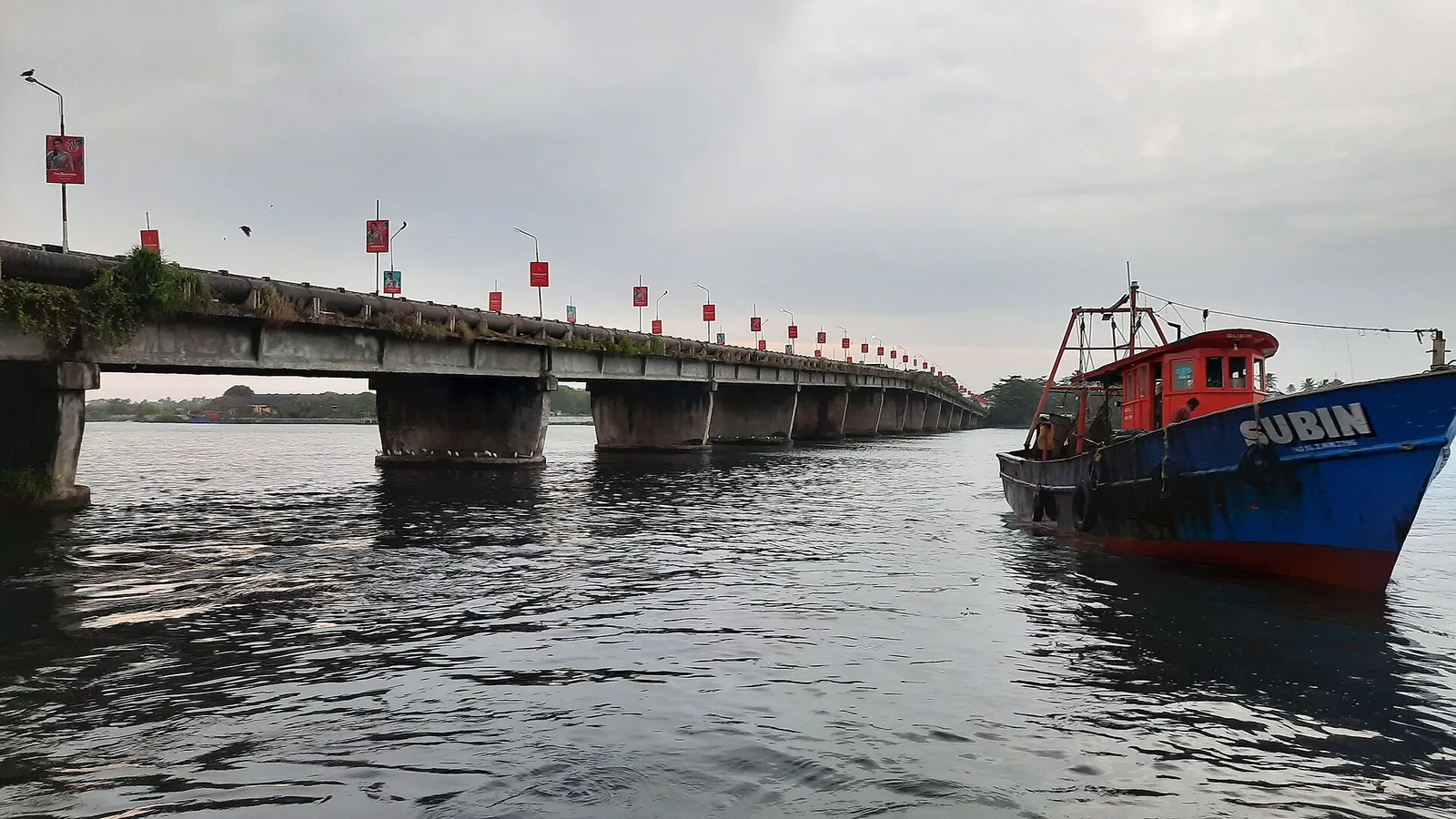
A large pipeline runs along the flank of the old 1972 bridge at Neendakara, plainly visible in photographs, and Wikimedia Commons categorises the bridge under pipeline bridges in India. Whether the pipe you can see there today is that original line, we could not establish, and we are not going to claim it. What is documented is that the project laid a Sasthamcotta–Kollam main.
The latrines, the clinics and the nurses
The sanitation work was done by inspection and construction: the project carried out a sanitation survey and built about 1,200 latrines in the villages.
Alongside it came doctors and health practitioners from Norway, a health centre at Kollam running two clinics — one for children, one for pregnant women — trained midwives and public health nurses making home visits, free medicines, milk powder and vitamins, and vaccination against smallpox and tuberculosis.
This is the half of the Indo-Norwegian Project that does not appear on any travel page about Neendakara, and it is the half that is still standing.
The hospital is still the hospital
What began as the Foundation Hospital is today the Neendakara Taluk Hospital, under Trivandrum Medical College. It is not a ruin, a plaque or a museum. It is a working government hospital, and it is the single most checkable thing in this entire story: you can go and look at it.
A staff member interviewed on 19 September 2023 gave a line that carries the whole arc without editorialising: the hospital ran well when the Norwegians were here — there were specialists for children and women.
And the boats
For completeness, because the contrast is the point. Sixty new boats were built at Kollam. Motors fitted to canoes proved more expensive, needed far more maintenance and were less seaworthy than the traditional canoes in the shallow, rough water close to the coast. A new flat-bottomed motorboat was designed at a purpose-built yard and did not convince the local fishermen either. The cooperative marketing model, imported from 1930s Norway, did not transfer. After intensive experiments, the project gave up trying to modernise the beach fisheries in 1960.
Three Norwegian schooners arrived in January 1955; one was converted into the research vessel Varuna, which covered nearly 135,000 nautical miles and took some 3,000 oceanographical stations over four years. That part was real science and it lasted.
So the ledger reads roughly like this. The fisheries modernisation that the project came to do was abandoned after seven years. The oceanography, the hospital, the water main and the latrines are all still there in some form. And the thing Neendakara is famous for — a harbour-based mechanised fleet fishing shrimp for export — was the fallback plan.
Frequently asked questions
What were the Indo-Norwegian Project’s stated goals?
Four, per the Kerala Museum’s reconstruction of the 1953 agreement: to help fishermen earn more; to distribute fresh fish efficiently and improve fish products; to better health and sanitary conditions in the fishing communities; and to raise the overall quality of life in the project area. Two of the four are public health.
What did the project build that still exists?
The hospital it founded is now the Neendakara Taluk Hospital, under Trivandrum Medical College. It also built the Primo Pipes factory, laid a water main from Sasthamcotta to Kollam, and constructed about 1,200 latrines. The research vessel Varuna, converted from a Norwegian schooner, ran four years of oceanographic work.
Is the pipeline on the Neendakara bridge the original Norwegian water main?
Unverified, and we are not going to claim it. A large pipeline is clearly visible along the flank of the old 1972 bridge and Commons categorises the bridge under pipeline bridges in India. That the project laid a Sasthamcotta–Kollam main is documented; that this is that line is not.
Who ran the project?
The first director was D. H. Lund; the first Indian counterpart official was P. T. Koshy. The project area covered about 25 sq km with roughly 12,000 people and around 400 fishing vessels, across Neendakara, Sakthikulangara and Puthenthura.