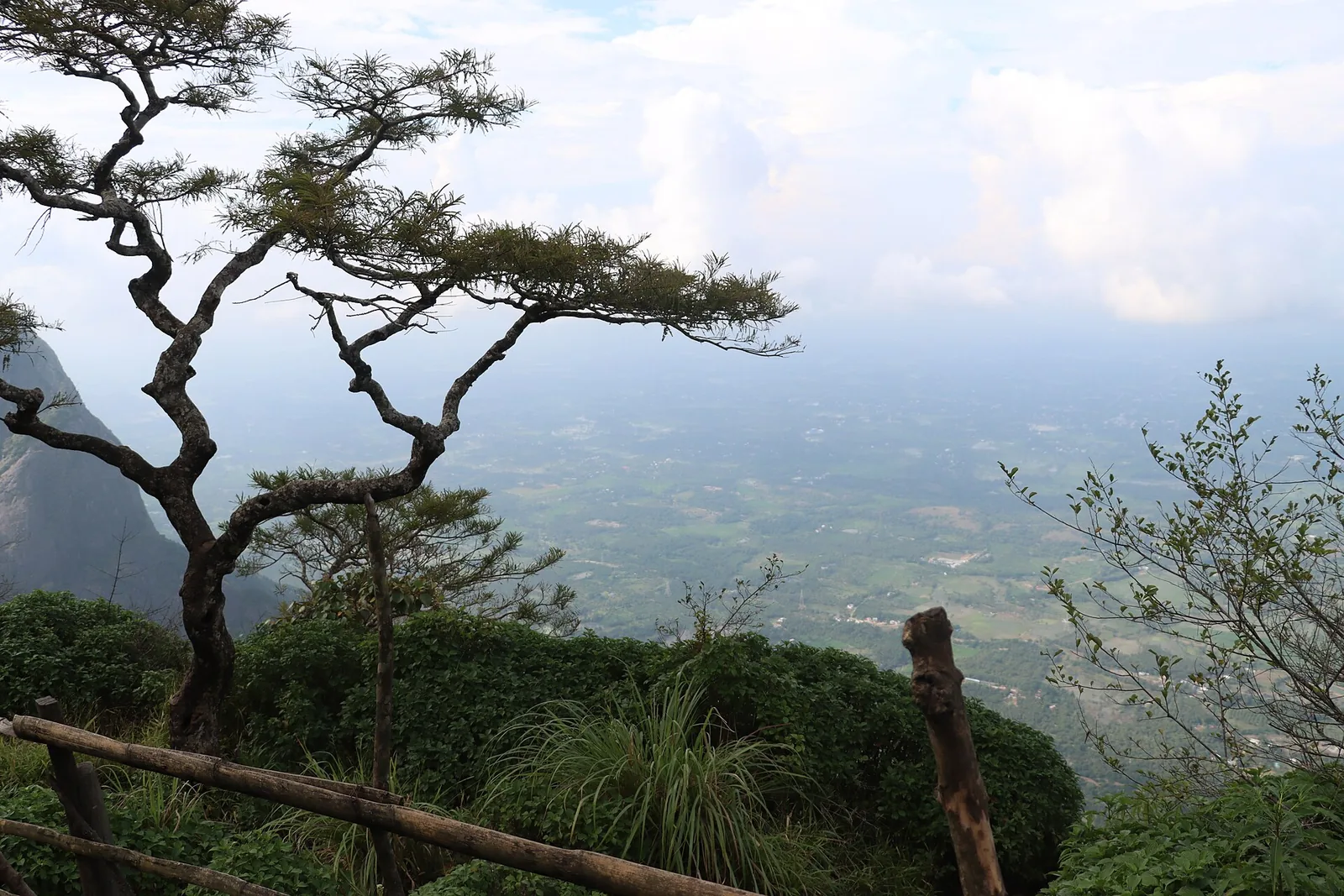
The road up to Nelliyampathy does not so much climb as coil. Leaving the hot paddy flats of Palakkad behind, it folds back on itself again and again — a dozen or so true reversals threaded through evergreen forest, and a great deal more curve besides — until the air turns cool, the light goes soft, and a range of estates opens up where oranges, tea and coffee grow side by side on the same slope. Locals call it the poor man’s Ooty. The name undersells it.
Ten bends up from the plains
Nelliyampathy is not a single peak but a range of hills in the Sahya (Western Ghats) ranges of Palakkad district, spread across altitudes from roughly 467 to 1,572 metres above sea level. The usual approach begins at the town of Nenmara and runs a scenic ghat road of about 25 kilometres, negotiating at least ten hairpin bends as it winds through dense evergreen forest. From the town of Palakkad it is around 52 kilometres. The climb is the point as much as the destination: at several turns the forest parts to reveal the paddy fields of the plains laid out like a green carpet, and a clear view of the Palakkad Gap, the great natural break in the Western Ghats that lets the winds — and once the trade routes — pass between Kerala and Tamil Nadu.
The reservoir on the way up
Before the real climbing begins, the road from Nenmara passes the Pothundy dam and its reservoir, sitting in a bowl of low hills at the foot of the range. The water is a popular halt — there are boating facilities and it makes an easy picnic stop — and it marks the moment the journey shifts from farmland to forest. Many travellers pause here to look back at the plains before the switchbacks swallow the view and carry them into the hills proper.
A hill station the planters made
Like so many of South India’s hill stations, Nelliyampathy was developed as a retreat during the British colonial era, prized for a climate that offered escape from the heat of the plains. But its deeper story is agricultural. Over the past century and a half, tea, coffee, cardamom, orange, pepper and vanilla plantations have been woven into the mountain ecosystem, and that planting history is what gives the range its distinctive patchwork of estate and forest. The temperature here is gentle year round — from about 15°C in December to 30°C in April, averaging around 22°C — the kind of weather that made planters, and later tourists, want to stay.
The estate that grows almost everything
The heart of the range is the Poabs Organic Estates, also known as the Seethargundu Estate, spread across the hills in Chittur taluk. It is described as the largest perennial multi-crop organic plantation in India, growing both arabica and robusta coffee alongside tea, with inter-crops of pepper, cardamom and orange. The land was first planted with arabica coffee and cardamom; over a roughly hundred-year working history, old coffee bushes were replanted with new varietals and tea was introduced as an additional crop. The result is unusual — a single organic estate where mandarin oranges ripen on the same hillside as tea bushes and coffee, all of it slowly grown into the surrounding forest rather than carved out of it.
Seethargundu and the legend of Sita’s rock
The signature stop is Seethargundu, a viewpoint five kilometres by road above the Nelliyampathy settlement that drops away into a vast valley of tea, coffee and cardamom fringed by tropical forest. The name is where the range keeps its oldest story. According to legend, the word Seetharkundu means “Sita’s rock,” and tradition holds that during their exile Rama, his brother Lakshmana and his wife Sita rested at this spot; the story goes that Sita offered prayers here and bathed in the stream that falls away into the valley, which is why many still regard the water as sacred. It is a legend, not a chronicle — but standing on the edge with the wind coming up off the drop, it is easy to see why the place attracted a story worth keeping.
Where you can see two states
For the widest views, trekkers head deeper into the range. A community hall at Kaikatti serves as a base camp, and from there a trek to Mampara peak — about 20 kilometres from Nelliyampathy — opens onto a panorama of the entire Palakkad range: valleys, forest and paddy fields spread below. On a clear day the sightline reaches astonishingly far, taking in a string of dams across the plains and, beyond the Palakkad Gap, parts of neighbouring Tamil Nadu, including towns like Pollachi, Coimbatore and Mettupalayam. Elsewhere the estate boundary is marked by the Raja’s Cliff, a natural rampart from which the plains and the town of Palakkad appear on a clear morning.
The forest still belongs to the elephants
For all the tidy rows of tea, Nelliyampathy sits within a reserve forest, and the wild edge is never far. Elephants move through the range, along with leopards, sambar deer and bison, and the plantations share their slopes with genuinely dense Western Ghats forest. This is part of what keeps Nelliyampathy quieter and greener than the better-known hill stations — it has stayed a working landscape of estates and jungle rather than a resort town, and the animals that were here before the planters arrived have never entirely left.
Why they call it the poor man’s Ooty
The nickname is affectionate and widely used — a nod to the fact that Nelliyampathy delivers the mist, the plantations and the cool climate of a grand hill station without the crowds, the traffic or the price of one. What it trades in scale it makes up for in intimacy: a handful of viewpoints, a scatter of estate bungalows, and long stretches of road where the only company is forest. The best months to visit run from September to January, after the heavy monsoon rains of June to September have washed the hills a deep green.
Visiting Nelliyampathy
Reach Nelliyampathy via Nenmara, taking the ghat road that climbs past the Pothundy dam and doubles back on itself the whole way up — drive it slowly and in daylight, both for the bends and for the viewpoints along the way. Base yourself around the estates for Seethargundu, Kaikatti and the Mampara trek, and plan for cool evenings even in summer. For where it sits in the district and what else is nearby, see the Palakkad hub, then let the road do the rest of the storytelling.
Frequently asked questions
How many hairpin bends are on the road to Nelliyampathy?
It depends what you count as a hairpin, which is why the published figures run from ten to twenty-three. On the mapped road there are about a dozen genuine reversals between Pothundy dam and the settlement — twenty kilometres and roughly half an hour — with a great deal more curve besides.
What does the name Seethargundu mean?
According to legend the name means “Sita’s rock.” Tradition holds that Rama, Lakshmana and Sita rested here during their exile and that Sita bathed in the stream below — a legend rather than recorded history, but one long attached to the viewpoint.
When is the best time to visit Nelliyampathy?
September to January is generally considered the best window, once the heavy monsoon rains of June to September have passed. Temperatures stay mild through the year, from about 15°C in December to 30°C in April.