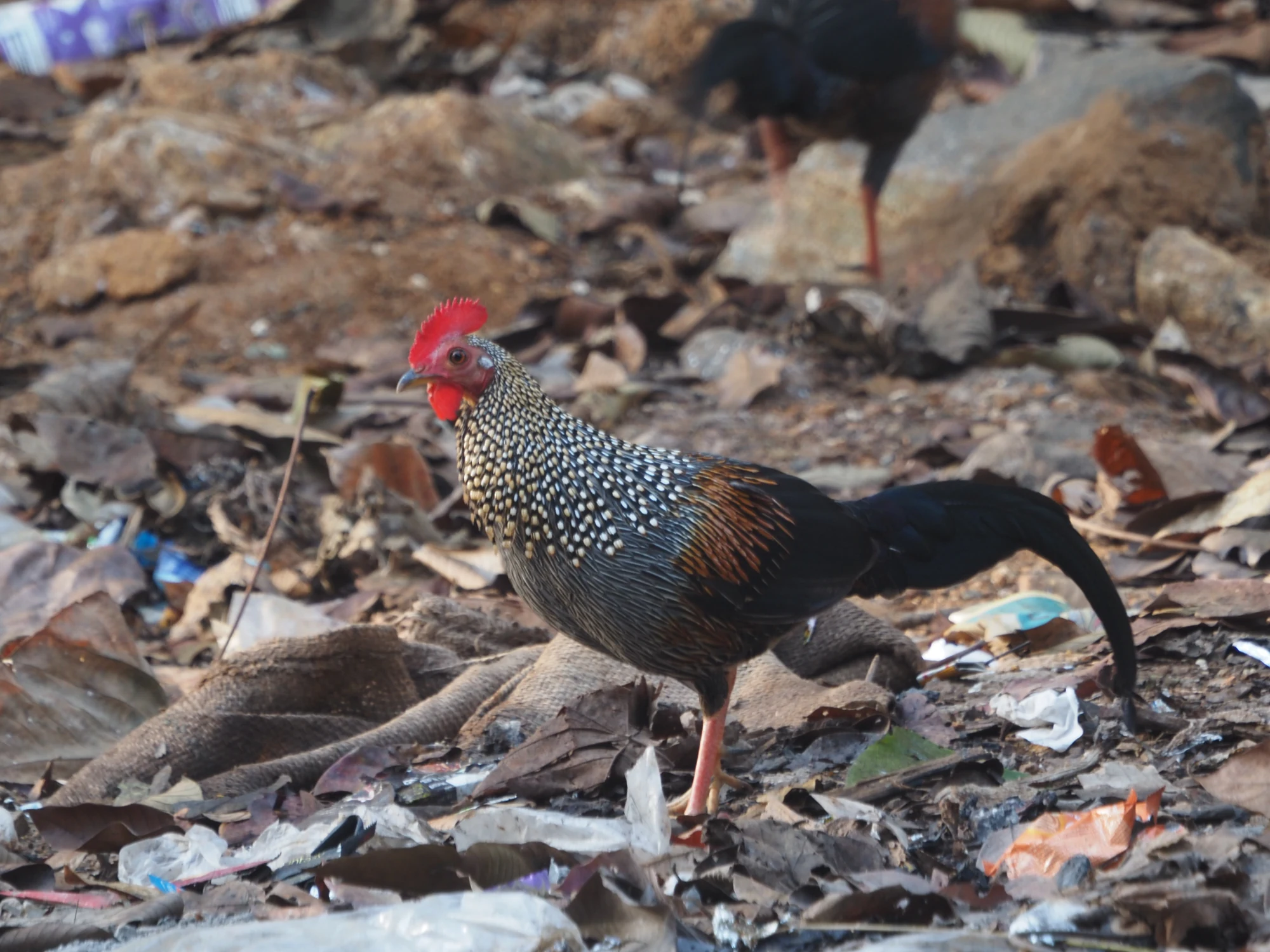
A grey junglefowl among roots and fallen leaves is a small scene beside Nilackal’s much larger pilgrimage activity. In the same photograph, discarded plastic lies on the ground. The frame brings wildlife and visitor waste into one view, making an otherwise broad environmental concern immediate and local.
A forest setting beside a busy arrival base
Nilackal’s parking and pilgrim services sit within the wider forest-edge landscape of the Sabarimala journey. Large numbers of people pass through the base, carrying food, offerings and travel supplies. The ground beyond a stopping area is therefore not separate from the consequences of what is left behind there.
Roots, leaf litter and discarded packaging occupy the same small patch of ground around the junglefowl. The bird’s presence makes the meeting of wildlife habitat and pilgrimage activity immediate. Waste left around developed areas remains within reach of animals moving through the forest edge, even when the surrounding trees make a stopping place appear separate from the camp.
Nilackal is part of the waste-handling chain
Writing in the Forest Department’s June 2025 Aranyam, the Goodrical Range Forest Officer describes waste collection at Nilakkal and Pamba and the work of eco-guards along the forest-road corridor. The account identifies food-contaminated plastic as a danger to animals and makes prevention an important part of the response.
The government’s Sabarimala instructions also describe Mission Green Sabarimala and Suchitwa Mission activity at Nilakkal. Collection, separation and onward handling require organised work; leaving packaging beside a tree does not make it available to that system. Use the collection arrangement indicated at the place where you stop.
A cloth bag has a local story
A December 2024 Local Self Government Department report describes Kudumbashree’s Saree Challenge for the pilgrimage season. Households supplied suitable cloth, stitching units made reusable bags, and distribution included Suchitwa Mission counters at Nilakkal and Chengannur. The initiative connected everyday fabric reuse with the needs of a heavily travelled pilgrim route.
That history gives a concrete alternative to treating every purchase as another disposable carry bag. Bring a reusable bag for the journey and follow the current restrictions on what can be carried onward. A campaign report from one season does not guarantee that a distribution counter will supply a bag on every future visit.
Food waste deserves the same attention as packaging. Keep it within the designated collection system and do not feed birds or other animals beside the parking area. A close wildlife encounter created by food changes the animal’s behaviour and brings it into the movement of people and vehicles.
Nilackal’s temples, church and transport role can dominate the visit, but the forest edge remains present around them. Noticing a bird, a web or roots beside the path can make that setting visible. Keeping waste out of it is part of visiting this particular place well, supported by the local work already devoted to collection and reuse.
Sources: Government Sabarimala instructions, the Forest Department’s June 2025 Aranyam, and Kudumbashree’s Saree Challenge.
Plan the visit: Nilackal.