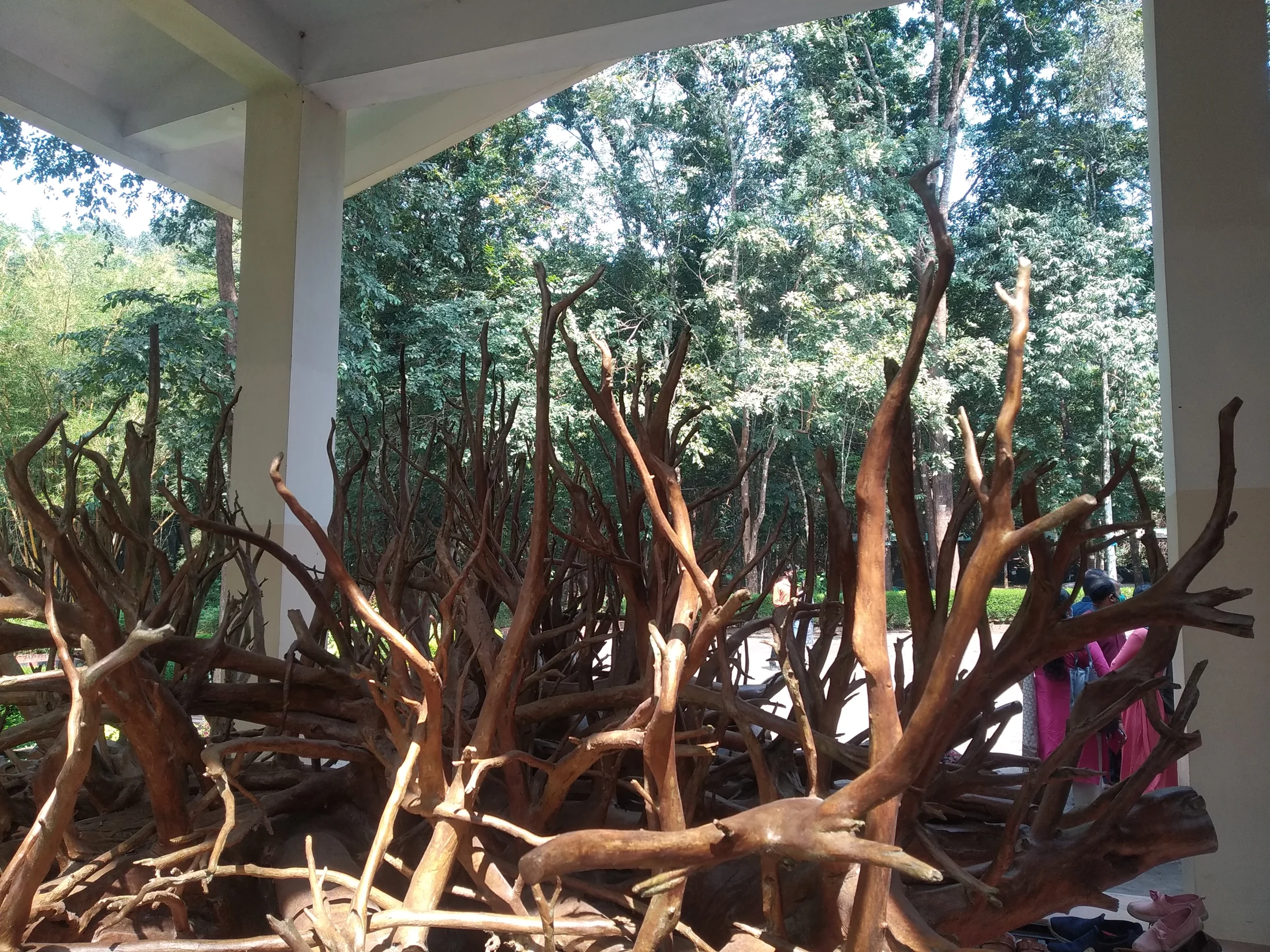
The first large teak exhibit at Nilambur is a reversal of an ordinary forest view. Outside, a trunk disappears into the ground and its roots remain hidden. In the museum portico, the roots themselves occupy the visitor’s field of vision. They branch across the space between the columns, with the living greenery of the campus visible behind them.
A branching structure at human scale
KFRI identifies the exhibit as the root system of a 55-year-old teak tree. That figure describes the tree associated with the collected specimen; it is not the age of the museum or a claim that the wood is still growing. The specimen makes the below-ground form available for observation in a way that a standing tree cannot.
Begin with one of the thicker pieces and follow it with your eyes towards the smaller divisions. The form repeatedly changes direction and thickness. Light picks out some surfaces while others disappear behind neighbouring roots. From a different position, openings appear between the branches and the arrangement becomes less like a solid mass. There is enough to look at without touching or climbing it.
Why the museum begins below ground
A timber museum could open with a polished board or a finished piece of furniture. This entrance asks the visitor to begin earlier in the material’s story. The tree had an entire living structure before its wood became an exhibit. Setting the roots beside the doorway makes that biological origin hard to overlook when entering the galleries of wooden objects and plantation history.
The surrounding columns also provide scale. A photograph of roots alone can resemble an abstract wooden sculpture; the building and people around the specimen show how much space it occupies. When photographing it, including part of the portico helps explain what the viewer is seeing. A close detail can then explore the surface or branching pattern without pretending to show the whole specimen.
Carry the question into the galleries
The exhibits inside break teak into other forms: foliage, flowers, fruit, bark, timber sections and objects made from wood. Each shows a different part or use of the same species. The root display is a useful starting point because it encourages a visitor to ask what is missing from any single view. A log does not show the crown; a leaf does not show the tree’s eventual dimensions; a finished object conceals much of the work that produced its raw material.
The science floor develops the story through propagation and growth. Returning mentally to the roots helps connect these smaller exhibits with a mature tree. Seed treatment and nursery work concern the beginning of a process whose later scale is visible in the portico. That connection is particularly useful for a family visit: compare the smallest displayed stage with the largest specimen rather than trying to memorise every label.
Return to a standing tree outside
The garden offers the final comparison. Observe where a living trunk meets the ground, staying on the path and leaving soil and roots undisturbed. Most of the structure that supports it is out of sight again. The museum has supplied a view that the garden cannot, while the standing trees restore the root specimen to the larger idea of a growing organism.
Sources: KFRI’s Teak Museum collection and the institute’s illustrated museum brochure.
Plan the visit: Nilambur Teak Museum.