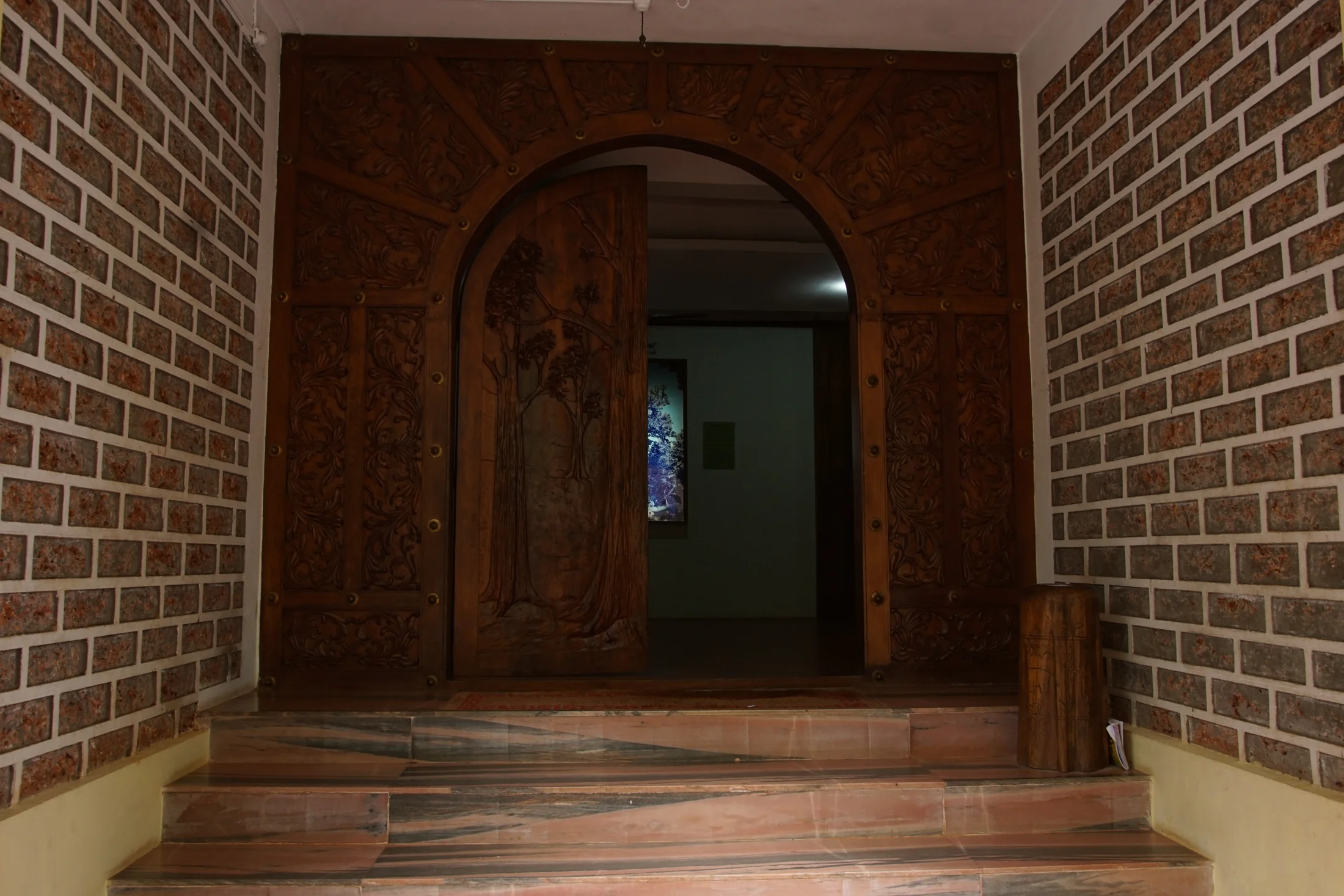
The entrance to Nilambur Teak Museum is already an object lesson. A carved timber surround rises above the steps, its curved opening bordered by foliage patterns. The door panel carries tree forms. Before reaching a display case, the visitor sees teak presented as a surface that can hold both structure and ornament.
Read the doorway before walking through
Look at the difference between the broad frame and the carved detail within it. The frame defines the opening; the relief gives the surface a second purpose. Branches and leaves are represented in wood, linking the material to the tree from which it came. The effect suits a museum where a species is considered through both its living form and its uses.
The doorway is also a reminder to look at the museum at more than one distance. From the garden, its roof and facade form a building among trees. Close to the entrance, lettering, joints and carved surfaces become the subject. Give other visitors room to pass while examining the details, and use the visible carving as a starting point rather than treating the threshold as a place to pose on the steps.
From storage to the sea
KFRI describes historical and artistic exhibits on the ground floor, including a granary and a model of an uru, the wooden vessel associated with Kerala’s maritime craft. These objects put teak into different settings. One concerns the storage of a harvest on land; the other represents a vessel built for movement on water. Their different forms make the same material serve different requirements.
A useful way to read these displays is to ask how each object is assembled. Notice where surfaces meet, where a frame carries another part and how a curve differs from a flat panel. A museum model makes the overall form easier to see, but it should remain clearly identified as a model. It does not imply that a full-size historic vessel is housed in the building.
The dimensions behind the object
The collection also includes timber sections and material associated with plantation thinning. These connect craftsmanship to the size and condition of the wood available. A finished object can make its material seem inevitable; the plantation displays restore the earlier questions of growth, tending and selection. The museum’s interest is therefore wider than admiring a polished surface.
Large-tree representations offer another comparison. KFRI identifies a life-size replica of a notable Malayattoor trunk and an illuminated representation of Kannimara teak. These communicate scale without claiming that the living trees have been brought to Nilambur. Read their labels alongside the smaller objects: a huge trunk and a carefully made container tell different parts of the story of how people value wood.
A history of use as well as beauty
The museum opened in a town closely associated with plantation forestry. Its object displays belong beside that history because demand for useful timber helped give cultivation its purpose. The galleries allow visitors to move between the finished work and the much slower process of growing a tree. Neither view is complete alone.
On leaving, the carved entrance looks different. It is no longer simply an attractive doorway: it joins the standing trees outside, the growing methods upstairs and the wooden objects on the ground floor. That is a satisfying route through a museum devoted to one species—follow the material through several forms, and notice what each form makes possible.
Sources: KFRI’s Teak Museum collection and the institute’s illustrated museum brochure.
Plan the visit: Nilambur Teak Museum.