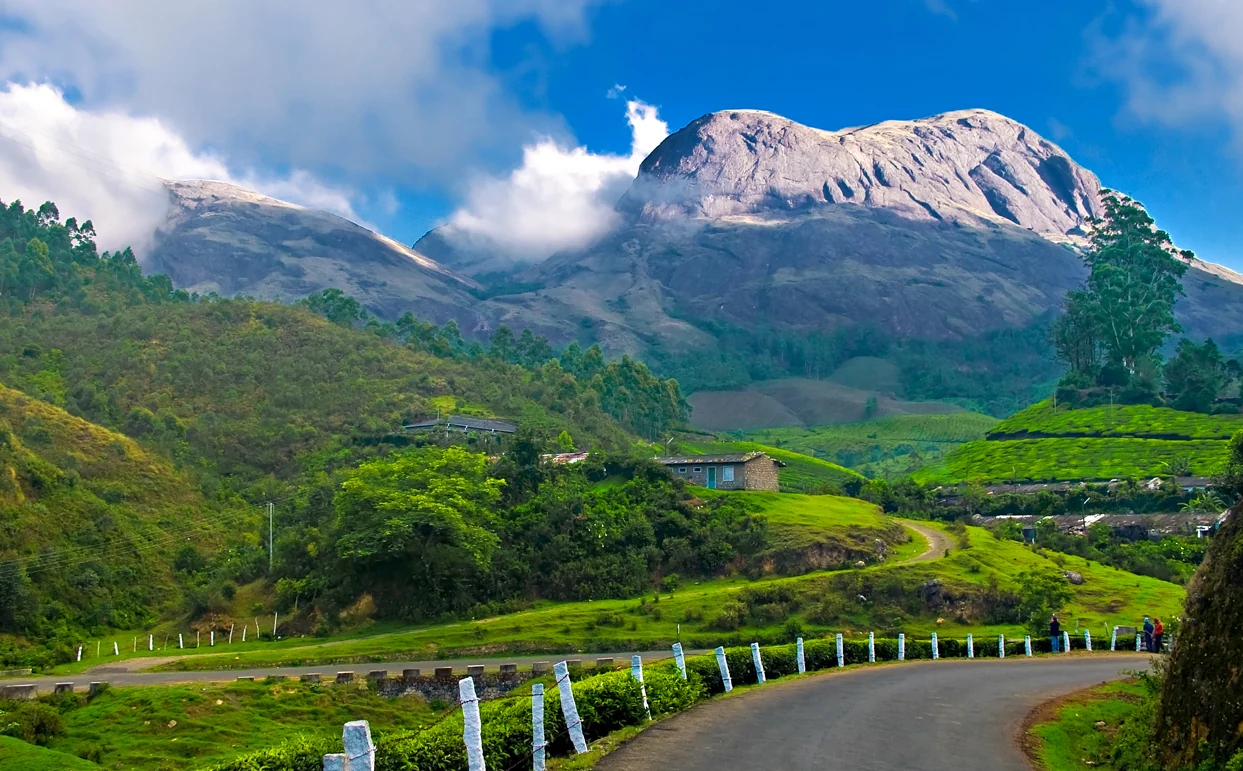
The northern road out of Munnar opens towards a high mountain landscape around Nyayamakad. In the photograph, Anamudi rises beyond the nearer cultivated ground, giving the estate setting a backdrop much larger than the immediate stream. It is a view of a mountain within a road journey, not the start of a summit climb.
Foreground and skyline
The nearer tea landscape and the distant mountain belong to different visual scales. Planting makes the lower slopes finely patterned, while the mountain’s broad surface and outline dominate farther away. Looking between them helps explain why a short road stop can feel connected to the wider high ranges.
The photograph’s source identifies Anamudi from the Nayamakad road. That is a specific camera perspective. It should not be turned into a promise that the same mountain outline is visible from every point called Nyayamakad, especially when cloud covers the higher ground.
A waterfall-focused visit can therefore contain several subjects: the stream near the road, the estate landscape and, in suitable visibility, a distant mountain backdrop. Each can be enjoyed without claiming that the whole landscape is reached by one public trail.
Keep Eravikulam separate
Eravikulam National Park has its own visitor arrangements. A road-side stop in the Nyayamakad locality does not replace its reporting process or include permission to walk towards Anamudi. The national park’s designated visitor experience should be planned through its own official information.
The distinction prevents a common itinerary mistake: adding a famous mountain name to a waterfall stop and assuming the two can be visited in the same way. Seeing the mountain, entering a permitted area of the national park and climbing a summit are different activities.
If an Eravikulam visit is part of the day, establish that booking first. The road stop can then fit around the actual reporting arrangement, with enough flexibility for traffic and visibility rather than an invented minute-by-minute transfer promise.
Observe from the road journey
The terrain is most legible when attention moves slowly across it. Notice where tea ends in the visible frame, where the surface becomes rougher and how the upper outline meets the cloud. Avoid assigning names to distant features simply because they resemble a familiar photograph.
A safe stopping position matters more than obtaining an identical angle. Narrow roads and passing vehicles can make a promising gap unsuitable for a group to stand beside. Let the driver choose an appropriate place, and keep the view within the permitted roadside area.
Nyayamakad’s mountain context adds depth to the waterfall locality. It shows how a small stream-side scene sits within a much larger high-range landscape, while keeping the separate destinations and their access rules clear.
Plan the visit: Nayamakad Waterfalls.