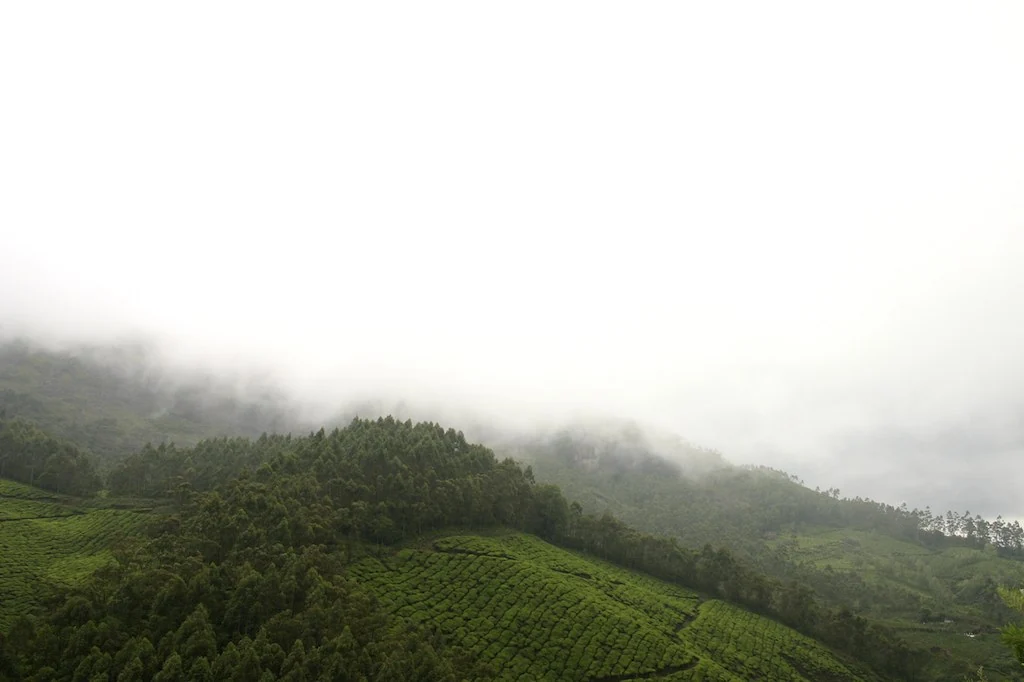
Mist changes the Nyayamakad approach before the water itself becomes the subject. Tea-covered slopes lose their far edges, trees emerge as darker shapes, and the road journey narrows to the ground immediately ahead. The photograph heading this story records that estate landscape near the approach, rather than presenting a close-up of the waterfall.
What the approach can reveal
A misty tea slope is useful context because Nyayamakad sits within cultivated high-range terrain. The planting continues around streams and roads, creating a landscape where natural drainage and estate work occupy neighbouring ground.
The image should be read at that scale. It shows the approach’s atmosphere and pattern, not the exact height or flow of the falls. A tightly framed water photograph and a wider estate view answer different questions about the visit.
In clearer weather, the relationship between nearby slopes is easier to see. In mist, the nearest planting may become the strongest feature. Neither condition guarantees a particular waterfall photograph, so it helps to value the wider landscape as part of the stop.
Wet conditions require a smaller plan
A stream carrying visible water can make a scene attractive while also making the adjacent rock slippery. Rain and mist may affect the road-side standing area, the driver’s visibility and the group’s ability to move comfortably between vehicle and viewpoint.
The sensible response is to keep the visit within a safe permitted position. A footpath, exposed boulder or apparent opening in the estate boundary should not become an improvised route just because the water appears close.
The main place page labels its marker as a roadside stream-view base. It does not promise swimming, a pool entrance or a maintained trek to the cascade. That distinction becomes particularly important when photographs make the water look easy to reach.
Build the outing around what is available
Use the northern Munnar road journey as the framework. A brief Nyayamakad stop can be combined with another correctly arranged destination in that direction, while a fixed forest or national-park booking keeps its own reporting requirements.
If visibility is poor or stopping would obstruct the road, shorten the pause or continue to a safer place. Waiting for a better photograph should not leave passengers standing in traffic or encourage entry into private planting.
A memorable visit need not reach the bottom of a fall. The stream, tea slopes and moving mist can form a complete roadside observation when approached with clear expectations. Nyayamakad is best understood through that particular estate-and-water setting, with any access beyond it established separately.
Plan the visit: Nayamakad Waterfalls.