Ochira Kali cannot be staged on dry ground. The whole character of it — the wading, the spray, the slowness of men moving through water, the mud — depends on the padanilam being a flooded paddy field in the first days of the monsoon.
Here is a number from Oachira Grama Panchayat's own published profile. Paddy has fallen from 51 per cent of the panchayat's land area to 9.3 per cent.
What replaced it
Coconut, mostly — the profile puts it at roughly 83 per cent of the area. This is a low, sandy place: an average elevation of about three metres, some 2,564 millimetres of rain a year, sandy loam over old sand ridges across roughly three-quarters of it, alluvium on the plains between.
The conversion of Kerala paddy land to coconut, rubber, and then to house plots, is one of the largest landscape changes the state has been through, and it is not news. What is worth noticing here is the specific consequence: a ritual that requires standing water in a worked field is happening in a panchayat where the worked fields are down to under a tenth of the ground.
And the padanilam itself is not temple land. It sits outside the 21.25 acres the Supreme Court recorded. The field the festival needs is somebody's field.
The other half of the calendar
The agrarian argument gets stronger when you look at what else this temple does in a year.
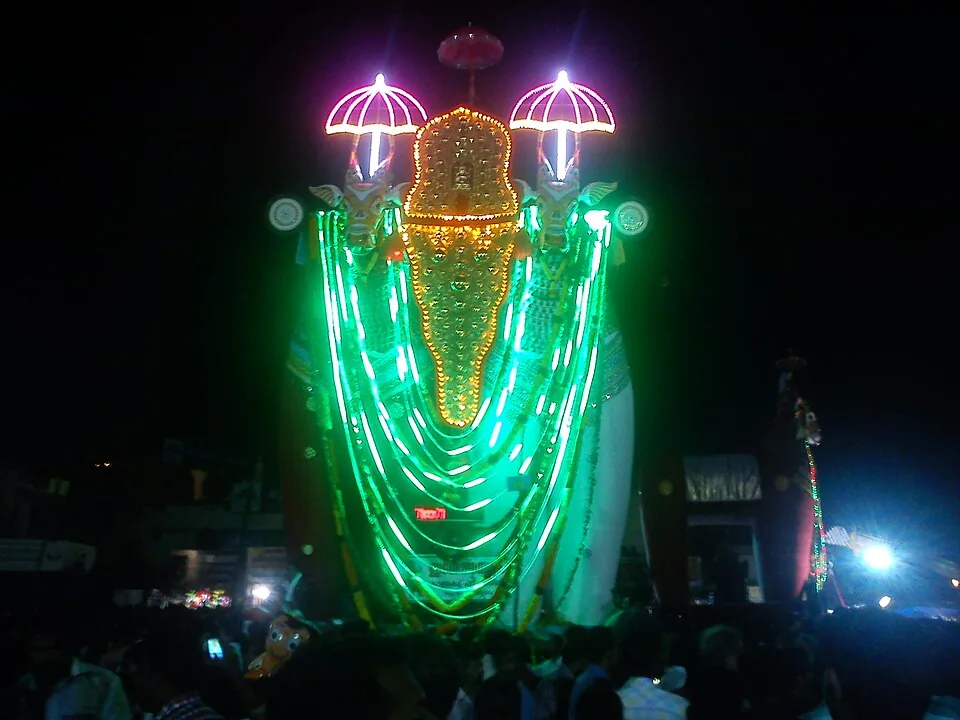
Irupathettam Onam falls twenty-eight days after Thiruvonam. Villages from across the surrounding country build kettukala — vast straw-and-cloth effigy bulls, reported up to around seventy feet, hauled in on wheeled frames from more than fifty villages — and bring them to the ground. There is a cattle fair. There is an agricultural market.
Set that beside the shrine itself, where the presiding image of devotion is a bull, and the picture is unambiguous. This is a festival calendar of cattle and grain: the working animals of a rice economy, honoured on the ground that economy used.
It is being kept up in a place that has largely stopped growing rice.
What that does and does not mean
It would be easy, and cheap, to write the elegy here — the dying festival, the vanishing tradition. We are not going to, because it would be a prediction and we do not have the evidence for it.
Rituals detach from their economies all the time and carry on perfectly well; the kettukala bulls are already effigies rather than animals, and Ochira Kali already remembers an army that has not existed for two and a half centuries. This is a ritual with a long record of surviving the loss of the thing it was about.
The honest observation is narrower and more interesting. Every part of this festival calendar was built by an agricultural society for its own purposes, and almost every one of those purposes has now gone: no army to muster, no draught cattle to bless, and less and less of the flooded field the fighting needs. What remains is the form, held in place by the people who want it held.
If you come in June, look past the sticks at what everybody is standing in, and ask whose field it is.
Frequently asked questions
How much paddy is left in Oachira panchayat?
About 9.3 per cent of the land area, down from 51 per cent, according to the panchayat's own published profile. Coconut now covers roughly 83 per cent.
Does that threaten Ochira Kali?
It is a real tension, but we are not going to predict the festival's end. The ritual needs a flooded worked field, and those are much scarcer than they were — though this is also a ritual that has already survived the disappearance of the army it came from.
Is the padanilam part of the temple?
No. The battle ground sits outside the 21.25 acres recorded by the Supreme Court as the temple's extent. The field the festival needs belongs to somebody else.
What is Irupathettam Onam at Oachira?
A festival falling twenty-eight days after Thiruvonam, for which villages build kettukala — huge straw-and-cloth effigy bulls, reported up to around seventy feet, brought in on wheeled frames from more than fifty villages — alongside a cattle fair and an agricultural market.
What is the landscape like?
Low and sandy: average elevation around three metres, about 2,564 mm of rain a year, sandy loam over old sand ridges across roughly three-quarters of the panchayat, with alluvium on the plains between.