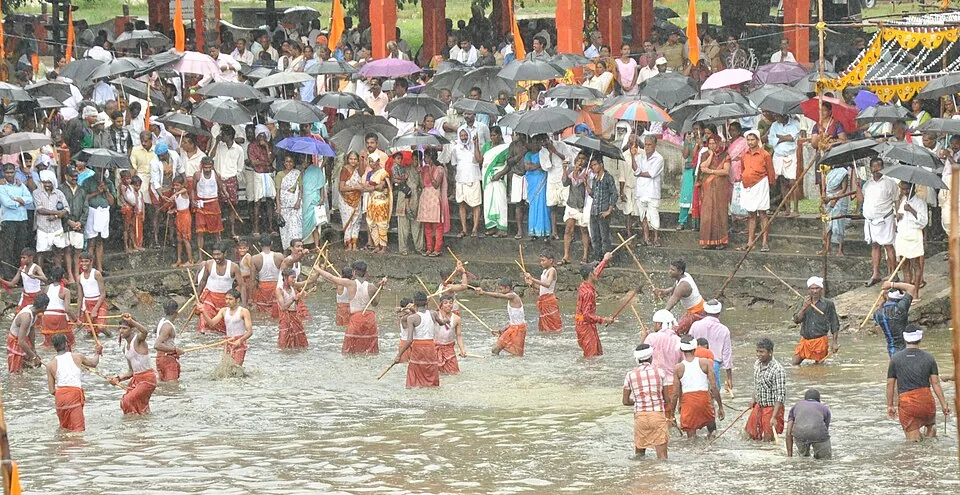
Every June, on the first two days of the Malayalam month of Mithunam, men wade into a flooded field beside the temple at Oachira and fight each other with sticks in the rain. Reported numbers run to around two thousand participants. There are drums, there is mud, there is a crowd on the bank under umbrellas.
It is filed almost everywhere under folklore: a colourful ritual re-enacting an old feud. That framing is doing the place a disservice, because the ground it happens on has a documented military history, and you can get at it through the name.
Read the name
Oachira is understood as a worn-down form of Onattuchira. A chira is a reservoir or embanked tank. The chira in question belonged to the Raja of Kayamkulam.
So the place is named for a ruler's water-tank — and the ruler it is named for is one of the two sides in the war the ritual is supposed to remember. The battlefield carries the name of the man who lost it.
The surveyors put soldiers on it
The second piece of evidence is better, because it comes from people with no interest in the story at all.
When Ward and Conner carried out their survey of Travancore in the early nineteenth century, they recorded at Oachira a damaged temple structure beside the padanilam and a large central reservoir. They also recorded what the reservoir was for: soldiers to bathe in, and horses to be watered at.
That is not folklore. That is a pair of British surveyors writing down the everyday function of a piece of infrastructure, and the function is military. A tank sized for cavalry and troops, on an open plain, named for the raja whose troops used it.
Which war, then
The version in widest circulation says the battle was between the neighbouring kingdoms of Kayamkulam and Ambalappuzha. It is on Kerala Tourism's own event page — which then, a few lines later, calls it "the historical battle fought between the Maharaja of Travancore, Marthanda Varma, and the Raja of Kayamkulam".
Both cannot be right, and the first is the weaker. In the seventeen-forties Kayamkulam and Ambalappuzha were allies against Travancore, not enemies of one another; Ambalappuzha sheltered the Kayamkulam ruler after Marthanda Varma took his country. The Travancore-versus-Kayamkulam version is the one the encyclopaedic sources carry alone, and it is the one that fits both the alliances and the name of the ground.
We go into this at more length in the myth section of the main Oachira page. The short version: the ritual almost certainly remembers Travancore's war on Kayamkulam, fought on Kayamkulam's own parade ground.
From muster to performance
What makes this more than a correction is what it implies about the ritual's origin.
This region carried a dense network of kalaris — the martial-arts schools of Kerala, which trained the men who fought these wars. An annual armed exercise on the raja's water-ground, drawn from the kalaris of the surrounding villages, is an entirely ordinary thing for a small south Indian kingdom to have had. What is unusual is what happened next.
The kingdom was annexed. The army it mustered stopped existing. The exercise did not. It kept its date, kept its ground, kept its two sides and its sticks, and gradually acquired a battle to be about — the sort of explanation a ritual grows when the institution that produced it has gone.
Which is why the argument over whether it commemorates Ambalappuzha or Travancore may be the wrong question. The likeliest answer is that it commemorates nothing in particular, because it did not begin as a commemoration at all. It began as training, and outlived the army.
Frequently asked questions
What is Ochira Kali?
A two-day ritual mock battle held on the first two days of the Malayalam month of Mithunam, usually in mid-June, in the flooded padanilam beside the Oachira temple. Men divide into two sides and fight with sticks in place of swords, in the monsoon rain, to drums. Reported participation runs to around two thousand.
What does the name Oachira mean?
It is understood as a worn-down form of Onattuchira — the chira, or embanked reservoir, belonging to the Raja of Kayamkulam. The ground is named after one side of the war the ritual is said to remember.
Is there any hard evidence this was a military site?
Yes. The early nineteenth-century Ward and Conner survey of Travancore recorded a damaged temple structure beside the padanilam and a large central reservoir, and noted that the reservoir was used for soldiers to bathe and horses to be watered.
Which battle does it commemorate?
Most likely Travancore against Kayamkulam under Marthanda Varma. The widely printed Kayamkulam-versus-Ambalappuzha version does not fit the politics — those two were allies against Travancore — and Kerala Tourism's own page gives both versions in adjacent paragraphs.
Why do the explanations disagree so much?
Possibly because the ritual did not start as a commemoration. An annual armed exercise drawn from the region's kalaris, held on the raja's water-ground, would have outlived the kingdom that produced it — and then acquired a battle to be about.