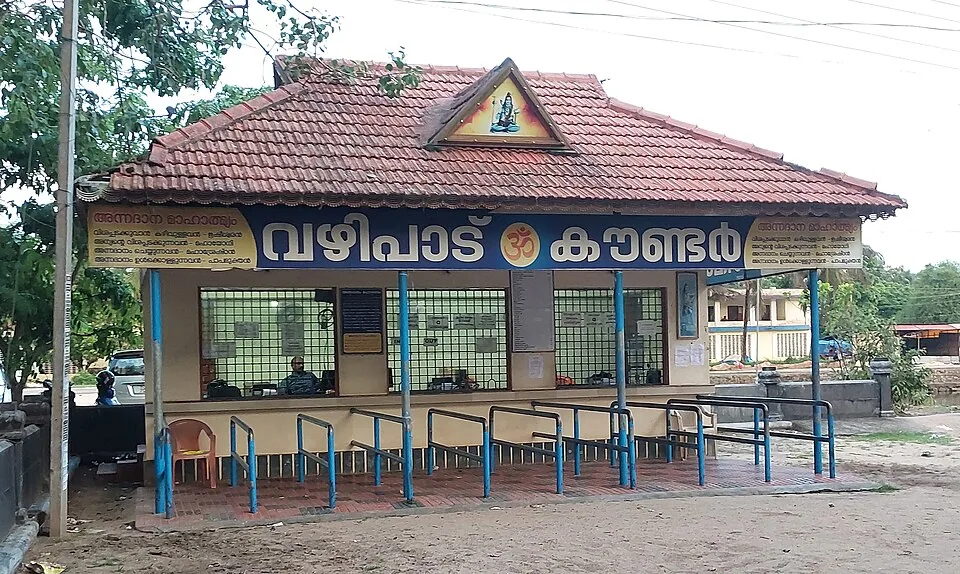
Most writing about Oachira stops at the absence. No idol, no sanctum, no image to garland — worship offered to the formless Parabrahma under open sky and old trees. It is the first thing anybody tells you and it is true.
What almost nobody tells you is that the absence has a legal consequence, and that the legal consequence took eighteen years to work through the courts and ended in front of the Chief Justice of India.
Why a temple with no deity is a hard legal object
Most large Kerala temples are administered by a Devaswom Board — statutory bodies that manage temple property, appoint priests and account for offerings. The framework assumes a deity: in Indian law the idol of a temple can be a juristic person, capable of owning property, and the board administers on its behalf.
Oachira does not fit. The Supreme Court described it in terms worth quoting, from paragraph 3 of its judgment: the temple "is a unique, ancient and historical one as there is no building, consecrated idol or deity and sanctum sanctorum."
So it governs itself. Under its own bye-laws it runs a three-tier elected structure — a general board, a working committee and an executive committee — on five-year terms. No Devaswom Board sits above it. Which is fine while the elections happen, and becomes a problem when they stop.
Eighteen years
The litigation began in 2006 with a suit in the First Additional District Court at Kollam. A preliminary decree followed in April 2010, and in October of that year the court appointed an Advocate Commissioner for a single, wonderfully concrete purpose: to count the offerings.
That detail is the whole case in miniature. A shrine with no idol still takes money — vazhipadu paid at a printed rate at a counter on the ground — and money is exactly the kind of thing a court can get its hands around when doctrine is beyond it.
The last election was held in May 2017. There has not been another since. A no-confidence motion followed in April 2022. In March 2020 the Kerala High Court placed a retired judge over the committee with power to ratify its every decision, and in February 2023 replaced the elected committee altogether with an unelected one.
What the Supreme Court did
On 3 December 2024, in Oachira Parabrahma Temple & Anr. v. G. Vijayanathakurup & Ors., reported as 2024 INSC 922, a bench of Chief Justice Sanjiv Khanna with Justices Sanjay Kumar and R. Mahadevan held that the High Court had become functus officio — that it had exhausted its authority in the matter and could not keep governing the temple by order.
It appointed Justice K. Ramakrishnan, a retired judge of the Kerala High Court, as Administrator, with the job of finalising the voters' list and completing elections within four months.
The same judgment recorded, at paragraph 15, that the temple's area "comprises a sprawling of 21.25 acres of land" — which is how we know that the thirty-six acres printed by every tourism site in India is wrong.
We should be plain about the limit of what we can tell you: this account is written as of that December 2024 judgment. Whether the elections were in fact held within the four months is not something we have been able to establish, and we are not going to guess.
What is actually being governed
It is easy to read all this as a squabble over a field with some trees on it. It is not. The institution the court was arguing about runs the Parabrahma Super Speciality Hospital and Research Centre, a Nursing College and a Nursing School, all under the same bye-laws as the shrine.
And it has Sthanis — hereditary trustees — who went to the High Court in their own right to protect what the record describes as "their share of amounts and their roles to play". A temple with no priesthood at a sanctum still has inherited offices, and those offices still have a share.
Stand on the padanilam at Oachira and none of this is visible. There is sand, there are trees, there is a bull, there is a counter where you pay for an offering. The counter is the part that went to Delhi.
Frequently asked questions
Why did Oachira temple end up in the Supreme Court?
Because it has no consecrated deity or sanctum, it does not fit the Devaswom Board framework that administers most large Kerala temples, and it governs itself through its own elected three-tier committee. When elections stopped after 2017, there was no board to step in — only the courts. The dispute ran from a 2006 suit to a Supreme Court judgment on 3 December 2024.
What did the Supreme Court decide?
In 2024 INSC 922, a bench of CJI Sanjiv Khanna with Justices Sanjay Kumar and R. Mahadevan held the Kerala High Court functus officio and appointed Justice K. Ramakrishnan, a retired High Court judge, as Administrator, directing him to finalise the voters' list and complete elections within four months.
How large is the temple ground really?
21.25 acres, recorded by the Supreme Court at paragraph 15 of its 2024 judgment and matching the mapped boundary. The widely printed figure of thirty-six acres is wrong — and a site that repeats it is copying rather than reporting.
What else does the temple run?
The Parabrahma Super Speciality Hospital and Research Centre, a Nursing College and a Nursing School, all under the same bye-laws. This is a substantial institution, not only a shrine.
Have the elections happened?
We do not know, and we will not guess. This account is written as of the December 2024 judgment, which directed elections within four months. The position afterwards is not something we have been able to establish from a source we trust.