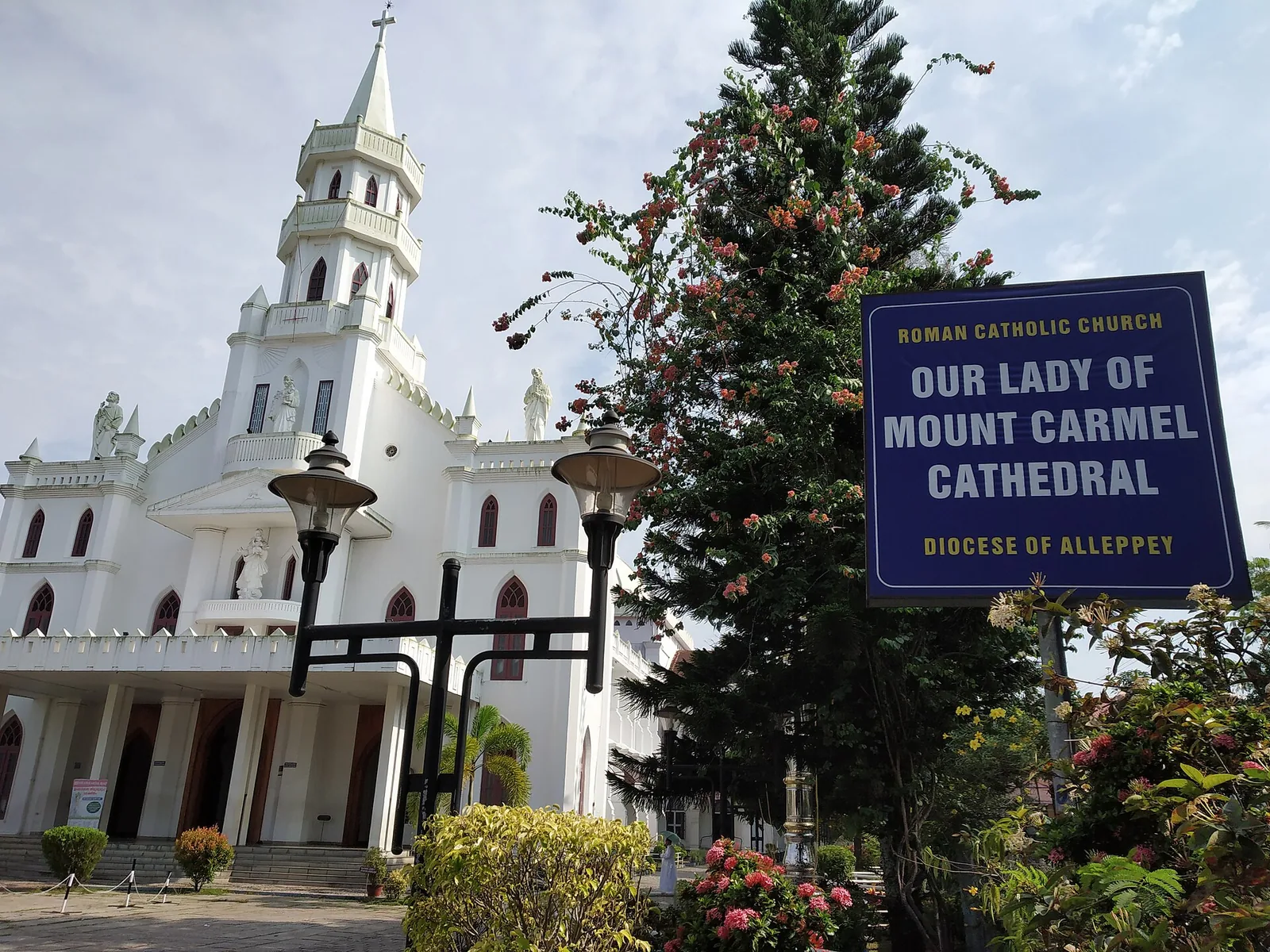
The Diocese of Alleppey’s own parish directory gives one date for Mount Carmel: Estd. 1809. GCatholic gives the same year independently.
Set that against the town. Raja Kesavadas opened the port in 1762 and laid Alappuzha out on its two canals. By 1809 there is a Latin Catholic parish at what is now Convent Square, and it has been there without interruption ever since. This is not a church that arrived once the town was prosperous. It is roughly coeval with it.
What the name is evidence of
Our Lady of Mount Carmel is a Carmelite title, and a new parish in Travancore in 1809 did not receive it by accident.
Jesuits had worked this coast from about 1570. After the Dutch took Cochin their mission wound down, and from the mid-eighteenth century the territory passed to the Carmelites under the Vicariate of Verapoly, where it remained until the Diocese of Cochin was restored in 1886.
So the dedication is a jurisdictional fingerprint. It tells you, without a single document, which religious order held this shoreline in 1809. That is a more interesting fact than most of what is written about this building, and as far as we can tell it appears nowhere else online.
The older layer, and a claim we are killing
Mount Carmel is often called the oldest Latin Catholic church in Alappuzha. It is not, and the diocese’s own directory says so.
St Peter’s at Vattayal, in the same forane, is listed as established in 1760 — 49 years earlier, with 1,038 families against the cathedral’s 550, so both older and about twice the size. And the sixteenth- and seventeenth-century foundations up and down this coast are older still: St Andrew’s at Arthunkal in 1581, St Michael’s at Kattoor in 1590, St Thomas’ at Thumpoly in 1600, St George’s at Manakodam in 1640.
The figure who dominates that earlier period is Fr Giacomo Fenicio, an Italian Jesuit, vicar at Arthunkal from 1584 to 1602 and again from 1619 until his death in 1632. The diocese calls him a pioneer in Indology, and it is not flattery: Fenicio wrote one of the earliest European accounts of Hindu religion. After the Coonan Cross Oath, the St Thomas Christians of this mission were reconciled to Rome by Msgr Giuseppe Sebastiani in 1662.
The churches that are not there
One line in the diocese’s history is worth carrying down to the shore. Of the churches founded along this coast in that early period, some no longer exist — destroyed, in its own words, either by wars or by sea erosion.
That is not a historical flourish. The diocese runs a standing programme on sea erosion today, and its boundaries are drawn as a ribbon of shoreline between a canal and the sea. A church here has always been a building with an expiry risk attached, and the ones still standing are the ones the water has not yet reached.
What the building actually is
The parish’s date is documented. The present building’s is not, and we would rather say that than fill the gap.
Dates of 1858 and 1866 circulate in listings and we could not trace either to any source — not the diocese, not GCatholic, not Wikipedia, not the district administration. One aggregator offers 1898 without a source. We publish 1809 for the parish and leave the fabric undated.
What the photographs support is a description rather than a date: whitewashed masonry, a three-stage octagonal bell tower with balustraded galleries under a slate-grey spire, lancet window heads, pinnacled parapets and free-standing statues along the parapet line. That is a Kerala colonial-Gothic idiom. Calling it simply “a Gothic cathedral”, as several pages do, oversells it.
Frequently asked questions
When was Mount Carmel Cathedral founded?
The parish dates from 1809, per the Diocese of Alleppey’s own directory and GCatholic — within about fifty years of the founding of the port town in 1762. The construction date of the present building does not appear to be documented; the 1858 and 1866 dates that circulate are not traceable to any source we can find.
Why is it dedicated to Our Lady of Mount Carmel?
Because the dedication records who held the mission. This coast passed from the Jesuits to the Carmelites under the Vicariate of Verapoly from the mid-eighteenth century until the Cochin diocese was restored in 1886 — so a parish founded here in 1809 received a Carmelite Marian title.
Is it the oldest Latin Catholic church in Alappuzha?
No. St Peter’s at Vattayal, in the same forane, is listed by the diocese as established in 1760, and it has roughly twice as many families. Arthunkal (1581), Kattoor (1590), Thumpoly (1600) and Manakodam (1640) are older still.
Who was Fr Giacomo Fenicio?
An Italian Jesuit, vicar of St Andrew’s at Arthunkal from 1584 to 1602 and again from 1619 until his death in 1632. He wrote one of the earliest European accounts of Hindu religion, and the diocese describes him as a pioneer in Indology.