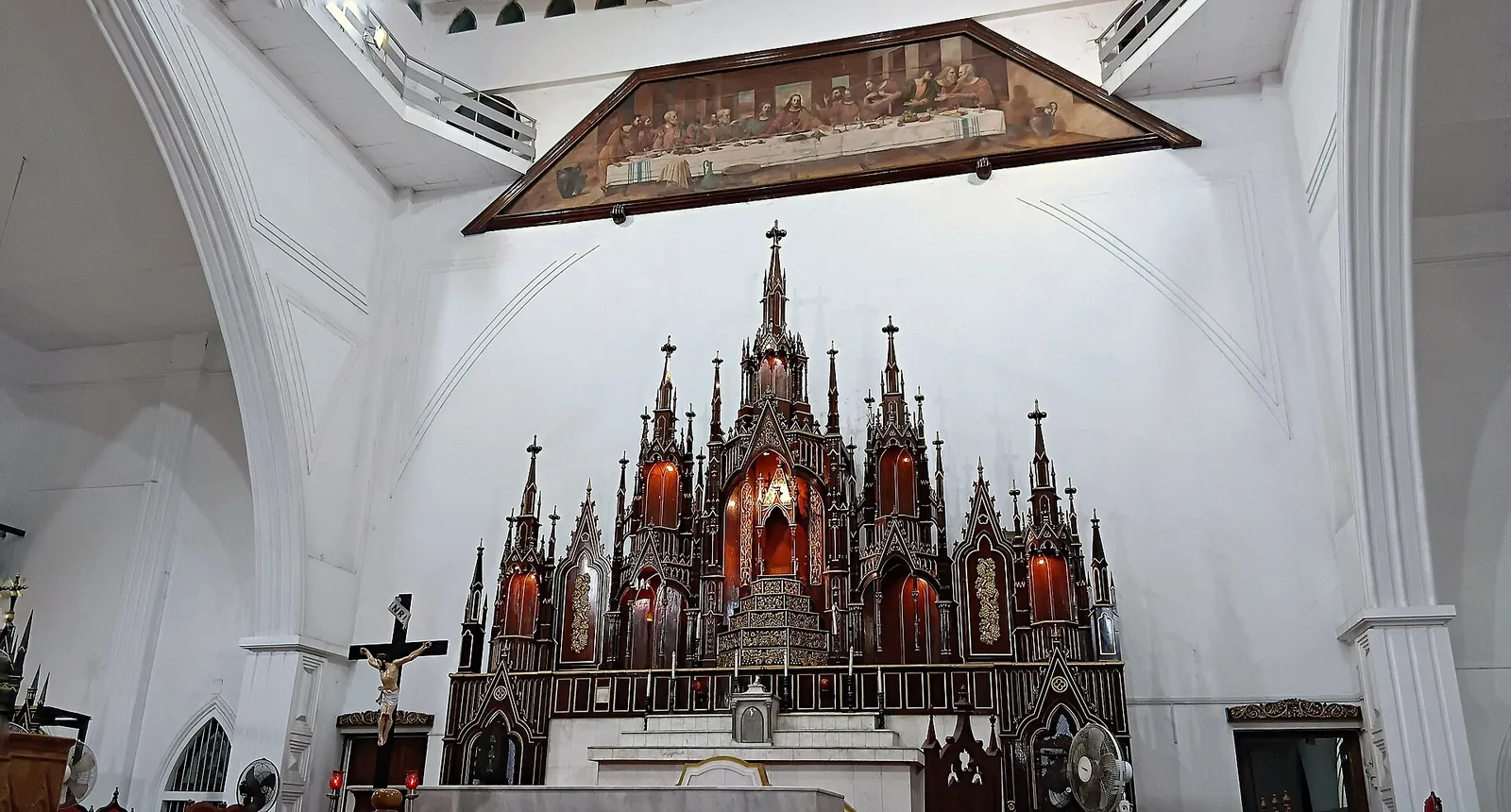
Most dioceses are drawn around towns. The Diocese of Alleppey is drawn around water.
The bull, and the canal
It was erected on 19 June 1952 by the papal bull Ea Redemptoris Verba of Pope Pius XII, which divided the northern territory of the old Diocese of Cochin along the line of the Kuthiathodu canal. North of the canal stayed Cochin. South of it became Alleppey, with Mount Carmel as its cathedral.
Its four boundaries are worth reading literally, because they are almost entirely hydrological. North: the Kuthiathodu canal line. South: a straight line drawn from the bend of the Pampa at Viyapuram to the Arabian Sea, passing through Thottappally. East: the middle of Vembanad Lake, continued south by the Pallathuruthy canal to Viyapuram. West: the Arabian Sea.
A canal, a river bend, the centre-line of a lake, and the ocean. The result is a ribbon of shoreline about 333 square kilometres in extent, with six foranes — Punnapra, Alleppey, Kattoor, Arthunkal, Manakodam and Kandakkadavu — strung along it roughly north to south, and around 66 parishes serving some 163,000 Catholics.
The decree nobody mentions
Here is the part that no travel writing about this cathedral has ever covered, and it is genuinely unusual.
On 8 September 1952 an Executorial Decree gave Alleppey and Cochin supplementary personal jurisdiction over certain parishes lying inside each other’s territory. It was approved by Propaganda Fide on 24 September 1952 and took effect on 11 October that year.
In plain language: rather than let a line on a map assign every congregation to whichever bishop happened to be on that side of it, the arrangement gave each bishop authority over particular communities wherever they were. Jurisdiction over people rather than over ground.
That is a solution to a specific problem — a coast where communities were defined by rite, language and trade rather than by which side of a canal they lived on — and it is a reminder that ecclesiastical boundaries here were being negotiated as recently as the 1950s, not inherited from antiquity.
Neythal
Kerala’s Latin Catholics are concentrated in the coastal districts — Thiruvananthapuram, Kollam, Alappuzha, Ernakulam and Thrissur — reflecting origins among fishing communities evangelised by Portuguese missionaries. A diocese shaped like a shoreline is a diocese of people who work the sea.
The clearest evidence of how thoroughly it understands itself that way is the name of its community radio station: Radio Neythal. Neythal is one of the five tinai of Sangam-era Tamil poetics — the landscape-modes into which the classical tradition divided the world — and it means the seashore.
A Catholic diocese created in 1952 named its radio station after a two-thousand-year-old Tamil literary category for the coast. That is not branding. That is a statement about where its people live.
And the sea is not only symbolic: the diocese runs a standing sea-erosion programme, and its own history notes churches on this coast lost to war or to the water.
Four bishops
The diocese has had four. Michael Arattukulam, the first, served from 19 June 1952 until 1984 — a founding episcopate of thirty-two years; he died on 20 March 1995. Then Peter Michael Chenaparambil from 28 April 1984, Stephen Athipozhiyil from 11 February 2001, and James Raphael Anaparambil from 11 October 2019.
One correction while we are here, because it is the single most common error about this building: Mount Carmel is a cathedral, not a basilica. The diocese’s basilica is St Andrew’s at Arthunkal, raised by Pope Benedict XVI on 21 May 2010 and solemnly proclaimed by the Apostolic Nuncio on 11 October 2010. They are twenty-one kilometres apart.
Frequently asked questions
When was the Diocese of Alleppey created?
On 19 June 1952, by the papal bull Ea Redemptoris Verba of Pope Pius XII, dividing the northern territory of the Diocese of Cochin along the Kuthiathodu canal line.
What are the diocese’s boundaries?
Almost entirely water: the Kuthiathodu canal to the north; a straight line from the bend of the Pampa at Viyapuram to the sea through Thottappally to the south; the middle of Vembanad Lake, continued by the Pallathuruthy canal, to the east; and the Arabian Sea to the west. About 333 km² of shoreline.
What was the 1952 Executorial Decree?
A decree of 8 September 1952, approved by Propaganda Fide on 24 September and effective 11 October, giving Alleppey and Cochin supplementary personal jurisdiction over certain parishes inside each other’s territory — authority over particular communities rather than over ground.
Why is the diocesan radio called Radio Neythal?
Neythal is the Sangam-era tinai, or landscape-mode, meaning the seashore. The name reflects a diocese drawn as a coastal ribbon whose community has historically been a fishing one.