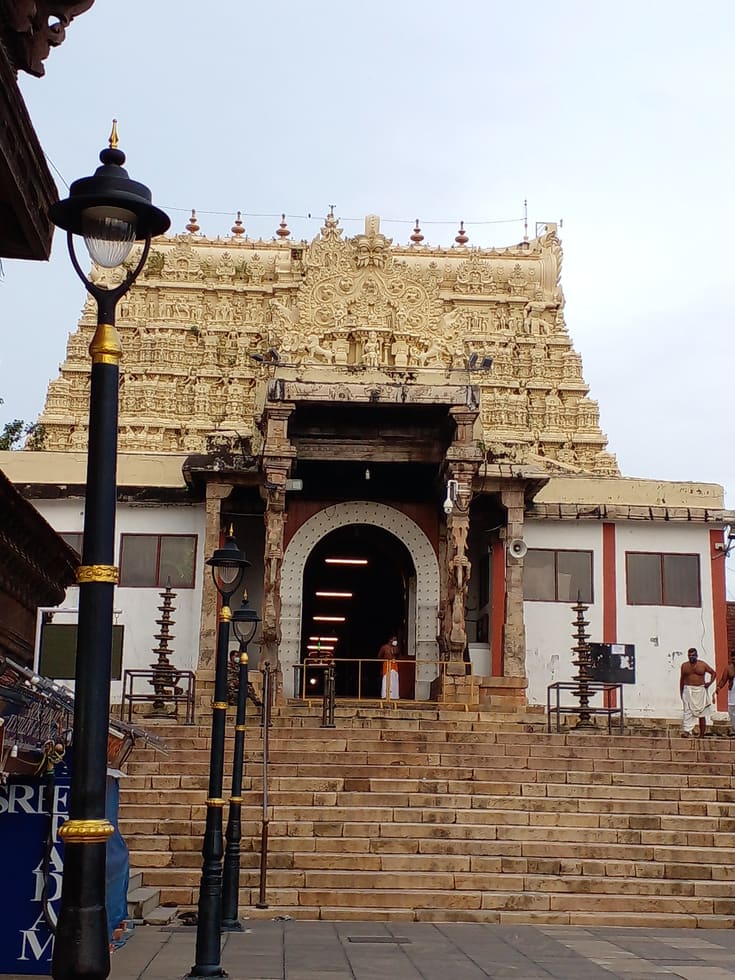
In January 1750, Anizham Thirunal Marthanda Varma, the ruler of Travancore, gave his entire kingdom away. He did not hand it to a rival or a foreign power. He gave it to the god who lies in yogic sleep inside the Padmanabhaswamy Temple at East Fort, and from that day he ruled only as the god's servant. That gift, called the Thrippadidanam, runs through everything that later made this temple famous, from its kings to its vaults to a Supreme Court judgment in 2020.
The god who received the kingdom is Vishnu as Padmanabha, resting on the coiled serpent Anantha. The city around him carries the serpent's name, because Thiruvananthapuram means the city of Anantha. The image is about 18 feet long, shaped from katu-sharkara, a mix of herbs and resin, over 12,008 shaligram stones. It is so long that worshippers see it through three doors: the face through one, the navel and its lotus through the next, and the feet through the last. Standing before those doors, it is easy to see why a king felt the land belonged to the one lying there.
Marthanda Varma had already given the temple its present form in the 18th century, so the gift of the kingdom completed work he had begun in stone. After the Thrippadidanam, every ruler of Travancore took the title Sree Padmanabha Dasa, the servant of Padmanabha. The kings went on ruling in the god's name until the state joined India. Even the temple's great night of lamps goes back to him, because Onmanorama reports that the first Lakshadeepam was held in 1750 under the same king.
Because the rulers saw themselves as servants, the palace grew up beside the shrine. The royal family built Kuthiramalika Palace next to the temple tank, and the short walk between them still shows how closely throne and temple were bound. That bond also shaped modern Kerala. On 12 November 1936, Maharaja Chithira Thirunal Rama Varma, another servant of Padmanabha, issued the Temple Entry Proclamation, which opened Travancore's temples, this one included, to Hindus of every caste.
Yet a temple run by a royal family in the god's name raised a hard question once there were no more kings. In 2009 that question reached the courts. T.P. Sundararajan, a former police officer and lawyer, asked the Kerala High Court to hand the temple to the state government. On 31 January 2011 the High Court agreed and told the state to set up a body to run the temple and its assets. The royal family appealed, and on 2 May 2011 the Supreme Court stayed that order. Instead, it told a committee to make a detailed inventory of the vaults, lettered A to F.
So on 27 June 2011 the stock-taking began. Sundararajan himself sat on the seven-member panel that watched five vaults being opened and their contents counted. He did not live to see the end of the story, because he died on 17 July 2011, as the count made the temple world news. Press reports that year put the objects in the five vaults at about ₹1 lakh crore. That number came from newspapers, not from any official valuation, so the dollar figures quoted abroad rarely agree.
What the count found was the working store of a living temple rather than a buried hoard. Incredible India describes Vault C as holding items used in special ceremonies. Vault D holds the ornaments that decorate the Garuda vahana, the god's carrier, during festivals. Much of the wealth still leaves its rooms each year to serve the god it was given to.
One vault, however, stayed shut. Kallara B is the vault behind most of the legends, and the royal family and many devotees hold that it lies under the god's own protection. They objected to opening it, so it remained closed through the whole 2011 inventory. The pressure did not go away. In July 2017 the amicus curiae, senior advocate Gopal Subramanium, told the court that the assets in Vault B should also be accounted for.
The answer came on 13 July 2020, when Justice U.U. Lalit and Justice Indu Malhotra set aside the High Court's 2011 judgment. They held that the royal family's shebait right, the right to manage the temple for the deity, did not end with the death of the last ruler. It passed to the family's successor, which meant the role Marthanda Varma created in 1750 outlived the kingdom itself. Day-to-day running went to an Administrative Committee chaired by the Thiruvananthapuram District Judge, guided by an Advisory Committee under a retired High Court judge. The court left the question of opening Kallara B for an inventory to those committees.
The servants of Padmanabha still keep his house by its old rules. Men enter in a mundu or dhoti with no shirt, and women in a sari, set-mundu, half-sari or skirt and blouse. Visitors in trousers or a churidar wrap a dhoti over them, and dhotis are rented out at the entrance. Entry is for Hindus, and in 2017 the singer K.J. Yesudas came to pray after signing a declaration of belief in Hinduism. The doors open from 3:15 am to 12 noon and again from 5 pm to 7:20 pm.
The god also leaves his house twice a year, and that journey shows how far the old order still reaches. The Painkuni festival ends in March or April and the Alpashy festival in October or November. Each time, the idols travel in procession to Shanghumukham Beach for the Aarattu, the sacred bath in the sea. Their route now crosses the runway of Thiruvananthapuram International Airport. So the airport stops flights for about five hours, as it did on 9 November 2024 and again on 20 October 2026. The god once given a kingdom still has right of way.
From the temple, the old city opens out in both directions. The Napier Museum is a short drive north, and the Attukal Bhagavathy Temple, home of the Attukal Pongala, lies to the south. For the places beyond the city, the Thiruvananthapuram district guide carries the story on.
Frequently asked questions
What is the Padmanabhaswamy Temple famous for?
It is the Vishnu temple at East Fort that gave Thiruvananthapuram its name. In 2011 its vaults were opened and counted on Supreme Court orders.
How much is the Padmanabhaswamy Temple treasure worth?
No official valuation exists. Press reports in 2011 gave a figure of about ₹1 lakh crore for the five opened vaults.
Has Kallara B been opened?
Kallara B stayed shut through the 2011 inventory. The 2020 judgment left the decision to open it for an inventory to the temple's Administrative and Advisory Committees.
What is the dress code at the Padmanabhaswamy Temple?
Men wear a mundu or dhoti with no shirt, and women wear a sari, set-mundu, half-sari or skirt and blouse. Dhotis are rented at the gate and can be worn over trousers or a churidar.