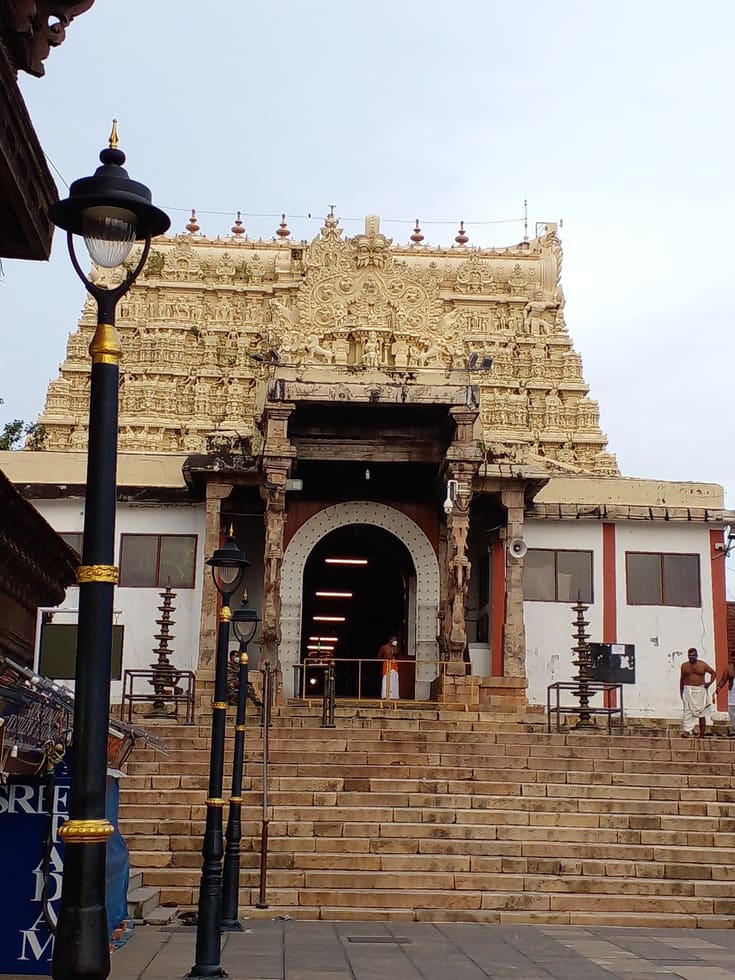
Sree Padmanabhaswamy Temple is the spiritual and historical heart of Thiruvananthapuram — the city, in fact, takes its name from Ananta, the great serpent on whom Lord Vishnu reclines here as Padmanabha. Behind the towering seven-tier gopuram at East Fort lies a shrine so revered that the Travancore royal family still serves it as “Padmanabha Dasa” (servant of Padmanabha), and so richly endowed that its sealed vaults made global headlines. For visitors it is unforgettable — but it is also a working temple with strict, non-negotiable rules. Plan around them and darshan of the reclining Lord is a genuine highlight of any Kerala trip.
Darshan timings
The temple opens well before dawn for Nirmalya Darshan and runs in fixed slots, closing for several hours in the afternoon for rituals. Times shift with festivals, the Malayalam calendar and special observances, so treat the table below as a rough guide only.
Darshan slots
| Slot | Approx time |
|---|---|
| Nirmalya Darshan (first, most auspicious) | ~03:30–04:45 |
| Special Darshan | ~06:30–07:00 |
| General Darshan | ~08:30–10:00 |
| Midday Darshan | ~11:45–12:00 |
| Temple closed (rituals) | ~12:00–17:00 |
| Evening Darshan | ~17:00–18:15 |
| Extended Darshan | ~18:45–07:20 |
| VIP / night Darshan | ~08:30–21:00 |
Nirmalya Darshan — the first sight of the deity still adorned with the previous day’s flowers, before the morning rituals begin — is considered especially blessed and draws devout early risers. If you want a calmer visit, the mid-morning General Darshan or the early-evening slot are usually easier than the pre-dawn and night rushes. Arrive at least 30–45 minutes before a slot, as queues, the dress check and the phone-deposit counter all take time.
The dress code — the part most visitors get wrong
Padmanabhaswamy enforces one of the strictest traditional dress codes of any Indian temple, and staff at the gate will turn away anyone who does not comply — this is not negotiable.
- Men: a mundu or dhoti worn around the waist, with the upper body bare (an angavastram or towel may be draped over the shoulders). Shirts, T-shirts, vests, trousers, jeans and shorts are not permitted inside.
- Women: a saree, or the traditional Kerala set-mundu (mundu neriyathu), or a half-saree/pavada. A salwar kameez (churidar) is generally accepted; jeans, leggings, skirts, shorts and other western wear are not.
- Children are usually given more latitude, but modest traditional dress is expected as they grow older.
If you turn up under-dressed, dhotis and wrap-cloths can usually be hired or bought from shops just outside the temple, and there are dhoti-hire counters near the entrance (a small charge or deposit applies). Many visitors simply wear the required attire over their normal clothes, then change back afterwards. Come prepared and you avoid a frustrating scramble at the gate.
Entry rules
A few firm rules govern who may enter and what you may carry in. Respecting them is part of visiting a living place of worship, not a tourist attraction.
- Hindus only: entry to the temple is traditionally permitted to Hindus. This is long-standing temple custom and is enforced at the gate; non-Hindus can still admire the gopuram and the tank from outside and visit the nearby Kuthiramalika palace and museum.
- No phones or cameras inside: mobile phones, cameras and electronic gadgets must be deposited at the cloakroom/counter before entering. Photography of the sanctum is prohibited.
- Cash only inside: carry small-denomination cash for offerings, special-darshan tickets, prasadam and lockers — card and UPI are not reliable within the temple.
- Footwear is removed before entering; leave shoes at the stands outside.
- Photography is generally fine of the exterior, gopuram and Padma Theertham tank — just not inside.
Special & VIP darshan
General darshan is free. If the queues are long or your time is tight, a paid Special Darshan lets you join a shorter line — expect roughly ₹150 without prasadam or about ₹180 with prasadam, with VIP/night slots priced higher. Tickets are bought at the counter inside (hence the cash-only advice), and some special and VIP passes can be booked in advance through the temple’s official booking portal. During festivals and the twice-yearly Alpashy and Painkuni Utsavams, timings change and crowds swell considerably, so check ahead if you are visiting then.
What to see inside
- Anantha Shayanam — the presiding image: Lord Vishnu reclining on the serpent Ananta, so large that it is revealed through three separate doors. You view the face and Shiva-lingam through the first door, the navel with Brahma on a lotus through the second, and the feet through the third — the ‘three-door darshan’.
- Ottakkal Mandapam: the striking platform carved from a single block of stone, in front of the sanctum, from which the royal family and dignitaries traditionally offer worship.
- The 365-and-a-quarter pillar corridor: a long granite colonnade — one pillar for each day of the year — with intricately carved columns, a fine example of the Dravidian–Kerala temple style.
- The gopuram: the seven-storey, roughly 30-metre eastern tower, a Trivandrum landmark best photographed from the tank side.
- Padma Theertham: the sacred temple tank beside the shrine, where devotees bathe and which mirrors the gopuram beautifully — a lovely spot to linger (from outside).
Getting there & nearby
The temple sits at East Fort (Kizhakke Kotta) in the old part of Thiruvananthapuram, about 4 km from the central railway station and KSRTC bus stand and around 6 km from Trivandrum International Airport — 15–20 minutes by autorickshaw or taxi in normal traffic. City buses stop at East Fort, a short walk away. Combine your visit with two attractions right next door: the Kuthiramalika (Puthenmalika) Palace Museum, the Travancore royals’ wooden palace with its carved horse brackets and heritage collection; and, a couple of kilometres north on Museum Road, the Napier Museum and adjoining zoo and art gallery set in landscaped grounds — an easy half-day pairing after an early darshan.
- Go early — the pre-dawn and mid-morning slots are the most atmospheric and (aside from Nirmalya) least crowded. Wear or carry the correct attire so you are not turned back at the gate. Leave phones and cameras at your hotel or use the deposit counter, and keep some small cash handy for tickets, prasadam and the locker. Allow extra time during festival days, when timings change and lines are long. Photograph the gopuram and tank from outside before you go in, since you cannot carry a camera inside.
Frequently asked questions
Can non-Hindus enter Padmanabhaswamy Temple?
No — entry is traditionally restricted to Hindus, and this is enforced at the gate. Non-Hindus can still see the gopuram and the Padma Theertham tank from outside and visit the neighbouring Kuthiramalika Palace and the Napier Museum.
What should I wear?
Men must wear a mundu or dhoti with the upper body bare; women a saree, set-mundu or salwar kameez. Trousers, jeans, shorts, T-shirts and western wear are not allowed. Dhotis and wrap-cloths can be hired or bought just outside if needed.
Is there an entry fee?
General darshan is free. A Special Darshan for a shorter queue costs roughly ₹150 (about ₹180 with prasadam), with VIP/night slots higher — all indicative, so confirm on the official site. Pay in cash inside the temple.
Can I take photos or carry my phone inside?
No. Phones, cameras and electronic gadgets must be deposited at the counter before entering, and photography of the sanctum is prohibited. You can photograph the exterior, gopuram and tank from outside.