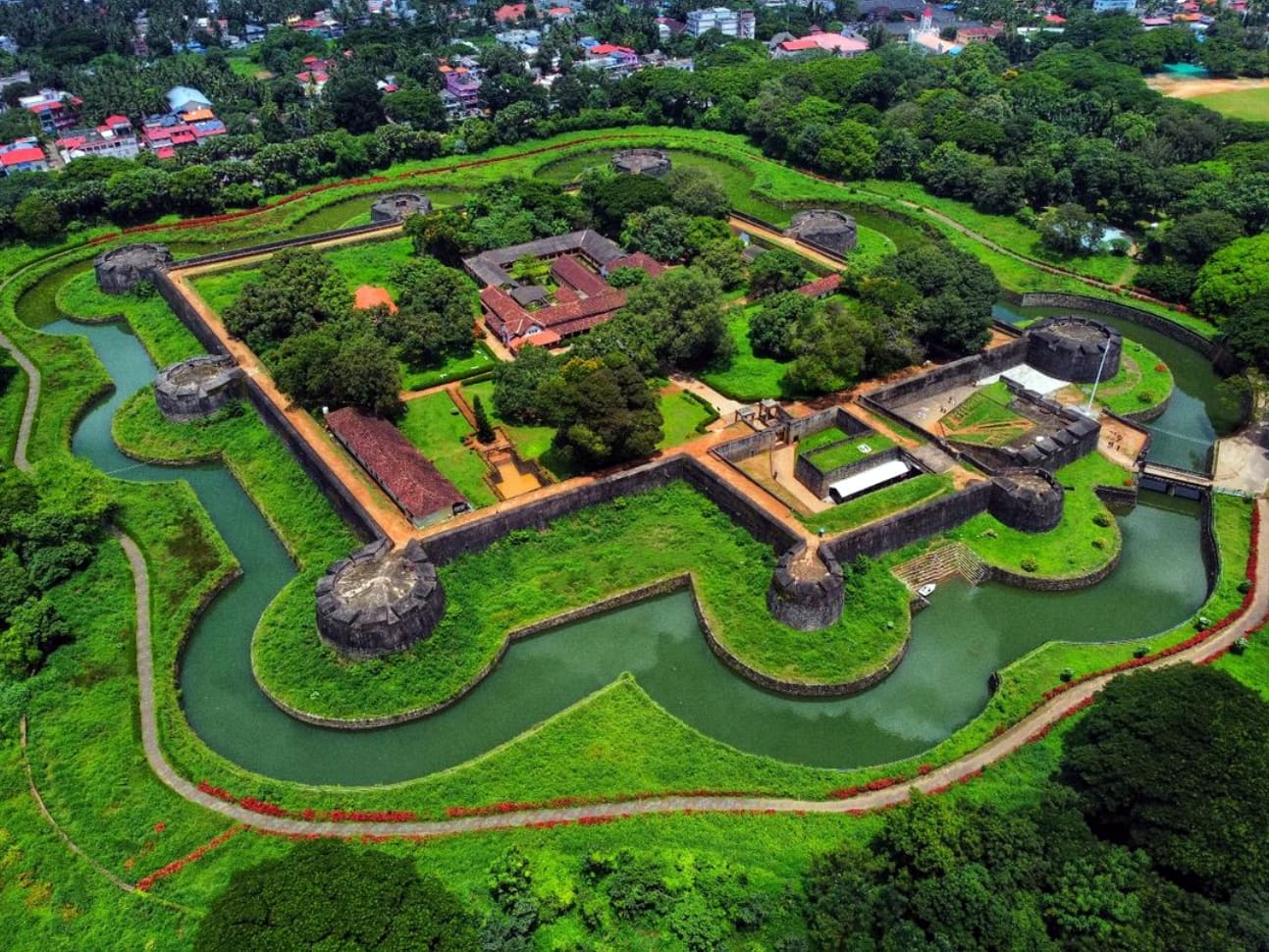
In the middle of Palakkad town, ringed by lawns and a moat, sits a low, immensely solid granite fort. Locals call it Tipu’s Fort, and for a few decades in the 18th century it was one of the most fought-over strongpoints in Malabar — because of where it stands.
The gap that made it matter
Palakkad guards the Palakkad Gap, the great ~30-km break in the Western Ghats that is the easiest land route between the Tamil plains and the Malabar coast. Whoever held Palakkad controlled the door between the two. The local ruler, the Palakkad Achan, had once been a tributary of the Zamorin of Calicut but had grown independent — and in 1757, facing a threatened invasion by the Zamorin, he made a fateful choice: he asked Hyder Ali of Mysore for help.
Hyder Ali’s granite fort
Hyder Ali seized the opening. Recognising Palakkad’s strategic value, he rebuilt the fort in its present granite form in 1766, and from then until 1790 Palakkad was almost continuously in the hands of Mysore or the British. It changed hands repeatedly: the British under Colonel Wood took it in 1768, only for Hyder to retake it months later; Colonel Fullarton besieged and captured it in an eleven-day siege in 1784, after which Hyder’s son Tipu Sultan won it back by a clever manoeuvre.
The fort today
After Tipu’s defeat in the Fourth Anglo-Mysore War, the fort passed to the British in 1790, and it has survived remarkably intact. Today it is a protected monument under the Archaeological Survey of India, its ramparts and moat free to wander, with a small Hanuman temple and public grounds inside — a quiet, green place that once decided the fate of a mountain pass.
- The fort is in the centre of Palakkad town, an easy stop that pairs well with Kalpathy heritage village and town food.
- The ramparts, lawns and moat are free to enter; go in the cooler morning or late afternoon.
- It is an ASI-protected monument — respect the structure and any restricted areas.
Frequently asked questions
Why is Palakkad Fort called Tipu’s Fort?
Because it was held by the Mysore rulers Hyder Ali and his son Tipu Sultan for much of the late 18th century. Hyder Ali rebuilt it in granite in 1766, and it stayed under Mysore or British control until 1790.
Why was Palakkad Fort so important?
It guards the Palakkad Gap, the main land route through the Western Ghats between the Tamil plains and the Malabar coast. Controlling the fort meant controlling that strategic pass, which is why Mysore and the British fought over it repeatedly.
Can you visit Palakkad Fort?
Yes. It is a protected monument under the Archaeological Survey of India, with free access to the ramparts, moat and grounds. It sits in the centre of Palakkad town and is easy to combine with Kalpathy.