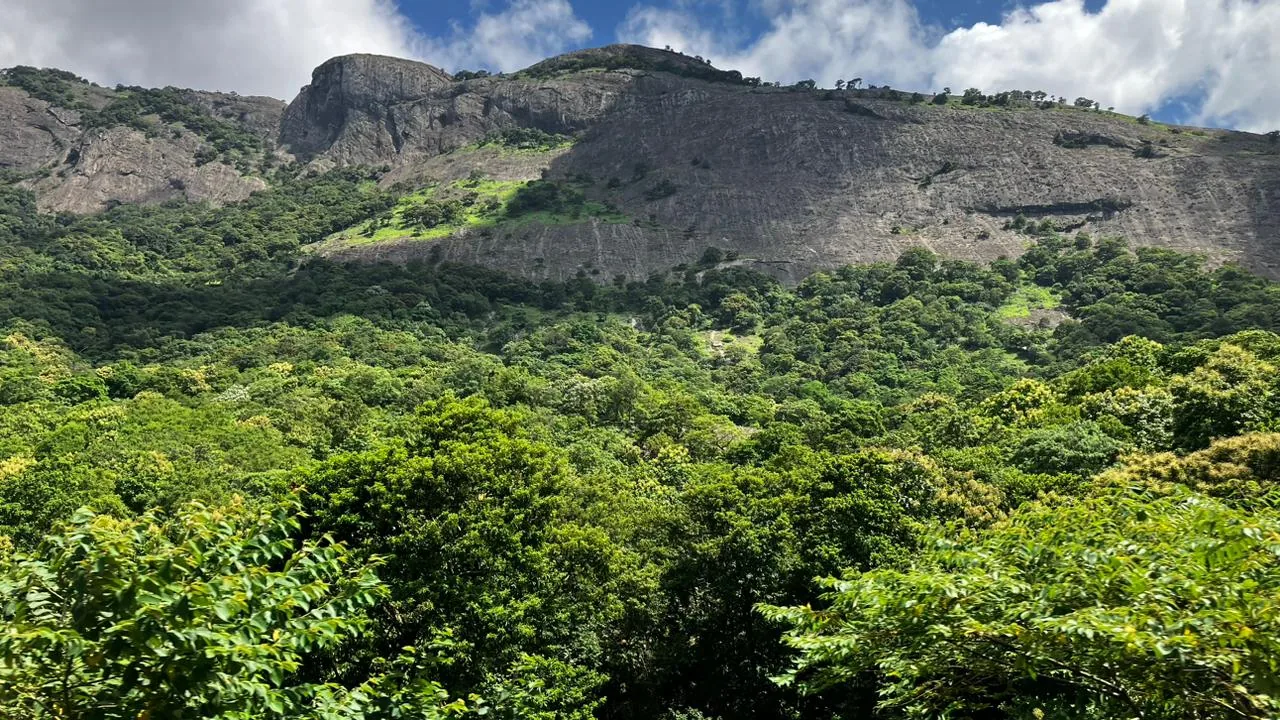
The Western Ghats run almost unbroken for more than 1,500 km down India’s western edge — a near-continuous wall of mountains that separates the Kerala coast from the interior. Almost. At Palakkad the wall drops away in a low, roughly 32 km-wide corridor between the Nilgiri Hills to the north and the Anaimalai Hills to the south. This is the Palakkad Gap, and it has quietly shaped the district for millennia.
Why Palakkad is hot and windy
A gap in the mountains is also a gap in Kerala’s weather defences. During the southwest monsoon the Ghats normally wring the rain out of the sea winds, but through the Palakkad Gap hot, dry air from the Tamil Nadu plains pushes the other way, warming eastern Kerala and giving Palakkad its reputation as the state’s hottest corner. Those same steady winds have made the hills flanking the Gap one of the region’s prime spots for wind farms.
A doorway for trade, road and rail
For as long as people have crossed the Ghats, they have crossed here. An ancient highway, the Rajakesari Peruvazhi, ran through the Gap linking the old west-coast port of Muziris with the east coast. Today the same corridor carries National Highway 544 and the main railway lines between Kerala and Tamil Nadu — which is why Palakkad Junction grew into such an important rail town.
The rice bowl behind the Gap
The flip side of the heat is fertility. The flat, well-watered plains behind the Gap are Kerala’s biggest paddy country, and the district’s wide green rice fields are the reason it is called the granary, or rice bowl, of Kerala. Geography that makes summers fierce also makes the land productive.
- The Gap is a geographic feature, not a single ticketed “sight” — you experience it in the landscape, the heat and the road/rail journey.
- It explains why Palakkad runs hotter and drier than coastal Kerala, especially in April–May.
- The best views of the paddy plains and windmill-topped hills come along the highways and railway through the district.
Frequently asked questions
What is the Palakkad Gap?
It’s a low mountain pass about 32 km wide — the one major break in the Western Ghats — between the Nilgiri Hills and the Anaimalai Hills, connecting Palakkad in Kerala with Coimbatore in Tamil Nadu.
Why is Palakkad so hot?
Because the Gap lets hot, dry winds from the Tamil Nadu plains blow through the Western Ghats into eastern Kerala, warming the region and making Palakkad the state’s hottest district, especially in April and May.
Why is the Palakkad Gap important?
It is Kerala’s main overland doorway to Tamil Nadu: the ancient trade route, National Highway 544 and the trunk railway lines all pass through it, and its winds and fertile plains drive the district’s wind farms and paddy farming.