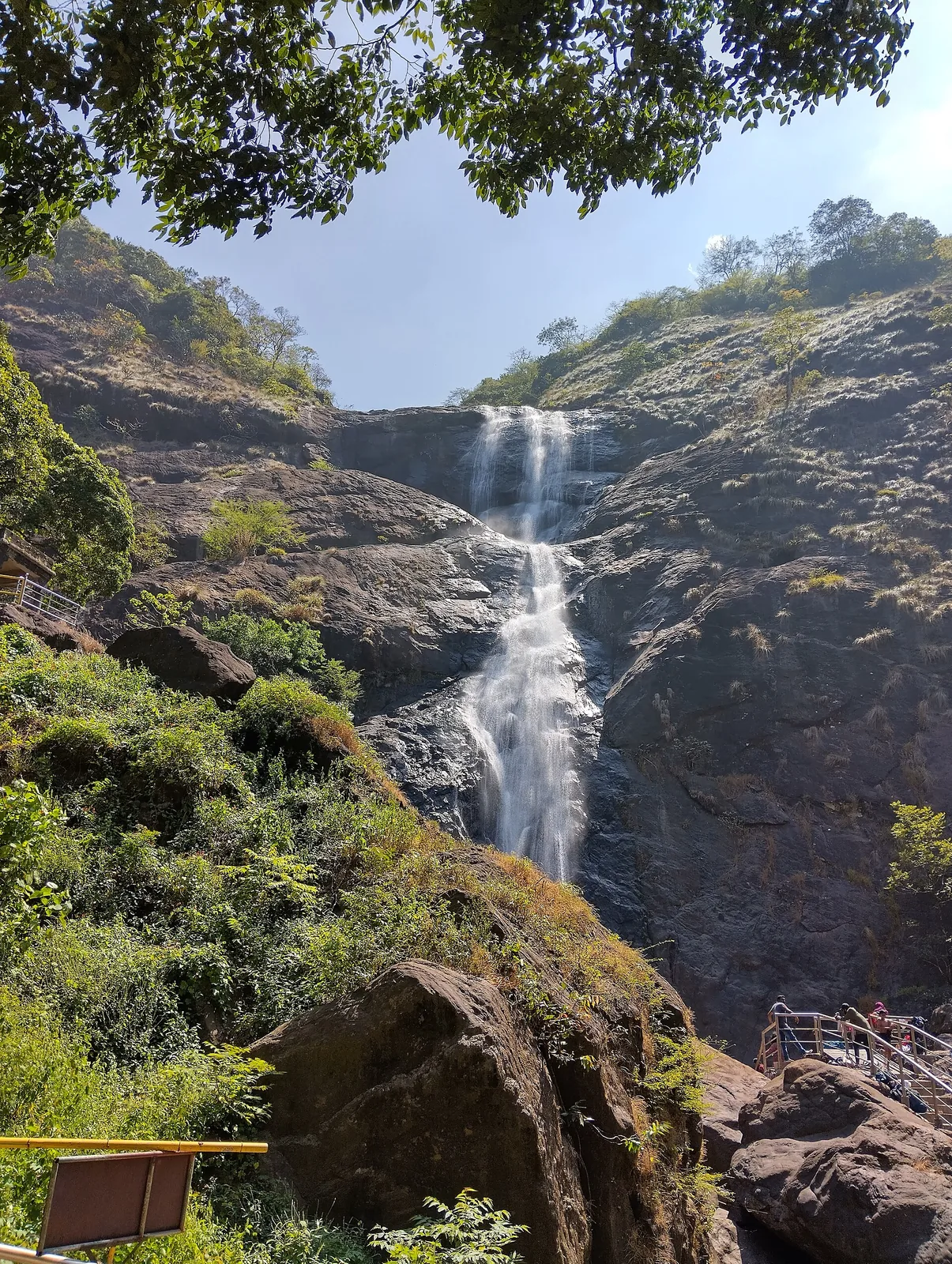
Palaruvi is 91 metres high. You will find that number on Wikipedia, on aggregators, on travel blogs and in the copy of hotels a hundred kilometres away. It is also, as far as we can establish, an artefact of a rounding error.
Four authorities, one round number, no metres
Start with who actually publishes a height. Kerala Tourism does, on its destination page: the falls plunge down from a height of about 300 feet. Kerala Tourism does again on a separate campaign page: from a height of 300 ft. The Kollam district administration does: comes down through rocks from a height of 300 feet. DTPC Kollam does: cascades from a height of 300 feet. Malayalam Wikipedia does, in its body text: മുന്നൂറടി, three hundred feet.
Four bodies, all of them Government of Kerala or its district tourism arm, all printing the same round number in the same imperial unit, and not one of them publishing a figure in metres or citing a survey.
That is not how measurements behave. That is how a number behaves when everybody copied it from the same place and nobody went and checked.
Where 91 metres comes from
Now do the arithmetic, because you can check every step of it yourself.
Three hundred feet is 91.44 metres exactly. Somebody rounded that to 91 metres. English Wikipedia’s infobox then ran the 91 back through a conversion template: 91 divided by 0.3048 is 298.6. So the infobox reads 91 metres (299 ft).
That 299 exists nowhere in the world. No surveyor produced it, no signboard carries it. It is a round guess, converted to metric, rounded, and converted back — and in the process the waterfall lost a foot.
Every 91 metres you find is a restatement of one unsourced about 300 feet. We looked for a real figure — a Forest Department measurement, a Survey of India spot height, anything metric from Kerala Tourism — and found none.
The one source with somebody physically standing at the falls is the local paper that covered the May 2026 reopening. It printed 250 feet.
The rank, and our own mistake
Several databases are said to place Palaruvi around 32nd on the national list.
There are not several databases. There is one, the World Waterfalls Database, and it is dead.
English Wikipedia says Palaruvi is the 32nd highest waterfall in India, cited to that database. Malayalam Wikipedia says it is India’s fortieth largest waterfall, cited to the same database. Two encyclopedias, one waterfall, one cited authority, two answers eight places apart.
It gets better. The two articles cite two different record numbers for the same falls — 608 and 702 — which strongly suggests the database carried Palaruvi twice. A database that lists a waterfall under two records cannot produce a stable rank, and that is a very plausible account of how one editor read off 32 and another read off 40.
And nobody can go and look. Both citations are flagged as dead links. Both archive links point at WebCitation, archived in August 2012 — and WebCitation itself no longer functions; fetching either returns an empty stub. The sole authority for both the height and the rank of this waterfall is a site that no longer exists, archived in a service that no longer works, cited under two identifiers, giving two answers.
Kerala Tourism, the district administration and DTPC — the three bodies that actually manage and promote the place — publish no ranking at all. The rank is purely an internet artefact.
The claim that eats itself
One more, which you will meet on blogs: Kerala’s third highest waterfall. It cannot survive alongside the 91 metres it is usually printed next to. Meenmutty in Wayanad is commonly given at around 300 metres and Soochipara at around 200. Either the rank is wrong or the height is, and on this evidence probably both.
Why we are not just giving you a number
It would be easy to write "about 91 metres (300 ft)" and move on. Every other page does. But a figure with a decimal-looking precision, derived from a round guess, converted twice, and attached to a rank from a dead website, is not information. It is the appearance of information.
What we can tell you honestly is this. The drop is tall — tall enough that the water is spray before it reaches the pool. It is somewhere in the region of 250 to 300 feet. It comes down in stages rather than one plunge: an upper chute, a broad convex apron the water spreads across, then a lower cascade. Nobody has surveyed it. And anyone who tells you it is 91 metres is quoting a rounding error.
The falls are not diminished by this. If anything they gain something: an unmeasured waterfall in a forest four kilometres off the highway is a rarer thing in 2026 than a very tall one.
Frequently asked questions
How tall is Palaruvi?
Unmeasured. Kerala Tourism (twice), the Kollam district administration, DTPC Kollam and Malayalam Wikipedia all print about 300 feet and none gives a metric figure or cites a survey. The local paper covering the 2026 reopening printed 250 feet. Treat it as roughly 250–300 feet.
Where does the "91 metres" figure come from?
300 ft is 91.44 m; somebody rounded that to 91 m; English Wikipedia then converted 91 m back to feet and got 298.6, printing "91 metres (299 ft)". The 299 exists nowhere in the real world — it is a guess run through two conversions.
Is Palaruvi the 32nd highest waterfall in India?
There is no reliable basis for saying so. The figure comes from the World Waterfalls Database, which no longer exists and whose archives are also dead. Malayalam Wikipedia cites the same source and says fortieth, and the two articles cite two different record numbers for the same falls.
Is it Kerala’s third-highest waterfall?
Almost certainly not, and the claim contradicts the height usually printed beside it. Meenmutty in Wayanad is commonly given at around 300 m and Soochipara at around 200 m — both far taller than 91 m.
Is it a single vertical drop?
No. There is an upper chute, a broad granite apron the water spreads and slides across, a lower cascade and a rocky run-out. The "single drop, horsetail" classification traces to the same defunct database as the height.