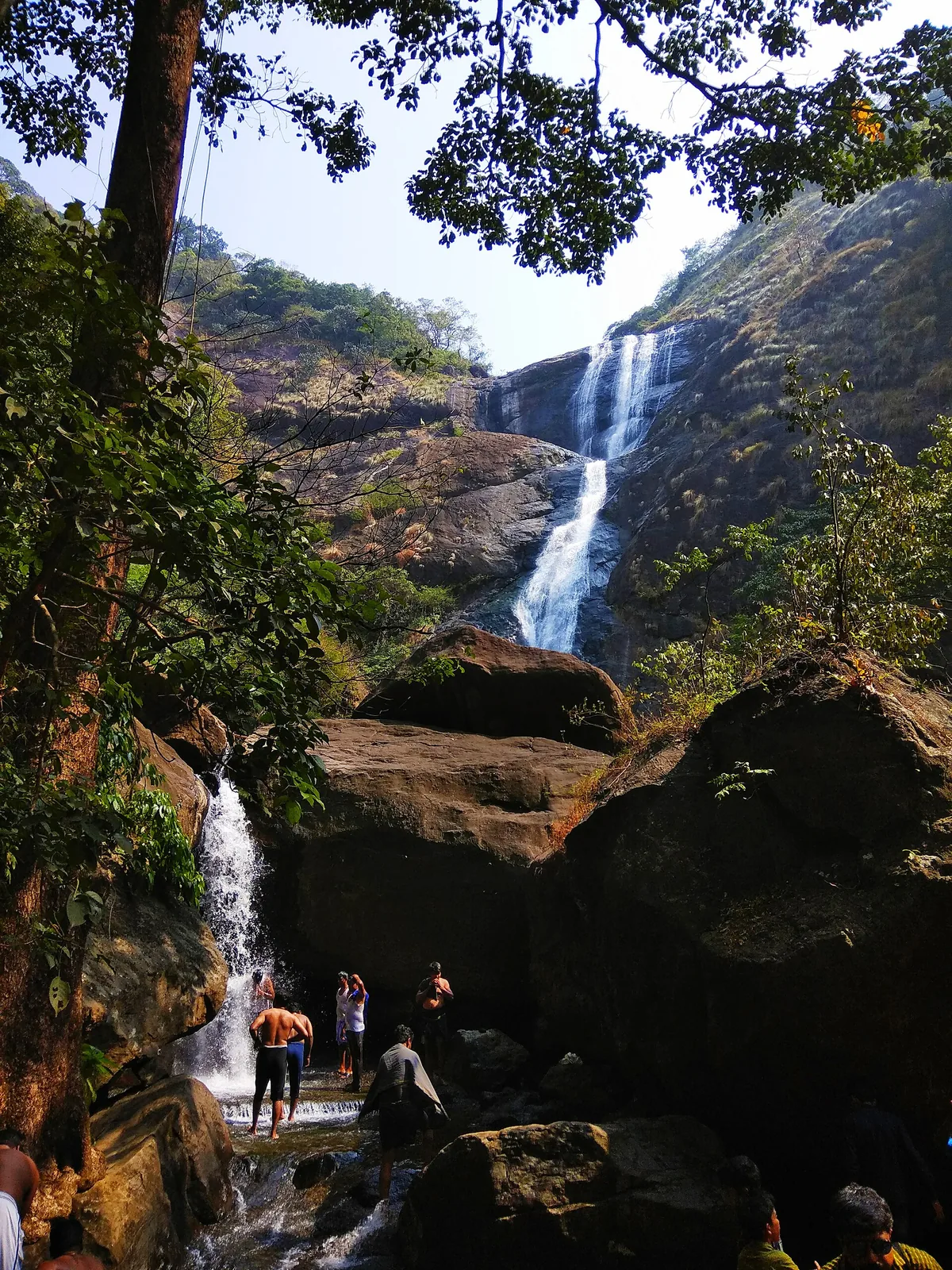
There are granite rest-mandapams in the forest at Palaruvi, and the remains of horse stables. Most visitors walk past them on the way to the water without being told what they are.
They are what is left of the time when this waterfall was a royal retreat — and the story of how it stopped being one turns on a single year that anyone who grew up in Kerala will recognise.
What the Malayalam record says
The Malayalam account is compact and worth translating carefully. During the period of royal rule, it says, the kings came here for hunting and for rest. Rest-mandapams built of granite and the remains of horse stables are still here. And then: it is said that in the flood that occurred in Kollam Era 1099, the bathing ghat at Palaruvi was smashed to pieces, and the kings turned their attention towards Tenkasi and Courtallam.
Elsewhere the same account calls Palaruvi a sukhavasa kendram — a health retreat, a place people came to for their wellbeing — since the time of royal rule, and notes that the stable and the stone mandapam are still preserved and that visitors like seeing them.
Kollam Era 1099
That date is the hook, and it deserves unpacking for anyone who does not read Malayalam years.
Kollam Era 1099 is 1923–24 in the Gregorian calendar, and in Kerala it needs no further introduction. Thonnutombathil vellappokkam — the flood of ninety-nine — was the benchmark catastrophe of the twentieth century, the one against which everything was measured until 2018. It is the flood that destroyed the Munnar monorail. It is the year older people still use as a unit of comparison.
And in that year, in a forest at the other end of the state from Munnar, it broke a stone bathing ghat at the foot of a waterfall — and a royal habit went with it.
Eleven kilometres, and a century of patronage
Here is where the story turns from anecdote into something with consequences you can still see.
Courtallam is 11.5 kilometres from Palaruvi in a straight line, just over the Sengottai pass, on the Tamil side. That is the destination the account says the kings turned to.
Today Courtallam is one of south India’s most famous bathing-waterfall complexes, with a named season, a full visitor economy, hotels, and a reputation that reaches well beyond the region. Palaruvi, four kilometres up a forest road on the Kerala side, gets about a lakh of visitors a year, is run by a village committee, and closed for fourteen weeks in 2026 because the water ran out.
We are not going to pretend one broken ghat caused all of that. Courtallam has more falls, an easier approach and a different geology. But a flood that redirected royal patronage in the 1920s redirected it across what is now a state border — and patronage, once it moves, tends to stay moved. The flood of ninety-nine did not just break a bathing ghat. It sent a century of attention over the pass.
What is actually still there, and what we will not claim
Being precise about this matters, because tourism copy has already run ahead of the record.
What is defensible: local and Malayalam-language accounts report granite rest-mandapams and the remains of horse stables surviving on the site, and visitors report seeing them.
What we could not source, and therefore will not assert: that the site was a royal summer getaway from the seventeenth century, that there was a palace, or that any of the surviving structures is dated, protected or listed by the Archaeological Survey. We found no gazette entry, no ASI listing and no state manual reference. The mandapams are there; their date is not established.
One nice thread we will pass on with the same caution. The streams that make the falls rise in the Rajakkoopp hills, and rajakkoopp reads as something like the king’s well or pit. It sits pleasingly beside the royal story. It is suggestive, not established etymology.
Go and look at them
The mandapams are the reason to allow more than the twenty minutes most people give this place. You ride four kilometres in through forest, and at the end of it there is a waterfall that people have been coming to for centuries — with granite proof of it standing in the trees, unlabelled, unfenced and largely unvisited.
Ask at the ticket counter, take the shuttle, and look up from the water for a moment.
Frequently asked questions
Was Palaruvi a royal site?
Yes, by the Malayalam record: the Travancore kings came here for hunting and rest, and it was known as a health retreat. Granite rest-mandapams and the remains of horse stables survive on the site.
What happened in Kollam Era 1099?
The great flood of 1923–24 — the flood of ninety-nine, Kerala’s benchmark disaster of the last century and the one that destroyed the Munnar monorail. Local accounts say it smashed the stone bathing ghat at Palaruvi to pieces, after which the kings turned their attention to Tenkasi and Courtallam.
How far is Courtallam from Palaruvi?
About 11.5 km in a straight line, over the Sengottai pass on the Tamil Nadu side. It is now one of south India’s best-known bathing-waterfall complexes, with a full season economy.
Can I see the mandapams and stables?
They are reported as standing and visitors report seeing them, but they are unlabelled and not part of any organised trail. Ask at the ticket counter. Note that we found no evidence they are dated, protected or ASI-listed, so treat any confident century you are told with caution.
Was there a palace at Palaruvi?
Not that we could source. Tourism copy describes a seventeenth-century royal summer getaway with a palace; the material we could verify supports rest-mandapams, a stable and a bathing ghat, and no more than that.