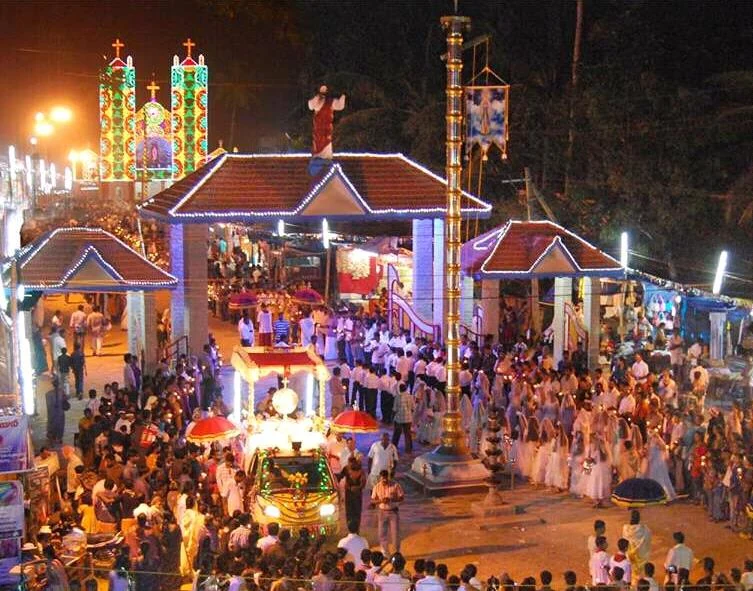
The entrance changes character in the festival photograph. Lines of coloured lights trace the tiled gateway, the twin towers glow behind it, and a procession moves through a crowded forecourt. The gate is no longer simply an architectural frame for arriving visitors. It is part of an event whose movement and purpose take priority over sightseeing.
February is a season, not a standing timetable
Pallikkunnu’s annual feast is associated with February in Wayanad’s district heritage account. Kerala Tourism’s festival archive describes a programme extending over about two weeks. Those sources establish the recurring place of the feast in the church year. They do not establish the current year’s order of services, procession departure or traffic arrangements.
For someone travelling specifically to attend, the distinction is practical. An ordinary Sunday Mass schedule is not a substitute for the feast notice. The parish’s current programme is the document that connects a particular date with a service or procession. A visitor can know the customary season well in advance while leaving the detailed journey to that announcement.
Several kinds of participation
The official festival record names prayers, Masses, novena, flag hoisting and shared food among the observances. Its Malayalam terms include Japamala, Divyabali, Kodiyettam and Nerchabhakshanam. Together they describe a programme with worship, formal beginnings and communal participation, rather than one continuous procession.
The archive also records forms of votive devotion: carrying stones on the head, carrying a crown by hand and shayanapradakshinam, a bodily act of circumambulation. These are described religious practices, not activities offered for a tourist to try. Their meaning belongs to a vow and the participant’s devotion. Observe without turning an individual act into a performance for a camera.
Another detail concerns clearing plates after others have eaten. In the archive it appears as an act associated with devotion and service. That changes the way the meal should be understood. The feast’s food is part of a religious gathering and shared work, with participants serving as well as receiving; it is not a daily restaurant facility attached to the attraction.
Read the procession photograph carefully
The night scene shows people carrying ceremonial objects and moving through a decorated entrance, while spectators stand along the edges. It also shows how little room remains for someone to step backwards for a wider photograph. The safest viewing position is one accepted by the organisers, with the passage kept clear and attention given to the direction of movement.
A decorated vehicle in the archival festival photographs carries two large swan figures, flowers and Marian imagery before the church. People gather beside it, bringing the scale of the display into focus. The frame records one past celebration, while the parish’s programme determines the processions and decoration of each new feast.
Arriving with that understanding makes the visit less dependent on reproducing an old image. A morning service, a shared meal and a night procession each offer a different way of encountering the parish community. Choose the part of the current programme that can be attended respectfully, and allow the congregation’s needs to determine where you stand and when you move.
Outside the feast season, the church remains a working parish with its own rhythm. The quieter visit is not a failed version of the festival. It gives more space to the building and its setting, while February brings the recurring collective acts through which the community marks its dedication.
Plan the visit: Pallikkunnu Church in Wayanad.