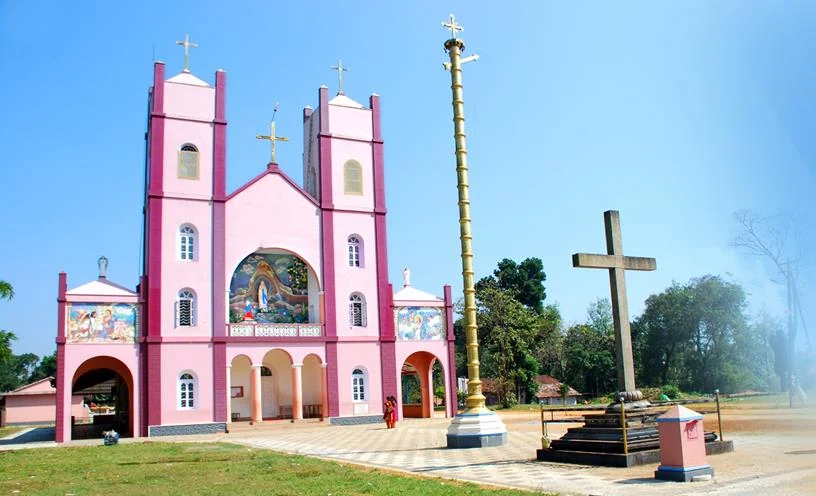
In an older view, Pallikkunnu Church has a pink facade, two square towers and a central axis running from the church door into the forecourt. Later photographs show a lighter exterior with the same recognisable outline. Behind this changing appearance lies an early-twentieth-century Catholic foundation and a parish whose February feast has become a major expression of its community life.
An early twentieth-century foundation
Wayanad district’s heritage account and Kerala’s Town Planning survey give 1905 as the foundation year; Kerala Tourism’s destination description gives 1908. The official accounts therefore place the beginnings within the same early-twentieth-century period while leaving the precise year unsettled. The parish’s subsequent story is carried in records of the missionary, early baptisms and the growing devotional life around the shrine.
The Town Planning survey places the church in Anjukunnu village, within the Panamaram area, beside the Kambalakkad–Vilambukandam road. This fixes the history to a particular Wayanad setting. Pallikkunnu is also a place name elsewhere in Kerala, so the Lourdes dedication and North Wayanad parish identity are useful companions to the road address.
A missionary account with its own chronology
Kerala Tourism’s festival archive gives a more detailed narrative of the missionary associated with the shrine. It describes his arrival in the region in 1907 and records the baptism of twenty families in September 1910. These dates help explain the emergence of a worshipping community, but the archive does not resolve all the differences between the shorter foundation summaries.
The same account connects the missionary with a wooden cross on Kurumbala hill. Read that episode as part of the shrine’s remembered devotional beginnings. A local tradition can explain why a hill or cross matters to believers without providing the same kind of dated evidence as a parish register. Keeping those forms of memory distinct gives each its proper role.
The archive records the missionary’s death on 23 December 1935. That is a later point in the narrative, separate from both the first community and the present façade. It is tempting to compress every element into a single founding moment; the sequence instead describes a religious community taking shape over time.
The Lourdes dedication remains the clearest identifier
The official Calicut church directory identifies the parish as Lourdu Matha Church, Pallikunnu, in its North Wayanad grouping. The Lourdes dedication links the name, the Marian imagery on the front and the February feast. It is a more reliable identifying detail than a loose label such as “old church near Kalpetta.”
At the church, the central Marian image, crosses above the towers and separate forecourt cross form a connected devotional setting. The towers frame the approach, while the objects in the open court bring worship beyond the doors. During a quiet visit, their arrangement is easier to notice; during the feast, the same ground becomes part of a larger gathering.
At the Wayanad shrine, the paired towers and central Marian image give the written history a visible setting. In front, the cross and flagstaff stand within the space used by worshippers and feast gatherings. An early-twentieth-century mission became a continuing parish community here; an ordinary service and the February celebration offer different encounters with that living history.
Plan the visit: Pallikkunnu Church in Wayanad.