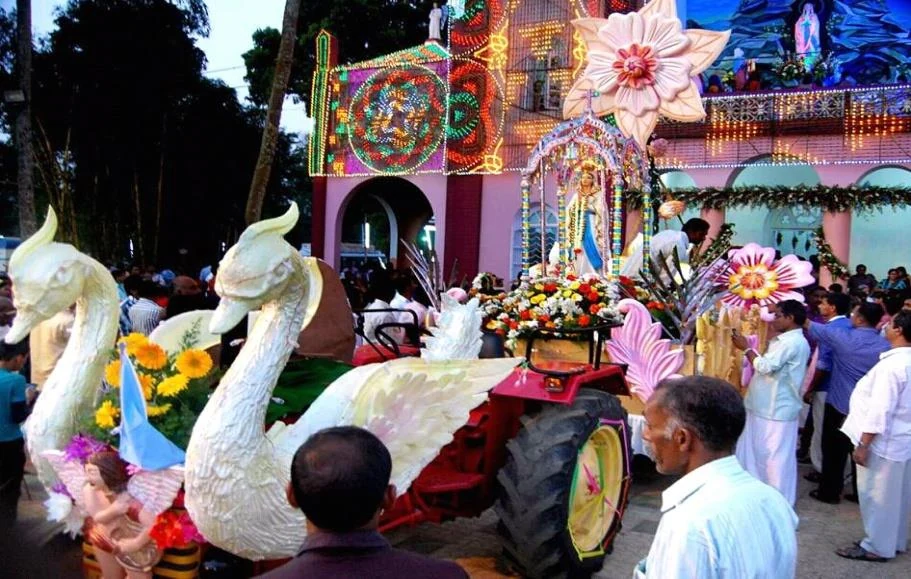
Two large white swan figures fill the foreground, their curved necks rising ahead of a decorated vehicle. Flowers surround a small Marian image under an ornamental canopy. Behind it, Pallikkunnu’s pink façade carries strings of festival lights. The photograph brings a temporary processional arrangement and a lasting church building into one frame.
A temporary centre of attention
On an ordinary day, the twin towers and central doorway organise the view of Pallikkunnu. During this photographed feast, the decorated vehicle takes over the foreground. The Marian image is raised above the flowers, while people stand beside the wheels and along the church wall. The arrangement allows a devotional image to move through a community rather than remain fixed within the building.
Two large swan figures give the front of the vehicle a repeated curved outline. Bright floral forms rise around the canopy, with Marian imagery above the crowd. The combination makes the vehicle stand apart from the straight lines of the church facade behind it. Its scale becomes clearer beside the people gathered along the wheels and the wall.
The vehicle’s red body and large rear wheel remain visible beneath the decoration. This practical structure matters to the scene: the display must move, turn and pass people standing nearby. A procession has a working side as well as an ornamental one. Keeping clear of that movement is part of observing it well.
The façade provides the identifying background
Behind the temporary display, arched openings and the lower part of the church’s Marian panel remain visible. The festival lighting follows portions of the architecture while adding patterns of its own. A daylight photograph would make the doors and wall surfaces clearer; the evening frame explains how the building becomes a backdrop for a larger devotional event.
Other archival views show the complete twin-towered front and a freestanding stone cross in the forecourt. A tall golden flagstaff stands on a separate base. These are different objects with different positions, and retaining that distinction helps a visitor read the space. The tower crosses, courtyard cross and flagstaff should not all be described as the same “church cross.”
The church’s older pink finish gives the procession a warm-coloured backdrop. More recent views show a lighter exterior, but the paired towers and central frontage remain recognisable. In this frame, the procession and the building work together: one supplies a moving foreground, the other a stable outline against which the celebration gathers.
Photography beside a living ritual
A useful photograph keeps enough of the church and people’s movement to explain the setting. A very tight crop on flowers might be attractive but could belong to almost any procession. In this frame, the façade, vehicle and congregation together explain why the image belongs to Pallikkunnu. Context is part of the subject.
The Kerala Tourism festival archive supplies the setting for this photograph. It should be read as an archival feast scene, with no promise that an identical display will return. At a present-day event, the organisers’ directions and the participants’ privacy matter more than recreating its camera position.
For someone visiting outside February, the same exercise can begin with the quieter forecourt. Locate the stone cross, flagstaff, doorway and towers, then imagine the open space used for collective movement. The building is easier to understand when both its ordinary arrangement and its festival use remain in view.
Plan the visit: Pallikkunnu Church in Wayanad.