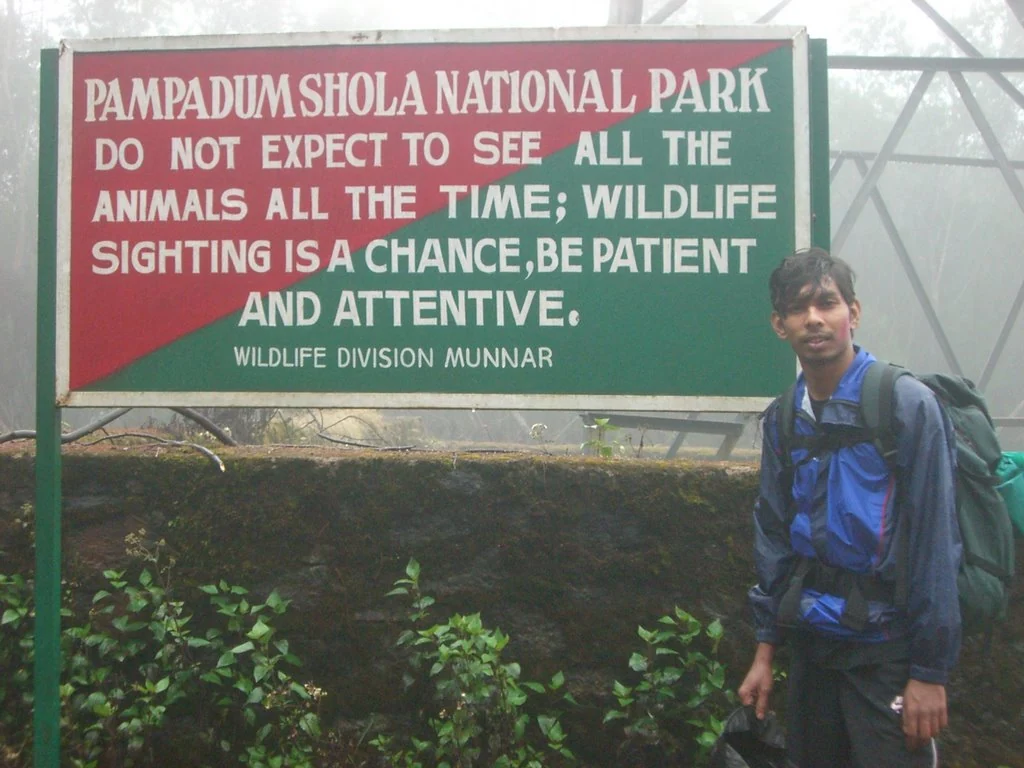
One of the clearest introductions to wildlife watching at Pampadum Shola is a sign. Photographed beside an observation structure, it asks visitors to be patient and attentive because wildlife sightings are a matter of chance. That message is more useful than a list that makes every animal in the park sound like a scheduled appearance.
A forest inhabited beyond the visitor’s view
The park’s management plan identifies the Nilgiri marten as a flagship species. A flagship draws attention to the place’s conservation value; it does not guarantee that a visitor will see the animal during a short walk. The forest continues to function whether or not its most sought-after mammal enters the visible part of a path.
This changes the purpose of observation. Instead of treating the day as a checklist of animals that must be delivered, look at the setting in which they live. Dense vegetation, the layered canopy and the relationship between wooded slopes and more open ground give a visit substance even when larger animals remain out of sight.
The sign also distinguishes patience from pursuit. Being attentive means allowing the guide time to listen and assess the surroundings. It does not mean leaving the route, following an animal into cover or approaching a sound without instruction.
Different scales of attention
A wide forest view and a close look at the verge answer different questions. Across the valley, canopy texture and the shape of the slope are apparent. Near the path, hanging stems, leaves and the darker space beneath the trees become visible. Both scales help a visitor understand why an animal can remain unseen only a short distance away.
The management plan treats the park as a montane forest landscape with restoration needs, not merely a backdrop for animal photography. Older plantations of wattle and eucalyptus are part of that management history. Learning which vegetation belongs to a particular area can make a quiet stretch of the walk more informative than repeatedly asking when the next animal will appear.
A guide’s role includes deciding how the group moves through that setting. A pause, a changed route or a decision to turn back can be part of a good forest visit. It should not be interpreted as a failure to provide the promised photograph, because wildlife access is not a performance controlled by the visitor.
A useful way to remember the day
After the walk, distinguish what was seen from what was discussed. Seeing a particular bird, hearing an explanation of marten habitat and reading an animal’s name on a sign are three different kinds of experience. Naming them accurately makes the memory more specific rather than less impressive.
The same care applies to photographs. A sign with an animal’s name is evidence of the park’s message; a distant shape should not receive a confident species label without a reliable identification. The guide can help with uncertainty while the encounter is fresh.
Pampadum’s own sign offers a durable standard for the outing: patient attention. It leaves room for a memorable sighting, but it also makes room for understanding the forest when its inhabitants choose to remain hidden.
Plan the visit: Pambadum Shola National Park.