The river is part of the address
The Pandalam royal family’s account describes two palace groups: one around Valiya Koyikkal Temple and another around Kaipuzha Temple. They occupy different banks of the Achenkoil. This is the first useful fact for a visitor who might otherwise expect a single monumental building behind one ticket gate.
The family places Valiya Koyikkal on the left bank and Kaipuzha downstream on the right. Their proximity across the river does not translate into the same distance by road. Keep the named building or shrine in the destination when arranging a drop-off.
What survives is a group, not a complete original palace
The family records losses of buildings and documents through floods and fires. Its present-day account therefore concerns surviving structures and continuing places of worship within a complex shaped by change. It does not describe an intact royal residence preserved exactly as it was at one historical moment.
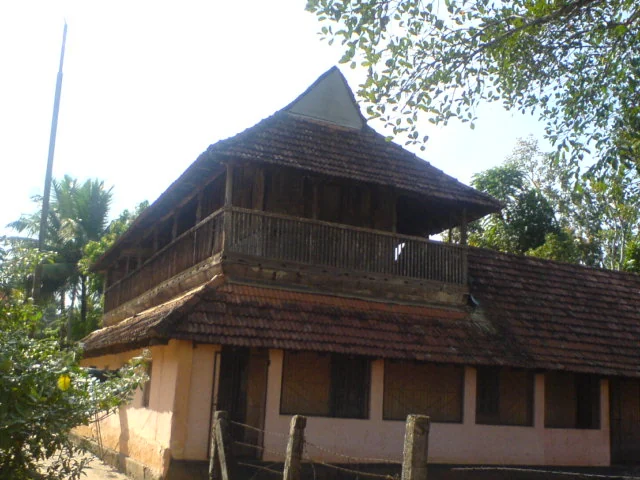
A modest tiled-roof building can belong to that history as much as a more elaborate balcony. The photograph with this story shows a long roof above a cream-coloured facade. Its domestic scale is a useful corrective to expectations formed by monumental palaces elsewhere.
Use the approach to orient yourself
Manikandan Aalthara, beside the MC Road, is the family’s named landmark for entering the palace precincts. The mapped road turn-in beside it is the arrival base used on the place page. From there, identify the part of the complex you intend to visit and follow the current local arrangement.
The family’s description places the Nalukettu to the left of the road towards Valiya Koyikkal and Vadakkekottaram farther north. These relationships help explain the layout, but they do not make every building interior publicly accessible. Houses and prayer rooms require their own permission.
Give each stop its own purpose
A visitor interested in the Ayyappa connection may concentrate on Valiya Koyikkal and the palace’s devotional history. Someone studying buildings may pay more attention to roof forms, timber balconies and the relationship between the surviving structures. Both purposes benefit from knowing that the complex is distributed.
If Kaipuzha is part of the plan, arrange it as a separate movement across the river by the available road route. Avoid sending members of a group to different banks under the same vague meeting instruction.
Pandalam becomes easier to understand once the river and the individual names remain visible in the itinerary. The visit then follows a living palace locality with several focal points, rather than searching for a single grand hall that represents the whole.
Sources: Pandalam royal family: palace complex, prayer rooms and layout and Manikandan Aalthara.
Plan the visit: Pandalam Palace.