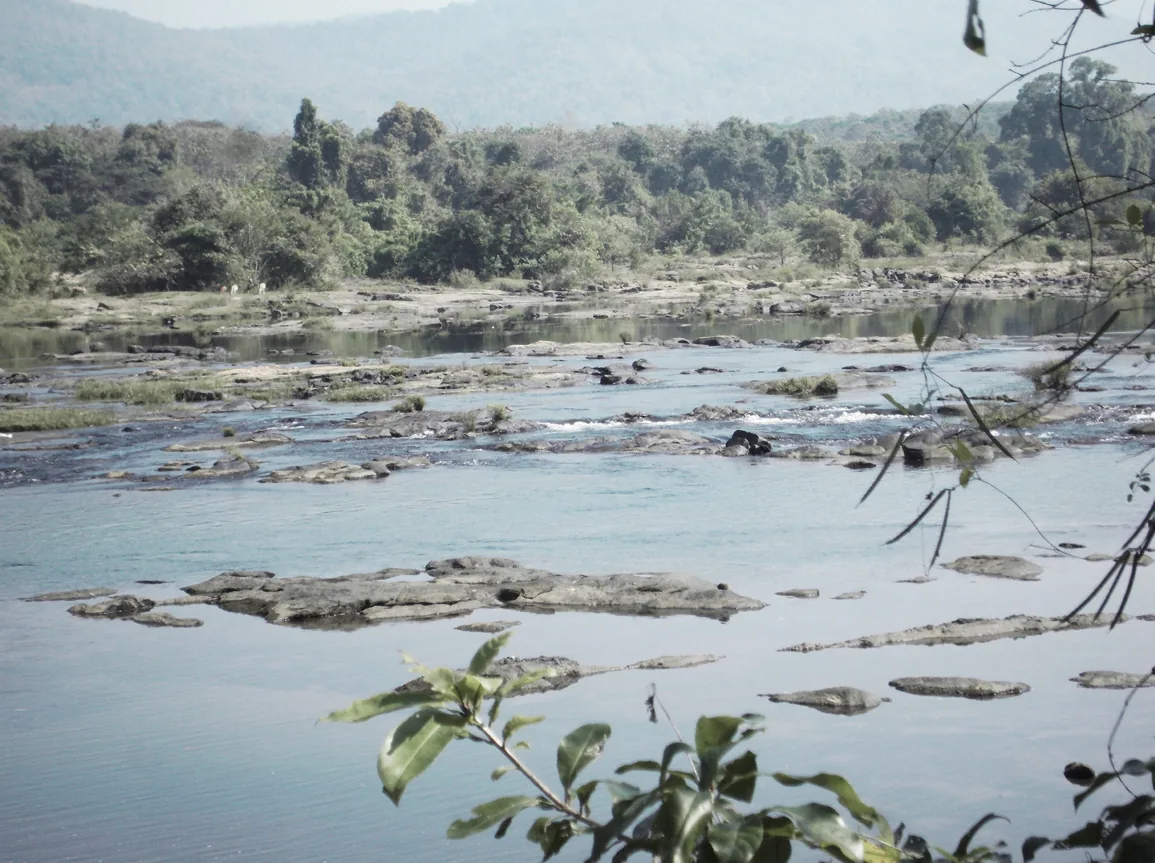
Stand on the rock field at Paniyeli Poru and the obvious question is where all the stone came from. The river runs through a bed of enormous boulders, wedged and stacked, with the Periyar forcing itself between them. There is a geological answer and there is an older one, and the older one is told all along this stretch of river.
The night the bhoothams worked
A short way upstream stands the Shiva temple at Thrikkariyoor. The story goes that the bhoothams — the word covers spirits, demons and goblins, and the tellings do not much distinguish — set out to destroy it. Not by attacking it, which would have meant facing the god, but by engineering: they would dam the Periyar, back the water up, and drown the temple and its country under the reservoir.
They had one night to do it. Bhoothams cannot work in daylight, so the dam had to be finished before dawn, and they set about rolling colossal stones into the riverbed in the dark.
Shiva did not fight them. He cheated. He counterfeited the dawn — in most tellings by causing a cock to crow before its time — and the bhoothams, hearing the signal that the light was coming, dropped what they were carrying and fled. The dam was never closed. The temple was never drowned. And the stones they abandoned mid-task are, according to the story, the boulders still lying in the Periyar today.
- Bhoothathankettu, the barrage a few kilometres upstream, means “the demons’ dam” — kettu being the dam or the bund.
- Thrikkariyoor temple, the target in the story, is still standing and still dry, about half an hour away by road.
- Nothing at Paniyeli Poru signposts any of this. The legend belongs to the river rather than to the ticket counter.
How much of it is Paniyeli Poru’s
Honestly: the legend is properly Bhoothathankettu’s. That is the place named for it, and that is where guides tell it. Whether the boulders at Paniyeli Poru, downstream, are part of the same abandoned dam depends entirely on how far you are willing to stretch a story, and different people stretch it differently.
What is not in dispute is that this is the folklore of this stretch of the Periyar, and that it is an explanation for exactly the thing you are looking at when you stand here. We would rather tell you that than either omit it or pretend it was coined for this rock field.
What the river says
The geological account is less dramatic and, to our mind, no less interesting. Upstream of the rocks the Periyar is wide, shallow and slow. At the rock field the whole of that water has to pass through narrow crevices and over low ledges, so it accelerates hard, and it has been doing so for a very long time. The result is scoured bedrock, potholes ground into the stone by trapped gravel turning under pressure, and blocks broken loose and wedged where the flow left them.
In other words, the boulders were not carried here and dropped. They are what is left of the rock the river has been taking apart. That is the answer, and it does not make the other one worth less — the story is about why the temple survived, not really about the stones.
The dam humans did break
There is a coda that the legend does not know about, and it is true. In 1790, with Tipu Sultan’s army advancing into Travancore and needing to cross the Periyar, a small Travancore party went upstream and breached the dam walls at Bhoothathankettu, sending a flood down the river. It helped stop him. Combined with the monsoon, disease in his camp and a British declaration of war, he withdrew.
So the river at Bhoothathankettu has a story about supernatural engineers who failed to build a dam overnight, and a documented episode about human ones who destroyed a dam overnight and changed a war. Both stories are about the same water doing the same thing: rising, fast, when somebody interferes with it upstream. That is worth remembering as a visitor, for reasons that have nothing to do with folklore.
Frequently asked questions
What is the legend of Paniyeli Poru?
The folklore of this stretch of the Periyar is the bhootham story: spirits set out to dam the river overnight and drown the Shiva temple at Thrikkariyoor, Shiva counterfeited the dawn with a cock’s crow, and they fled before finishing. The huge stones left in the riverbed are said to be their abandoned dam.
What does Bhoothathankettu mean?
The demons’ dam — bhootham for the spirit or demon, kettu for the dam or bund. The barrage a few kilometres upstream of Paniyeli Poru carries the name, and it is the place the legend properly belongs to.
Is the legend specifically about Paniyeli Poru?
Not strictly. It is told of Bhoothathankettu upstream, which is named for it. Whether the boulders at Paniyeli Poru are part of the same abandoned dam depends on how far you stretch the story — but it is the folklore of this stretch of river, and it explains exactly what you are standing on.
Which temple were the demons trying to destroy?
The Shiva temple at Thrikkariyoor, near Kothamangalam in eastern Ernakulam. It is still standing and about half an hour away by road, which makes it an easy and satisfying pairing with a Paniyeli Poru or Bhoothathankettu trip.
Why are there so many huge rocks at Paniyeli Poru?
Geologically, because the Periyar arrives wide and slow and is then squeezed through narrow gaps, accelerating sharply. Over a very long time that has scoured the bedrock, ground potholes into it with trapped gravel, and broken blocks loose. The boulders are what the river has taken apart, not material carried in.
Has the dam at Bhoothathankettu ever been breached?
Yes, deliberately. In 1790 a Travancore party breached the dam walls to flood the Periyar and stop Tipu Sultan’s army crossing during his advance into Travancore. It is one of the reasons he withdrew.