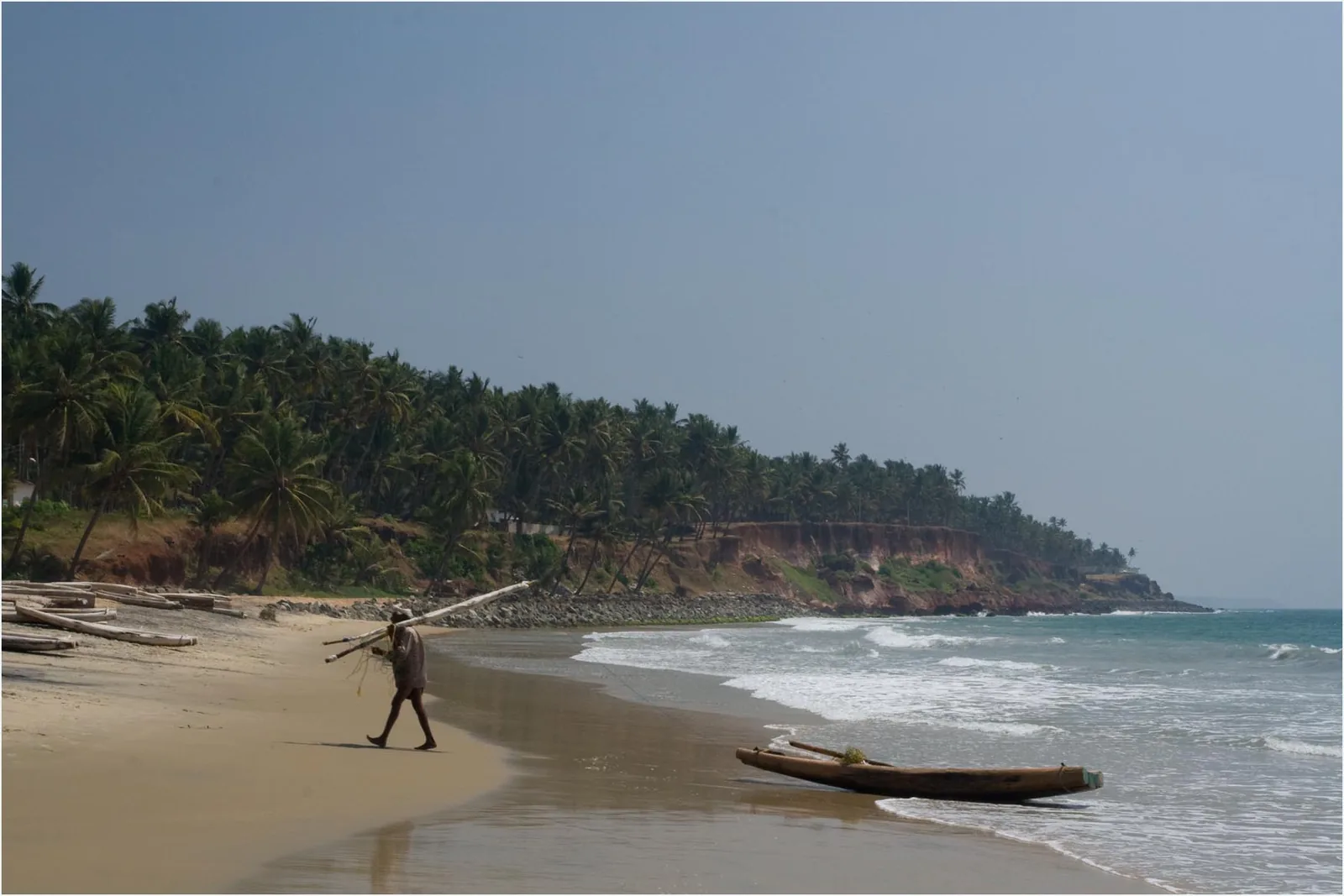
Places like this are usually described as though they had no history — a quiet spit of sand, a nice sunset, nothing much else. Paravur Pozhikkara has been a named and recorded place for at least eight hundred years, and almost everything that has happened to it has happened within a few hundred metres of the same temple.
The Pozhikara sasanam
The oldest item in the record is an inscription — the Pozhikara sasanam, recorded locally as a twelfth-century text cut in vattezhuthu, the old round script of Kerala and the Tamil country, on a sila phalakam, a stone slab, at the Pozhikkara Sivakshetram. The shrine that stands on the spot today is a Devi kshetram.
We should be honest about the sourcing: this comes from local history writing rather than from an epigraphical corpus we can cite, so read it as recorded locally rather than as established. What it does tell you is that somebody in the twelfth century thought this breach in the sand was a place worth cutting into stone.
On a travelled route
Independent literary evidence comes from the Unnineeli Sandesam, the classical Malayalam messenger-poem written more than six hundred years ago, which names the temples of Paravur. Messenger-poems work by naming places along a real journey; being in one means the place was on a route people actually travelled.
The administrative record is more recent and more surprising. Before independence Pozhikara was an administrative headquarters, and remnants of an old fort and a police station are reported here. There is also Pozhikara Palace, which survives as a Kerala PWD rest house — the kind of afterlife that quietly tells you a building mattered once.
What the names say
Pozhikkara is pozhi plus kara: the place of the breach. It is named for the thing the water does.
Paravur is attributed to paravii, the sea, plus oor, a settlement — Paravayoor, worn down. That derivation is offered locally and we pass it on as attribution rather than assertion, but the pattern is the same: both names are about water.
February 2026
On 14 February 2026, five boys came to swim at the beach behind the Pozhikkara Devi Temple. Three went into the water and were taken by the current. One was rescued by the Fire and Rescue Services and the police. The other two, both sixteen, were missing overnight; their bodies were recovered the following afternoon, with the Coast Guard assisting the search.
The reporting on the incident carried one line that belongs on any page about this place: the estuary is considered highly dangerous, and residents typically avoid swimming there.
We are not going to use two dead children as an atmospheric ending, and we have deliberately not printed their names. The reason the incident belongs in a history of this spit is narrower and worth stating plainly: for eight hundred years the water here has been the reason to name the place, the reason to record it, the reason to build a temple beside it and the reason to write it into a poem. It is also, still, dangerous. The stone and the current are the same fact.
Stand on the bar, walk the spit, watch the sunset. Do not go in.
Frequently asked questions
What is the Pozhikara sasanam?
An inscription recorded locally as a twelfth-century text in vattezhuthu script, cut on a stone slab at the Pozhikkara Sivakshetram — the site of the Devi temple that stands there now. The sourcing is local history writing rather than a published epigraphical corpus, so we report it as recorded locally.
Is Paravur mentioned in classical literature?
Yes. The Unnineeli Sandesam, a Malayalam messenger-poem more than six hundred years old, names the temples of Paravur — which places it on a route people genuinely travelled.
What does the name mean?
Pozhikkara is pozhi (the breach where a backwater cuts through to the sea) plus kara (place). Paravur is locally derived from paravii, the sea, plus oor, a settlement — Paravayoor worn down. We pass the second on as local attribution.
Was Pozhikara ever administratively important?
It is reported as an administrative headquarters before independence, with remnants of an old fort and a police station, and Pozhikara Palace still stands — now serving as a Kerala PWD rest house.
Is it safe to swim behind the temple?
No. On 14 February 2026 three teenagers were swept away there; one was rescued and two aged sixteen died. Reporting on the incident stated that the estuary is considered highly dangerous and that residents typically avoid swimming there. There are no lifeguards.