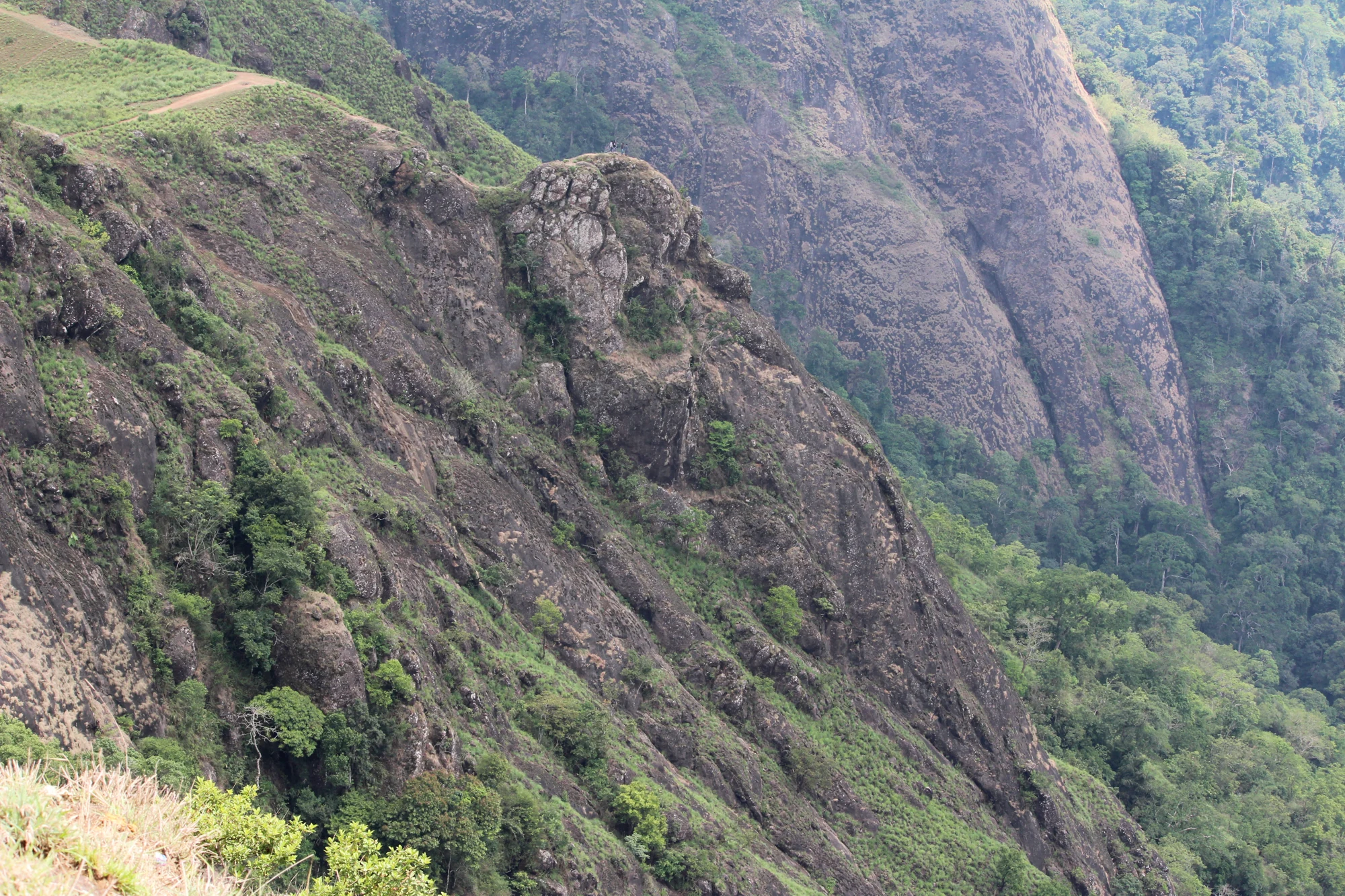
Among Parunthumpara’s rounded slopes, one projecting rock draws a more particular kind of attention. Its outline is compared with the face of Rabindranath Tagore. The comparison asks visitors to look at a natural profile, finding a familiar human form in stone rather than approaching a carved portrait.
The face is an outline
The impression comes from the edge of the rock against the valley beyond it. A projecting upper section, a recession below and the larger descending mass can suggest a forehead, nose and beard from the appropriate angle. The shaded face of the stone contributes less than its silhouette. Change position and those relationships shift.
This makes the profile different from a statue intended to be read from a fixed frontal view. There is no sculpted eye or inscribed pedestal to explain it. The larger hillside supplies the setting, and the viewer recognises a resemblance within the form. Kerala Tourism records the Tagore comparison as part of Parunthumpara’s appeal.
Resemblance is not a visit by the poet
The rock’s name does not establish that Tagore travelled here or composed a work at the viewpoint. The useful story is the visual association itself. Keeping it at that scale avoids adding a historical event to a landscape nickname. A visitor can enjoy the comparison without needing the place to claim a connection it has not documented.
The same principle applies to Parunthumpara’s eagle association. The place is described through a broad, bird-like view over the hills, while the rock offers a face-like outline on a smaller scale. Both names help people remember shapes and viewpoints. They are ways of reading the landscape, not architectural descriptions of objects built on the ridge.
Keep the valley in the picture
A close crop can isolate the rock so completely that its setting disappears. A wider frame shows the steep wooded country below and explains why the profile stands out. The contrast between exposed stone and the softer texture of the forest is part of the effect.
Look for an angle from the admitted viewing area rather than moving towards an edge to exaggerate the face. The rock’s projection and the drop beyond it are real features, even when the familiar name makes the scene feel playful. A barrier or an obscuring branch is not a reason to seek a position outside the visitor route.
Cloud can change the reading too. Against a pale distant background, the outline becomes more distinct; in mist, the far valley may vanish and the rock seems more isolated. When cloud covers the whole view, the nearby stone and grass still provide detail, but the full profile may be less easy to pick out.
After finding the face, turn back to the wider panorama. Tagore Rock is one part of Parunthumpara, not a separate monument requiring a second admission or a different expedition. Its value is the small act of recognition within a large highland scene: one edge of stone becomes memorable, then leads the eye back into the valley.
Place context: Kerala Tourism’s Parunthumpara feature.
Plan the visit: Parunthumpara.