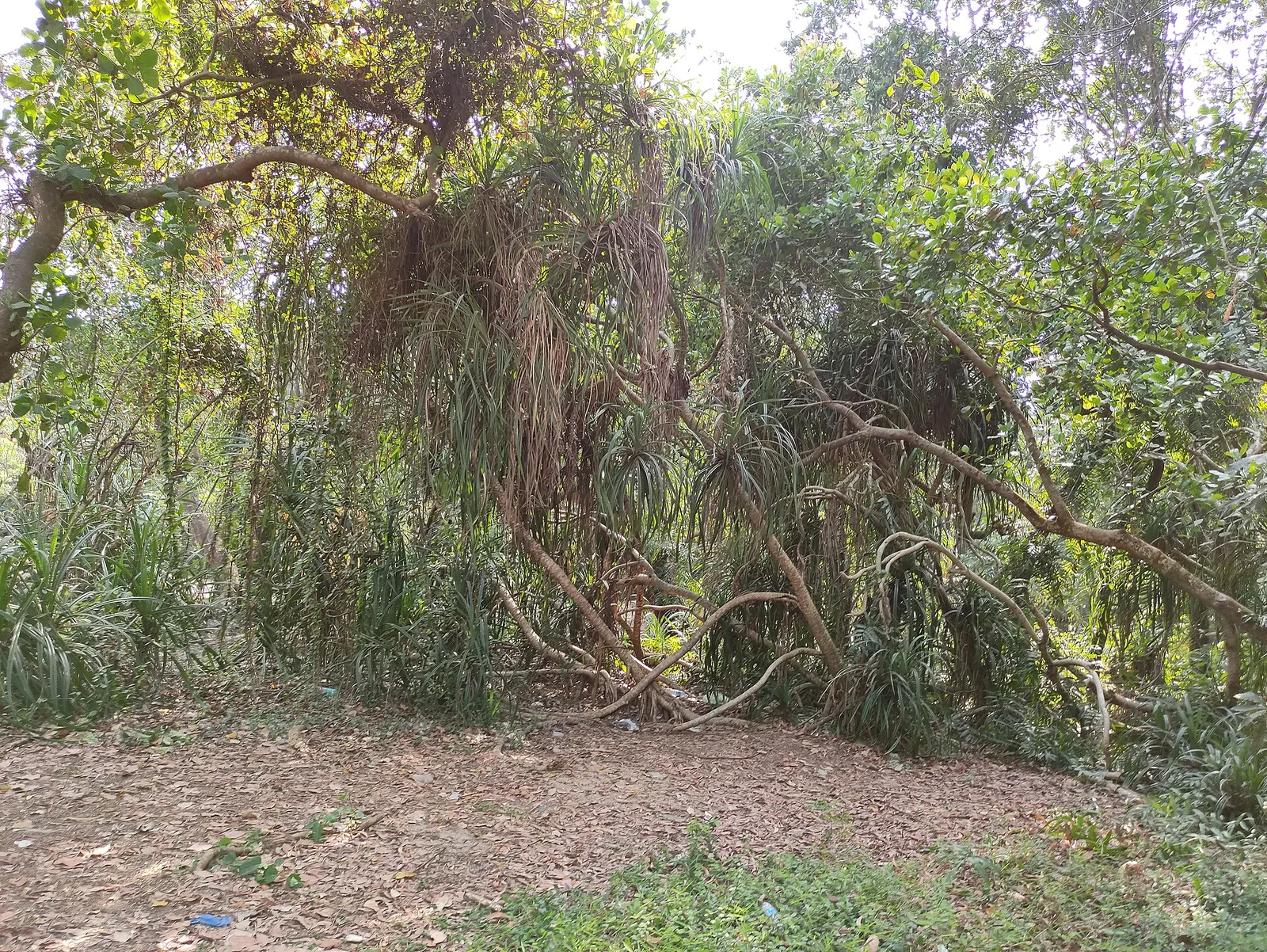
The name of Pathiramanal is the whole legend in two words. Pathira is the dead of night; manal is sand. Midnight sand — an island that arrived after dark.
The version the boatmen tell
In the fullest sourced telling, which Kerala Tourism publishes on its own mythology page for this island, the man involved is Vilwamangalathu Swamiyar. He was crossing Vembanad by boat at night when he needed to answer the call of nature, and there was nothing but open water in every direction. So by his powers he raised the island out of the lake overnight, and because it appeared at midnight, out of sand, it has been called Pathiramanal ever since.
A plainer version leaves the sage anonymous: a young Brahmin, deep in his devotions, waded into the lake at night to perform his ablutions, and the waters drew back to let dry land rise beneath him. The two agree on the essentials — a holy man, the deep of night, and a lake that briefly parted.
A caution about the sage, because it matters for how much weight the story carries. Vilwamangalathu Swamiyar turns up all over Kerala’s temple literature, at Guruvayur and Ambalappuzha among many others, and a name that appears everywhere is usually doing narrative work rather than historical work. What makes this instance worth printing is that the episode is specifically and consistently attached to this island by the state tourism department itself, rather than floated onto it. We tell it here and we do not reuse it anywhere else on this site.
There is a second name for the island, too — Anantha Padmanabhan Thoppu, “the grove of Anantha Padmanabhan”, which points at the tutelary deity of the Travancore royal house. No story has attached itself to that name in any source we can reach. We record it and we have not invented an explanation for it.
The version in the paperwork
What is unusual about Pathiramanal is that its legend has a documented rival, and Kerala Tourism sets the two against each other itself, noting that the historical records reveal a different narrative. That narrative is a chain of ownership.
The island belonged to a landlord named Parayi Tharakan. It was bought by Bheemji Devji, a Gujarati merchant of Kochi. From the M/s Bheemji Devji Trust it passed to Chevalier A. C. M. Anthraper, who planted coconut on it and ran it as a plantation, and it remained in the private hands of the Thaimattathil family until the late 1970s.
Then the Land Reforms were enforced in 1979. The island was taken as surplus land above the ceiling, passed to the Government of Kerala, and was transferred to the Department of Tourism, which holds it still.
The fourteen families
Here is the part of the ledger that the legend cannot match, and it is the reason this story exists. Fourteen worker families lived on Pathiramanal until the late 1970s. They were resettled on the mainland, in Muhamma panchayat, and the island has been uninhabited since.
Every visitor comes here for the emptiness. It is the whole selling proposition: no shops, no lights, no voices, the quietest room in the great house of the backwaters. That emptiness is not primordial, and it was not conjured by a sage at midnight. It is roughly fifty years old and it was created by a land ceiling.
This is not a complaint about land reform, which broke a genuinely brutal concentration of land in Kerala and is not something we are second-guessing from a travel page. It is a point about how places acquire their atmosphere. A legend says this island was made out of nothing. The record says it was emptied out, deliberately, within living memory — and the laid stone walkway that visitors photograph runs past ground where fourteen households lived.
Both stories are true in the way that matters to a visitor. One tells you what the island means. The other tells you what happened.
Frequently asked questions
What does Pathiramanal mean?
“Midnight sand”, from the Malayalam pathira (the dead of night) and manal (sand). Kerala Tourism also renders it “Sands of Night”. The island is separately recorded under a second name, Anantha Padmanabhan Thoppu, to which no story is attached in any source we can find.
Who is supposed to have created the island?
In the version Kerala Tourism publishes, the sage Vilwamangalathu Swamiyar, who raised it from the lake overnight while crossing Vembanad by boat. A plainer variant leaves the Brahmin unnamed. Both are folklore, not history — and the same sage appears in the legends of many other Kerala sites, so the attachment to this island is what makes it worth telling here.
Who owned Pathiramanal before the government?
A recorded chain: the landlord Parayi Tharakan, then Bheemji Devji, a Gujarati merchant of Kochi, then Chevalier A. C. M. Anthraper via the M/s Bheemji Devji Trust, who ran coconut plantations on it, and then the Thaimattathil family until the late 1970s.
Why is the island uninhabited?
Because it was cleared. Fourteen worker families lived there until the late 1970s and were resettled on the mainland in Muhamma panchayat after the Land Reforms were enforced in 1979 and the island was taken as surplus land above the ceiling and handed to the Department of Tourism.