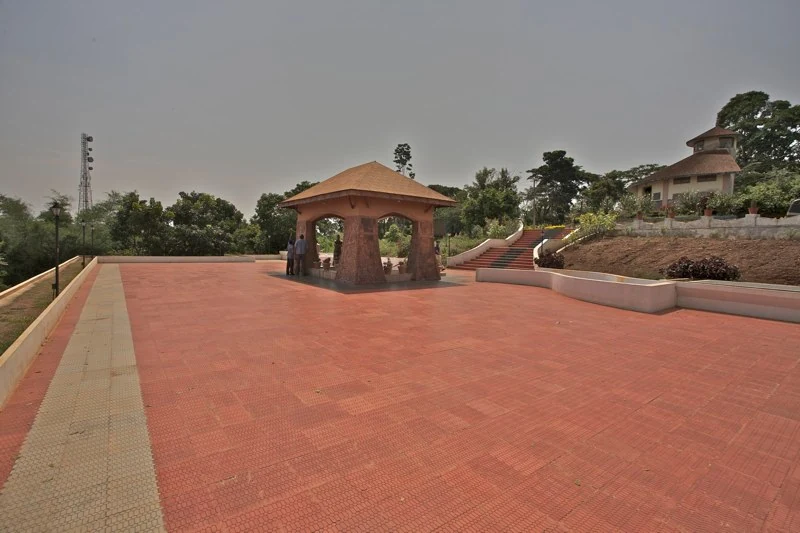
The broad court at Mananthavady gives the memorial an unmistakably public setting. There is a tiled pavilion, a maintained paved surface and a route up towards the surrounding buildings. It is easy to see why a visitor might assume that the place commemorates the final encounter itself. The geography is more specific: this is the location to which Pazhassi’s remains were brought, not the forest site where he died.
Two locations in Wayanad
Kerala Archaeology’s account identifies Mavilamthod near Pulpalli as the place of Pazhassi Raja’s death on 30 November 1805. It then places the cremation at Hospital Hill in Mananthavady. The memorial and museum belong to the second location. A driver asked only for “Pazhassi’s place” has not been given enough information to distinguish the two journeys.
For a first visit, Mananthavady offers an organised introduction through the monument and galleries. The site can be fitted into a town itinerary, with the museum providing the names and historical sequence needed to understand a later journey through the wider region. Mavilamthod should be treated as a separate destination with its own current access arrangements, rather than an extra corner of the same museum grounds.
The pavilion at Mananthavady is a place of remembrance at the cremation site. Its court, roof and low tomb draw visitors towards a commemorative centre. Mavilamthod belongs to a different part of the story, the final encounter in the Pulpalli-side forest landscape. Keeping those places distinct gives both the memorial visit and the wider history a clearer geography.
Kottayam means northern Malabar here
A second source of confusion lies in the ruler’s family name. Pazhassi belonged to the Kottayam royal house of northern Malabar, associated with the present Kannur region. A search for Kottayam can otherwise send a reader towards the central Kerala district with the same name. In this history, retain the words northern Malabar alongside Kottayam.
The wider Pazhassi circuit therefore extends across present administrative boundaries. Kerala Tourism’s Thalassery heritage material includes royal residences, monuments and museums in the Kannur region as well as Wayanad locations. Their shared subject does not make them branches of a single building or interchangeable map pins. Each place needs its own name and purpose in the itinerary.
Mananthavady’s value lies in the combination found at this particular address: the conserved tomb and a museum that places the resistance leader within a broader district history. A Kannur museum may illuminate another setting or stage in that history. Choosing one should depend on the journey being made, not on which search result uses the most familiar portrait.
Read the sequence before following the circuit
The Archaeology Department’s monument account traces conflict over authority and revenue, a temporary settlement, renewed resistance and the final encounter. The dates establish a sequence; they do not require every associated location to be visited in chronological order. A coherent day can stay with Mananthavady and its museum, leaving the wider circuit for another journey.
Inside the galleries, note who produced each document and what it was meant to achieve. An administrative proclamation and a later memorial image speak from different positions. Bringing that distinction back into the courtyard makes the monument more than a marker of a death: it becomes a place where later generations chose to preserve, display and interpret a contested past.
Leave with three names clearly separated: Mananthavady for the memorial and museum, Mavilamthod near Pulpalli for the final encounter, and northern Malabar’s Kottayam for the royal house. That small piece of orientation prevents a large amount of confusion in the next stage of the journey.
Plan the visit: Pazhassi Smarakam in Mananthavady.